Community Corner
Due To Giant African Land Snail Sighting, No Compost Allowed Out Of Quarantined Area In Pasco County
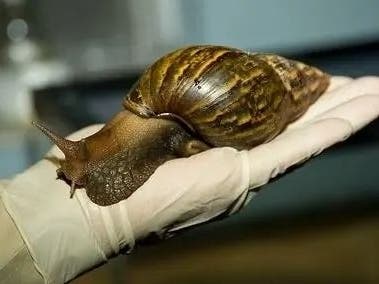
Giant African land snails pose a serious health risk to humans by carrying the parasite rat lungworm, known to cause meningitis in humans.


NEW PORT RICHEY, FL — At the direction of the Florida Department of Agriculture and Consumer Services, the city of New Port Richey is advising residents that it's against the law to transport or deliver compost outside the area under quarantine due to the discovery of the giant African land snail.
However, residents in the quarantined area can still have compost delivered to them.
See related story: Giant African Land Snail Invasion Causes FL Quarantine
Find out what's happening in New Port Richeyfor free with the latest updates from Patch.
The quarantine was put in place after the Florida Department of Agriculture and Consumer Services confirmed a sighting of the snail, one of the most invasive pests on the planet, causing agricultural and environmental damage wherever it is found.
The presence of the snail was reported by a master gardener with the Pasco County Cooperative Extension Service in a New Port Richey garden on June 21 and confirmed by the Department of Agriculture and Consumer Service on June 23.
Find out what's happening in New Port Richeyfor free with the latest updates from Patch.
Giant African land snails pose a serious health risk to humans by carrying the parasite rat lungworm, known to cause meningitis in humans. The snails should not be handled without proper protection and sanitation.
The quarantine was put in place because the snails can move long distances by clinging to vehicles and machinery, such as transportation carrying local produce, or burying themselves in compost and yard trash that is hauled away.
The quarantine is in place starting at the northwest corner of U.S. 19 and Ridge Road, and proceeds east on Ridge Road, south on Little Road, west on Trouble Creek Road and then north on U.S. 19.
The snails, which can grow to be about the size of a fist, eat many plants, including peas, beans and cucumbers. But if they can’t find enough vegetation, the Department of Agriculture and Consumer Services said they will eat paint or stucco off a house.
Because they're rarely found alone, the division of the plant industry is searching for others in the area. The snails can reproduce as young as 4 months old, laying many thousands of eggs in its multiple-year life span
On June 29, the department's division of plant industry began treating for the quarantine area with metaldehyde-based molluscicide (snail bait), approved by the U.S. Environmental Protection Agency for residential use.
Metaldehyde works by disrupting the mucus production ability of snails and slugs. This reduces their digestion and mobility and makes them susceptible to dehydration. Snails and slugs that have eaten metaldehyde often seek hiding places, become inactive and begin to die within days.
Metaldehyde is a pesticide used to control snails and slugs and is approved for use in a variety of vegetable and ornamental crops in the field or greenhouse, on fruit trees, small-fruit plants, avocado and citrus orchards, berry plants, banana plants and in limited residential areas. Available products can be applied as granules, sprays, dusts or bait pellets. Applications are typically made to the ground around the plants or crops to be protected.
The FDAC will attempt to notify residents in advance before applying the snail bait.
Believed to be originally from East Africa, the snail is now established on the Ivory Coast and Morocco, and throughout the Indo-Pacific Basin, including Guam and the Northern Mariana Islands, American Samoa and the Hawaiian Islands.
It is illegal to sell or possess them in the United States. Nevertheless, they are smuggled into the country as food, for pets or for religious ceremonies.
Once released into the environment, the giant African snail has been documented as causing damage to more than 500 different species of economically important agricultural plants.
In addition to carrying the parasite rat lungworm, the snail also distributes Phytophthora palmivora in its feces spores, the cause of black pod disease in cacao plants in Ghana, as well as P. parasitica and P. colocasiae. The snail is also responsible for the spread of foot rot in Piper nigrum.
The giant African land snail has been eradicated twice in Florida. The first detection was in 1969, and it was finally eradicated in 1975.
The snails were found again in Miami-Dade County in 2011, and it took until 2021 and cost $24 million to destroy more than 168,000 snails plus millions of eggs, agricultural officials said.
Before the New Port Richey discovery, the last live snail in Florida was collected in Miami-Dade County in December 2017.
The FDACS is asking anyone who sees one of the giant snails to email a photo for identification to DPIHelpline@FDACS.gov.
Get more local news delivered straight to your inbox. Sign up for free Patch newsletters and alerts.