Politics & Government
FL Gov Signs Election Reform Bill, Establishes Election Crimes Office
The bill includes establishing a 25-person Office of Crimes and Security to weed out voter fraud.


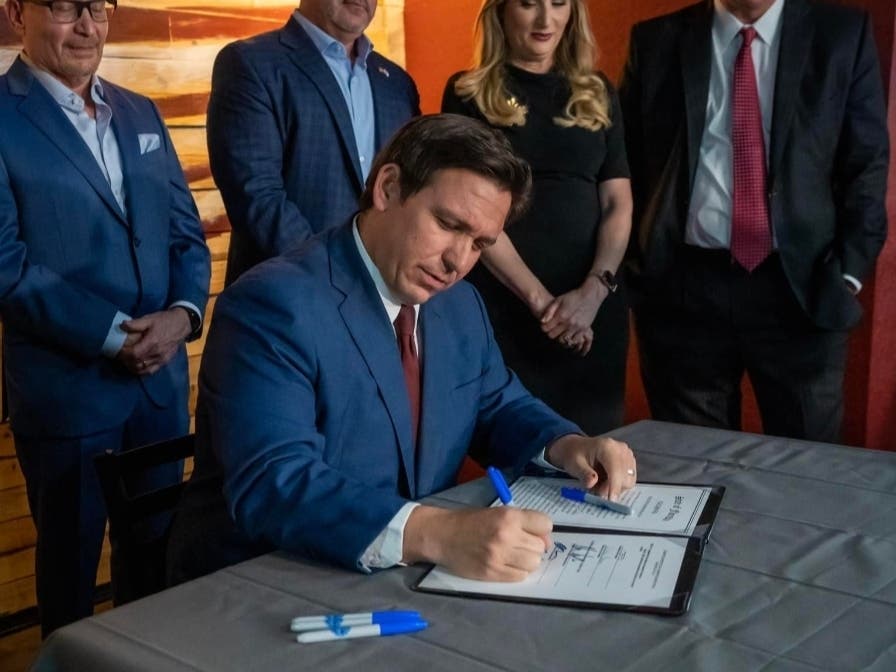
SPRING HILLS, FL — Florida Gov. Ron DeSantis signed an elections reform bill into law Monday afternoon during a news conference in Spring Hill that includes establishing a 25-person Office of Crimes and Security to weed out voter fraud.
Senate Bill 524 contains changes DeSantis said are intended to prevent voter fraud and tampering and increase transparency in the voting process. It also creates an office within the executive branch that has the authority to investigate election-related crimes and enforce security during elections to ensure voting integrity.
“I don’t think there’s any other place in the country where you should have more confidence that your vote counts than in the state of Florida,” DeSantis said during the bill signing at Rookies Sports Bar & Grill in Spring Hill.
Find out what's happening in New Port Richeyfor free with the latest updates from Patch.
DeSantis vowed to crack down on voter fraud following the 2020 presidential election in which former President Donald Trump claimed voter fraud resulted in him losing the presidency to President Joe Biden. Subsequent investigations have failed to produce any evidence of voter fraud that would have changed the outcome of the presidential election.
Nevertheless, DeSantis questioned the integrity of Florida's voting laws that permit the mass mailing of vote-by-mail ballots to voters without first checking their eligibility.
Find out what's happening in New Port Richeyfor free with the latest updates from Patch.
"This legislation will strengthen election security measures by requiring voter rolls to be annually reviewed and updated, strengthening ID requirements, establishing the Office of Election Crimes and Security to investigate election law violations, and increasing penalties for violations of election laws," DeSantis said.
Among the reforms, the new law:
- Increases the penalty for ballot harvesting from a first-degree misdemeanor to a third-degree felony, punishable by up to five years in prison, a $5,000 fine and up to five years probation.
- Requires the Department of State to strengthen ID requirements for mail-in ballots.
- Creates an Office of Election Crimes and Security to investigate allegations of voter fraud.
- Requires supervisors of elections to check voter rolls every year for ineligible voters.
- Prohibits election supervisors from receiving “Zuckerbucks.” (When the pandemic hit in 2020, Facebook CEO Mark Zuckerberg donated grant money to help cities and counties pay the cost of running voting sites and mailing out and processing absentee ballots.)
“Twenty years ago, nobody thought Florida was a prime example of how to conduct elections, but we have become a national leader by running the most secure elections in the country,” said DeSantis. “We need to do more to ensure our elections remain secure. We have ended ballot harvesting, stopped drop boxes and the mass mailing of ballots, and banned Zuckerbucks, and this bill will give us more resources to make sure bad actors are held accountable.”
The Florida League of Women Voters was quick to condemn the bill, however.
“The League of Women Voters of Florida believes Gov. Ron DeSantis has made a mistake by signing Florida’s Senate Bill 524 into law," League President Cecile Scoon said. "The newly minted law adds a number of unnecessary hurdles that will deter voters from participating in the democratic process."
Among them, the league said the law unnecessarily increases criminal penalties against third-party voter registration organizations that want to help people to register to vote.
See related stories:
FL Bill Would Ban Campaigns From Giving Voters Water At Polls
"This will chill churches, nonprofits and other organizations from doing voter registration work that is relied upon by hundreds of the thousands of Floridians," she said.
The league also believes the creation of an "election-centered police force" has the potential to intimidate voters and discourage them from participating in the political process.
"The governor has repeatedly stated that Florida’s 2020 election was an envy of the nation in terms of efficiency and safety. In turn, this means there were no legitimate overarching problems with our current election system," she said. "Taxpayer dollars would be better spent improving access to the ballot and making the voting process more efficient."
Scoon said the intent of the new law appears to restrict voting.
"While focusing on measures that restrict our freedom to vote, our state Legislature has continuously rejected numerous changes to voting that would have actually made voting more accessible for Floridians," she said. "The league believes democracy is strongest when every voice is heard, which is why we will continue to strongly advocate for measures that make voting more accessible, not less.”
On March 31, a federal judge struck down portions of Florida's voting law passed during the 2021 session, saying restrictions regarding mailed ballots and drop boxes make it more difficult for Blacks with socioeconomic challenges to vote.
"For the past 20 years, the majority in the Florida Legislature has attacked the voting rights of its Black constituents," U.S. District Judge Mark Walker wrote.
Among the provisions Walker struck from the law was limiting the use of ballot drop boxes to early voting hours unless the boxes are in the supervisor of elections office and manned at all times.
Walker also nixed a provision that set up no-solicitation zones around polling places to prohibit special interest groups from "influencing voters" by handing out bottled water to voters waiting in line.
The new law also contains a provision that will allow state Rep. Chris Latvala, R-Clearwater, to run for the Pinellas County Commission during the 2022 election instead of waiting until 2024.
On Monday, Latvala announced on his Facebook page that he will be running for commissioner this year despite any legal challenges to the voting law signed by DeSantis Monday.
"I will be running for the Pinellas County Commission in 2022," he said. "If these arrogant liberals want to sue our great governor and Legislature to overturn the elections bill, bring it on. It will not be the first time they have wasted our tax dollars. They will lose in the courtroom and then at the ballot box."
Get more local news delivered straight to your inbox. Sign up for free Patch newsletters and alerts.