Politics & Government
Controversial WWII Statue Focus Of Debate Over History, Assault
The Sarasota City Commission decided to move "Unconditional Surrender," depicting end of WWII celebration, to a new bayfront location.


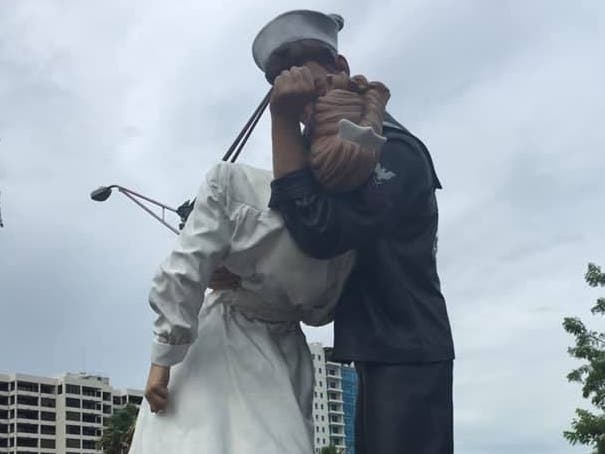
SARASOTA, FL — The infamous “Unconditional Surrender” statue — lauded by some as a celebration of the end of World War II and criticized by others as a symbol of a woman groped against her will — will be relocated from Sarasota’s bayfront to make way for a roundabout at U.S. 41 and Gulfstream Avenue.
The statue won’t be moving far, though. In a 4 to 1 vote at their Monday afternoon meeting, Sarasota City Commissioners gave the green light to moving the statue to nearby space along the bayfront between O’Leary’s Tiki Bar & Grill and Marina Jack.
The commission also authorized the use of up to $45,000 in public art money to disassemble, move and reassemble the 26-foot-tall aluminum sculpture in a 4 to 1 vote.
Find out what's happening in Sarasotafor free with the latest updates from Patch.
Commissioner Jen Ahearn-Koch was the sole no vote against both measures.
“Unconditional Surrender” is a three-dimensional depiction of the iconic photograph “V-J Day in Times Square” by Alfred Eisenstaedt. In the image, the photographer captured a U.S. Navy sailor grabbing and kissing a woman in a white dress – a complete stranger – on the streets of New York City on Aug. 14, 1945, the day the United States declared victory over Japan, ending World War II. It was published in Life magazine.
Find out what's happening in Sarasotafor free with the latest updates from Patch.
“Unconditional Surrender's” History in Sarasota
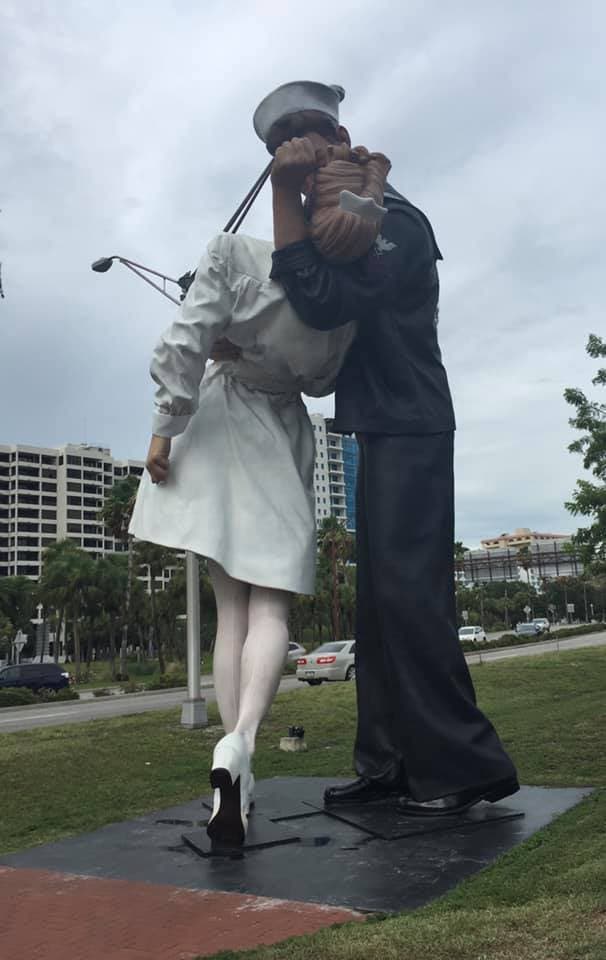
The controversial statue has been the subject of intense debate in the Sarasota community for more than a decade. While many veterans consider it a celebration of America’s WWII victory, others view it as a tacky eyesore. Still others think the forced kiss is a romanticized depiction of sexual assault, while some are concerned about the possibilities of copyright infringement because Time Inc. owns the rights to the original image.
It first came to the bayfront in 2005 as part of the rotating Sarasota Season of Sculpture exhibition. Every two years, new sculptures would be installed along the waterfront, said Kelly Franklin, a vocal opponent of the statue. That early statue was a smaller, 8-foot-tall version of the one that stands today, she said.
Thomas Savage, the founder and former director of the Sarasota Public Art Fund, loved the statue so much that he worked to bring it back for a second installation as part of the Season of Sculpture. This time, though, due to his efforts — with some help from Ringling College president Larry R. Thompson — the city displayed the larger, 26-foot-tall version of the statue from the New Jersey foundry estate of artist J. Seward Johnson, who conceptualized the piece. Johnson, who died in March, was heir to the Johnson & Johnson pharmaceutical fortune.
While it was on the display for a second time, local veteran Jack Curran became attached to the statue after the death of his wife, who had loved the sculpture. As a tribute to her, he pulled together his assets and purchased “Unconditional Surrender,” lending it to the city to display for 10 years.
For the past decade, it’s stood in its location near U.S. 41 and Gulfstream Avenue, serving as a popular downtown tourist attraction.
The only time it’s moved from its spot was in 2012, when a car crashed into the sculpture and it was shipped to Johnson’s New Jersey estate for repair. And in February 2019, it was tagged with a giant #MeToo in red spray paint, a nod to the #MeToo movement of individuals stepping forward to call out powerful and famous men for sexual abuse and harassment. The city kept the statue up and pressure washed it where it stood after this incident.
The 10-year loan from Curran ended in June, said Steve Cover, the city’s planning director at Monday’s meeting. That same month, the city accepted the sculpture as a donation and became its official owner.
Planning for the Future
Around the time Sarasota took ownership of the statue in June, city leaders, knowing the new roundabout would be constructed at the intersection, began making plans to move it — either temporarily for the duration of FDOT’s construction or permanently if a better location became apparent.
On July 8, the Public Art Committee voted to move the statue away from the bayfront permanently to the Sarasota Sahib Shriners property at 600 North Beneva Road, Cover said.
At Tuesday’s meeting, Josh Botzenhart, the Public Art Committee chair, said the statue doesn’t meet all seven of the city’s public art requirements. All seven must be met before it is put publicly on display. He also expressed concerns that the statue is a reproduction, rather than an original piece of art, with several versions of it displayed around the country, including one copy in San Diego.
The Shriners stepped up as enthusiastic partners to serve as a home for the sculpture. At the meeting, the group’s CEO, Gary Fields, reiterated their offer to raise the money needed to move and maintain the statue. And since many veterans are Shriners, it will be appreciated by the group’s membership if it’s moved to their property, he said.
On Aug. 20, the city’s Parks, Recreation and Environmental Protection Board recommended moving “Unconditional Surrender” to the front entrance of O’Leary’s and Marina Jack, Cover said. Since then, the commission considered nine locations for the statue — including the Shriners’ property — as well as a temporary move into storage.
The city also polled residents about their favorite spot to place the statue. Nearly 40 percent of the votes submitted indicated the statue should be moved to the bayfront between O'Leary's and Marina Jack. The next two popular choices were Ken Thompson Park, which received 21 percent of the vote, and the entrance of Bayfront Park in front of O'Leary's, which received nearly 17 percent of the vote.
But, the Sarasota Herald-Tribune reported, the results of the survey were inaccurate. The survey, conducted through the city's website using Survey Monkey, drew more than 10,000 responses. Thousands of the votes cast in this poll came from just a few computers, though. In fact, it's reported that a single IP address voted to move the statue to Ken Thompson Park 1,566 times between Sept. 19 and 21. Results for almost all bayfront options listed were compromised, the Herald-Tribune added.
Opponents of “Unconditional Surrender” Speak Out
At Tuesday’s meeting, both opponents and supporters of the statue spoke about the future home of “Unconditional Surrender.”
Kelly Kirschner, a former city commissioner who voted to accept the original loan of the statue a decade ago, said the commission at the time “did the wrong thing for what seemed like all the right reasons” — honoring veterans.
“It was a false choice then and continues to be one today,” he said, adding that “the lack of consent between the individuals was not established fact” when they made the decision.
There had been some question about who the people in the photo were. Over the years, various people claimed to be the mystery couple in the iconic image. But the 2012 book “The Kissing Sailor: The Mystery Behind the Photo that Ended World War II,” shed all doubts that the two in the image were anyone other than George Mendonsa, a U.S. Navy sailor at the time the photo was snapped, and Greta Zimmer Friedman, then a dental assistant.
Even before this, though, Friedman had indicated in interviews that the kiss was nonconsensual. In a 2005 interview with the Library of Congress, she spoke about the incident.
“It wasn't my choice to be kissed. The guy just came over and kissed or grabbed,” she said.
Friedman also said, “I felt he was very strong, he was just holding me tight, and I'm not sure I — about the kiss because, you know, it was just somebody really celebrating. But it wasn't a romantic event. It was just an event of thank God the war is over kind of thing because it was right in front of the sign.”
She refused to re-enact the incident on numerous occasions when requested by media and others.
Melanie Goddard spoke to several concerns about the statue, including copyright infringement – she called it “outright plagiary” – and the fact that the scene depicted “was not, in fact, a joyous consensual moment. Many refer to it as ‘The Kiss,’ but in reality, it was ‘The Assault.’ It was not her choice to be kissed. She was just grabbed and overpowered.”
It was also “an odd choice” for the city’s bayfront, she said, as “nothing about this statue tells our visitors who we are and what makes Sarasota unique.”
She suggested the city replace “the kitschy replica” that “glorifies misbehavior and aggression” with artwork that highlights Sarasota’s history or a tribute to all U.S. Armed Forces.
Meanwhile, Ron Kashden, a CPA specializing in the publishing industry, also spoke about copyright infringement and said there are “serious legal issues encumbering this piece.”
He said it’s “a willful violation” of Time’s copyright to the photo and the city could face a minimum of $150,000 in damages for knowingly displaying work that violates copyright law. He suggested returning the statue to Johnson’s estate, as well as “the liability that comes with it.”
Franklin played a video during her three-minute comment period. In the video, she discussed her volunteer work with local youth, sharing that one young person she knows had been sexually assaulted and was afraid to walk near the statue.
In an interview with Patch, she said, “It’s not just the assault victims this is problematic for. It's the subliminal messaging. We're going to teach youth to assume a domination pose and confuse (them) with the distinction between consensual acts and nonconsensual acts. To me, the sculpture is completely separate from the feelings or sentiments people might have had about the photograph in that time.”
The former publishing professional, who has worked with copyrights in her line of work, is also concerned about potential legal issues, especially after a 2015 lawsuit involving the film “Raging Bull” made its way to the U.S. Supreme Court.
In the case, Paula Petrella, the daughter of Frank Petrella, whose book and screenplay inspired the Oscar-winning film, sued MGM and 20th Century Fox for copyright infringement, according to The Guardian. In her argument, Paula said that any rights to the story became hers when her father died.
Her father died in 1981, though, and she waited until 2009 to take any legal action. MGM and 20th Century Fox unsuccessfully argued that the case should be thrown out because of the delay. They wound up settling with her.
“It settled what had been an open question in publishing circles since the 1976 Copyright Act was put forward,” Franklin said. “The idea of a three-year statute of limitations is wrong. At any time (a copyright infringement lawsuit) can be brought forward.”
In such a lawsuit, the plaintiff can hope to reclaim damages for the three most recent years, she added.
Supporters of “Unconditional Surrender” Share Their Thoughts
Jim Haberman spoke to the draw the statue has for Sarasota visitors, sharing a time-lapsed video of several hours to show how many passersby stopped to take their photo with “Unconditional Surrender” and admire it.
“It is an undeniable fact that it brings visitors to the downtown area,” he said.
He added that removing such a tourist attraction during a period of economic uncertainty, which has been caused by the COVID-19 pandemic, would be “the height of foolishness.”
Savage was also in attendance at the meeting and spoke to the sculpture’s tourism draw. Each year, thousands visit the statue, he said.
As far as concerns that “Unconditional Surrender” depicts a sexual assault?
“In a crime you have to have a victim and when the nurse was interviewed, she did not claim to have been assaulted,” he said.
In fact, he added, “The public sees this as a joyful celebration. The military sees this as service sacrifice and call to duty. It is an honor to have this iconic, historic statue in our city.”
Gerald O’Donnell said he was friends with both Mendonsa and Friedman. The two reconnected later in life. They kept in touch and sent each other holiday cards each year, he said. “These behaviors are hardly the actions of a victim of sexual assault and her attacker. Both of them were very proud to be portrayed in the photo and the statue that came to symbolize the end of World War II.”
Barbara Vaughn, a Venice resident, said Sarasota County’s veterans appreciate the statue.
“It represents veterans. It represents the greatest event in our country’s history and people come here and appreciate it and they enjoy it,” she said, adding that it’s “not representative of sexual assault…it was a simple kiss.”
City Leaders Discuss the Statue
City Attorney Robert Fournier addressed concerns that a lawsuit might be filed against the city for copyright infringement. Federal copyright laws say that there is a three-year window to file a copyright infringement lawsuit, he said.
The question is, when does the timer for this three-year period start, he asked. Under the discovery rule, this time accrues “when the holder of the copyright first discovers their rights were violated.” But under the injury rule, the injury only stops when the infringement stops, regardless of when it’s discovered, he said.
The 11th Circuit Court of Appeals, which has jurisdiction over Florida, “operates under the discovery rule,” Fournier said.
He also noted that in 2010, when the statue was first loaned to the city, it came with a three-year indemnity provision that would pay for any damages the city might sustain for displaying the statue through June 2013. Time Inc. and the Public Art Committee were in correspondence over the statue and Time indicated the ownership of the image had been in dispute since 2006.
Time Inc. said the city would have to license the image from them at that point, but never followed up on it, Fournier said. It could also be “credibly argued that the statute of limitation started to run back then and expired in 2010.”
He added, “In light of the time that’s gone by… I have the feeling they’re not terribly interested in pursuing it.”
The city commissioners also spoke about “Unconditional Surrender” and its place in the community. Ahearn Koch was the only commissioner to express any concerns about the statue.
Among her issues were the nonconsensual aspect of the image, the sculpture’s structural integrity and potential copyright infringement. She also said that not moving it to the Shriners’ property was “fiscally irresponsible” of the commission, since the organization offered to foot the bill.
Their land is also the ideal spot for the statue because there are so many veterans in the group, she added. “Art is…viewed in the context of where it’s displayed. I think it’s a better place to display it with the backdrop of this really wide membership that’s made up of veterans (rather than) the backdrop of a tiki bar.”
Additionally, Ahearn Koch said, the commission should pay attention to recommendations from the city’s Public Art Committee.
“None of us here are art experts. That’s why we have an advisory board,” she said, noting that the PAC’s unanimous consensus was to move the statue to the Shriners’ property. “I don’t think we should be going on what we like and what we feel.”
The other four commission members were committed to keeping “Unconditional Surrender” on the bayfront, though.
Vice Mayor Erik Arroyo, an attorney, said he didn’t think the statue “opens us up to liability, at all.” Copyrights aren’t as protected as patents and trademarks, he added.
As for the work itself, “art is not always supposed to make you feel good,” he said, and this particular piece “means very different things to people who have gone through some sort of trauma and it means something very different to nurses and to veterans.”
Arroyo added, “You really have to dig deep to find some offense.”
Commissioner Liz Alpert said, “I know there’s been a lot of controversy and I have heard the argument about the depiction of assault, but I think this sculpture has to be placed in the context of the time.”
After the sculpture is moved, veterans’ groups and victims’ advocates should have the opportunity to set up educational displays at the site, she added.
“Art evokes emotion and one way or the other, there are going to be people that love it and there are going to be people that hate it,” said Commissioner Kyle Battie. “When it comes to the idea of sexual assault, it’s something I, personally, don’t take lightly. I’m for the #MeToo movement and the work they’ve tried to accomplish. I would never diminish that or try to marginalize their concerns or the community.”
Mayor Hagen Brody said, “The statue belongs to the community and the community, in my mind, has really spoken. Art is supposed to stir emotion. It’s supposed to pose questions and provoke discussion, which is exactly what we’re doing here today.”
And, at the end of the day, “Unconditional Surrender” is about paying tribute to the area’s veterans, he said. “My personal feeling is that it does pay homage to the greatest generation, the jubilation and the unparalleled celebration of V-J Day.”
Get more local news delivered straight to your inbox. Sign up for free Patch newsletters and alerts.