Community Corner
Pygmy Killer Whales Rescued Along Fla. Coast Die
The whale named Lightning died around 9 a.m. Wednesday, Sept. 5. Thunder died 26 hours later, on Thursday, Sept. 6.


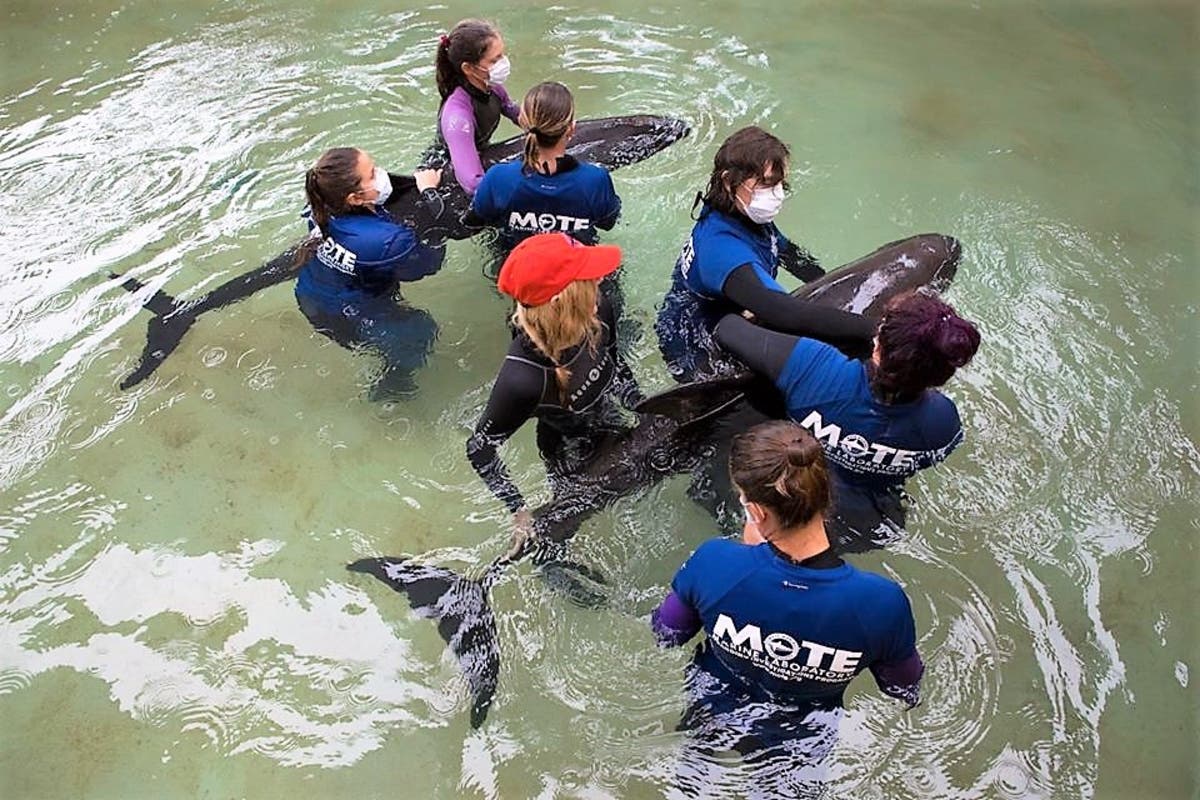


SARASOTA, FL -- Despite herculean efforts to save them, two rare pygmy killer whales rescued from Clearwater Beach have died.
The two whales were rescued Aug. 29 by the Clearwater Fire & Rescue Department and the Clearwater Marine Aquarium. They were named Thunder and Lightning because they arrived at Mote Marine Laboratory and Aquarium in Sarasota for treatment during an afternoon thunderstorm.
The whale named Lightning died around 9 a.m. Wednesday, Sept. 5. Thunder died 26 hours later, on Thursday, Sept. 6.
Find out what's happening in Sarasotafor free with the latest updates from Patch.
The two female pygmy killer whales were found beached together in the 1500 block of Gulf Boulevard in Sand Key.
Gretchen Lovewell, manager of Mote’s Stranding Investigations Program, said it's unusual to see pygmy killer whales near the shoreline. The pygmy killer whale is a small member of the oceanic dolphin family and are often confused with false killer whales and melon-headed whales.
Find out what's happening in Sarasotafor free with the latest updates from Patch.
“Pygmy killer whales are offshore, deep-water animals that are rarely observed and little understood — if they are sighted around the coast, they are generally in trouble,” said Lovewell,
They are naturally rare. Until a live whale was discovered in 1954, pygmy killer whales were known only from two fossil skulls for over a century.
Lovewell was visibly distressed as she announced Thunder's death.
"We are sad to report that Thunder passed peacefully this morning at Mote Marine Laboratory," she said.
She and her team had been tending to the whales around the clock in the waters of the Mote medical tank and had grown attached to the pair.
"When you actually have time to spend with an animal and get to watch their interactions and have those brief moments of excitement where you think they might be improving a little bit and then going through those ups and downs, its hard,” said Lovewell.
In their medical pool at Mote, Thunder and Lightning received 24-hour monitoring, physical support from caregivers as needed, fluid therapy and diagnostic tests.
“We provided antibiotics, fluids and treatment for parasites, and tested for other concerns that might affect this offshore species,” Lovewell said.
Lovewell wasn't surprised, however, that Thunder died so soon after Lightning.
"Thunder was very socially bonded with the other pygmy killer whale, Lightning, and we are unsure what impact Lightning’s recent passing had on Thunder," she said.
She said Lightning was the sickest of the two stranded whales. She repeatedly struggled to swim on her own, showed no interest in food, and was being treated for pneumonia, parasites known as nasotrema and gastric issues. Thunder was able to swim unaided for stretches of time.
The two whales were found north of the area impacted by red tide, and marine biologists are unsure if the red tide algae bloom played a role in their illnesses. Lovewell said the whales showed no behavioral signs of exposure to red tide neurotoxins.
Thunder’s body will be transported to the University of Florida for advanced diagnostic imaging before returning to Mote Marine Laboratory for a necropsy. Lighting is already at UF. Early results from diagnostic imaging revealed she had severe sinusitis.
Mote staff collected blood serum samples from to be tested at the Florida Fish and Wildlife Conservation Commission’s Fish and Wildlife Research Institute for red tide toxin exposure.
“The results will likely take weeks, as samples are being tested from many animals in many areas now,” Lovewell said.
Mote is also caring for a melon-headed whale found Tuesday, Sept. 4 off Longboat Key Beach. That whale, named Bolt, remains in critical condition .Bolt, who weighs about 300 pounds, is an older male. Unlike Thunder and Lightning, he is able to swim on his own in the hospital tank although Lovewell said he is very sick and his prognosis is uncertain.
Although saddened by the deaths of the two whales, Lovewell said their brief time at Mote yielded a great deal of insight into this rare species including a better understanding of their anatomy, physiology and behavior.
“Observing both of these animals from the same stranding event will hopefully allow us to learn an awful lot more about this species that we really don’t understand that well,” she said. "We are grateful for all those who sent positive wishes for Thunder and Lightning and for the Mote team who worked day and night to keep them as comfortable as possible."
In addition to caring for sick marine animals, Lovewell and her team in Mote’s Stranding Investigations Program have been working nonstop over the past month to recover an unusually high number of dead marine animals with suspected or confirmed red tide exposure. The lab is conducting necropsies on all of the animals.
“It’s been a herculean task for our small staff and trained volunteers — responding to several times our usual number of calls and conducting recoveries and necropsies continually, while simultaneously working with our hospital on 24-hour critical care for Thunder and Lightning," said Mote President and CEO Dr. Michael P. Crosby.
To date, 12 dolphin deaths have been attributed to red tide.
Images via Mote Marine Laboratory
Related stories:
Clearwater Fire Crews Help Rescue Stranded Pygmy Killer Whales
Rescued Pygmy Whales Remain In Critical Condition
(For more local news from Florida, click here to sign up for real-time news alerts and newsletters from Patch. If you have an iPhone, click here to get the free Patch iPhone app; download the free Patch Android app here.)
Get more local news delivered straight to your inbox. Sign up for free Patch newsletters and alerts.