Arts & Entertainment
$40M Expansion Includes Sea Lion, Puffin Habitats At Florida Aquarium
The Florida Aquarium announced plans for a $40-million expansion plan that will feature the first sea lion habitat on Florida's west coast.


TAMPA, FL — Already named the No. 3 aquarium in the country in 2022 by USA Today's 10 Best, The Florida Aquarium is preparing to up the ante.
On Tuesday, The Florida Aquarium announced plans for a $40-million expansion plan that will feature the first sea lion habitat on Florida's west coast.
The project, which will be constructed in three phases, will begin in January and is scheduled to be completed in 2025.
Find out what's happening in Tampafor free with the latest updates from Patch.
It includes the addition of a rotating special exhibit gallery, converting the second-floor lobby into to multi-species gallery, featuring puffins and a large-scale outdoor exhibit for California sea lions.
A significant African penguin habitat will also be part of the outdoor expansion.
Find out what's happening in Tampafor free with the latest updates from Patch.
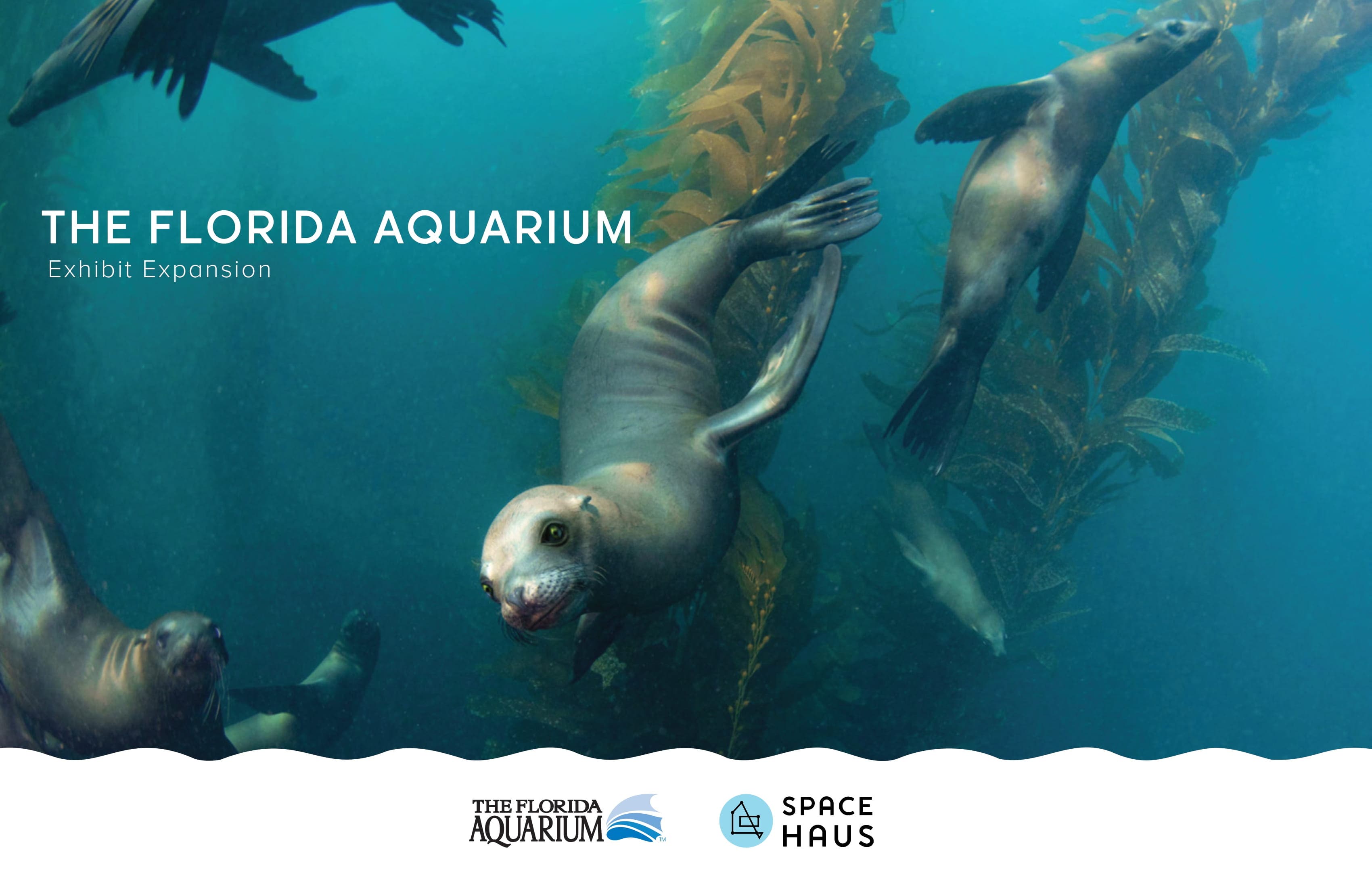
The Florida Aquarium announced plans for a $40-million expansion plan that will feature the first sea lion habitat on Florida's west coast.
“We are reinvigorating The Florida Aquarium by creating innovative and immersive habitats and exhibits, providing captivating guest experiences, and expanding our dynamic animal collection that advances our commitment to saving wildlife and wild places,” said Roger Germann, president and CEO. “Today we take a major step forward in building the world-class aquarium that Tampa Bay deserves.”
This marks the first major expansion for The Florida Aquarium since its opening in 1995.
Germann said the expanded guest experience is in response to a growing marketplace and historic visitor attendance at The Florida Aquarium in recent years. It also delivers on the aquarium’s mission to connect guests to the marine world in meaningful and inspiring ways, he said.
Equally important, the expansion will generate more revenue for The Florida Aquarium, helping it deliver on its promise to have a more global perspective in conservation.
Space Haus, an architectural design firm known for its expertise in the zoo and aquarium industry, will lead the creative design of the expansion project. Its list of clients includes The Shedd Aquarium, National Aquarium of New Zealand and the Dallas and Kansas City zoos.
The designs of all three phases of expansion prioritize animal welfare standards, Germann said.
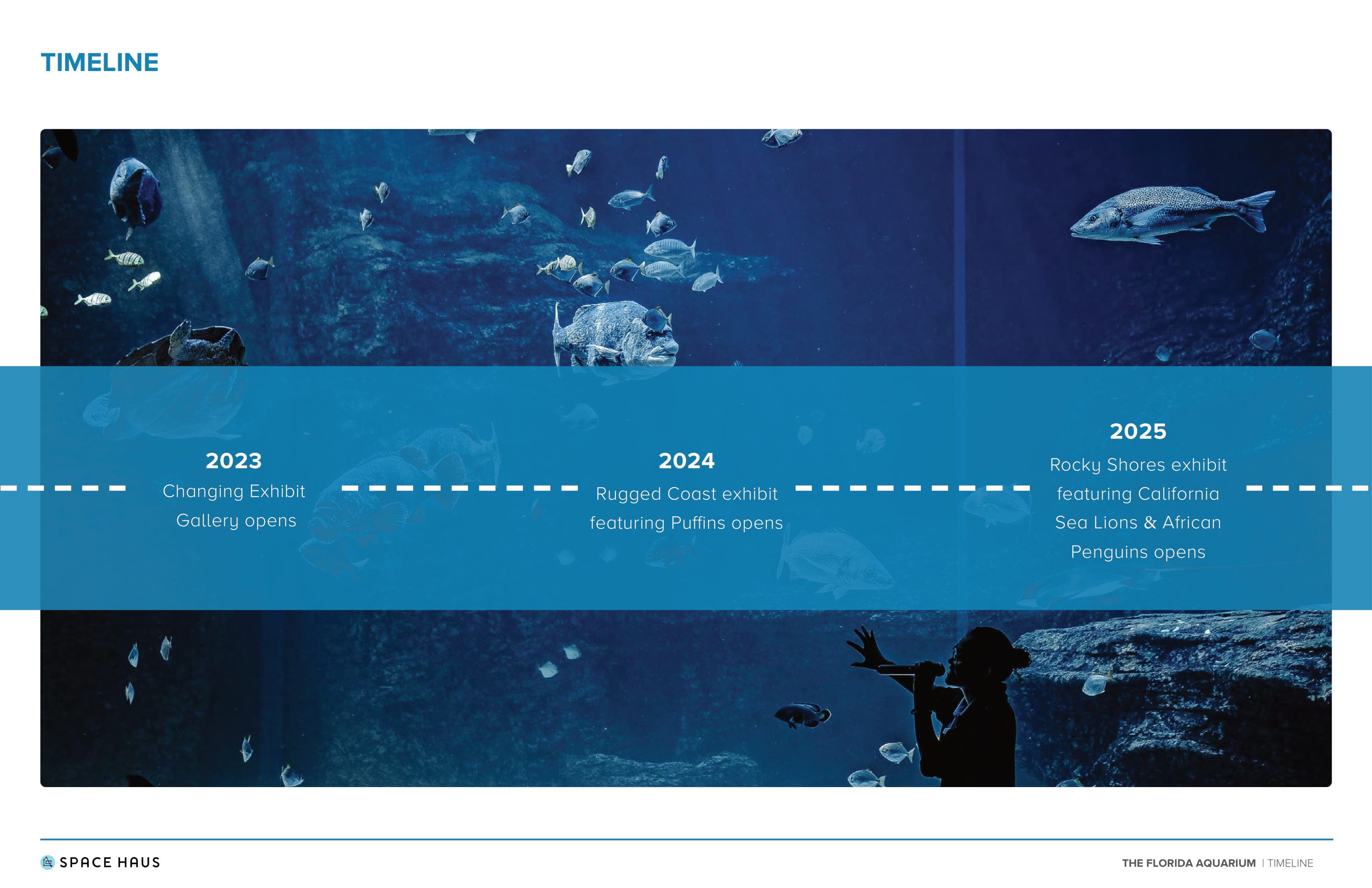
Phase I of the project, which is scheduled for completion in 2023, will transform the existing ballroom space in the Mosaic Center into a 3,700- square-foot flexible special exhibit hall.
Phase II, slated for 2024, will transport visitors to the rocky coasts with a two-level puffin habitat complete with a kelp forest, Atlantic salmon and other larger fish species. Multiple viewing windows measuring more than 20 feet will allow guests to see the numerous nesting sites and deep dive pool of this 45,000-gallon habitat for these black and white diving seabirds.
The planned completion for the third and most ambitious phase will be 2025. Three separate-but-interconnected sea lion spaces, which collectively measure more than 200,000 gallons, will include both a large main habitat and animal encounter habitat as well as a presentation space including underwater viewing and overlook seating.
The outdoor plaza will feature a 39,500-gallon African penguin habitat with a bubble viewing window, which will allow for optimal welfare to a colony of up to 30 penguins.
Fundraising is already underway for this major expansion that will attract more guests, elevate the guest experience, expand conservation impact and further establish The Florida Aquarium as a leader among Florida’s cultural attractions.
Calling it one of the best aquariums in the South, USA Today noted that the nonprofit aquarium is home to more than 8,000 fresh and saltwater animals and plants including alligators, sharks, seahorses, river otters and free-flying birds.
The Florida Wetlands Trail highlights regional life in a recreated mangrove forest, while the Journey to Madagascar takes visitors across the globe to observe a host of exotic animals like ring-tailed lemurs, hissing cockroaches and colorful chameleons. At Stingray Beach, visitors are invited to touch stingrays and sharks.
Groundbreaking Research
While the educational and entertainment value of the aquarium is undisputed, it's what visitors rarely see behind the scenes that makes the biggest impact on the environment.
In 2019, the aquarium made global history when it successfully spawned several species of Atlantic coral in a laboratory setting. This ground-breaking advancement is being used to regenerate and save the world's dying coral reefs.
Among them was the threatened Atlantic pillar coral (Dendrogyra cylindrus).
“Pillar coral is an extremely challenging species to collect eggs and sperm from in the wild and raise large numbers of offspring,” said Keri O’Neil, senior coral scientist at The Florida Aquarium. “The lab-induced spawning allows us to produce more larvae with a much higher diversity of parents than we ever could from wild spawning."
In 2020, the aquarium repeated its historical success as the first aquarium to reproduce and film larvae of the Ridged Cactus Coral, decimated by stony coral tissue loss disease.
“These advances give us hope that the round-the-clock work we are doing will make a difference to help conserve this species and save these animals from extinction,” said O’Neil. “To date we have now been able to sexually reproduce eight different species of coral affected by stony coral tissue loss disease at The Florida Aquarium’s Center for Conservation campus.”
Then, in May 2021, in a collaborative restoration initiative with the University of Miami Rosenstiel School of Marine and Atmospheric Science the aquarium was the first to breed grooved brain corals rescued from a disease outbreak.
The Florida Aquarium also joined with Biscayne National Park in an Aquarium-Park Partnership for America’s Keystone Species to rescue, rear and outplant genetically diverse corals to restore reefs at Biscayne National Park damaged by disease, overfishing, climate change, degraded water quality, marine debris and other stressors.
In December 2021, the aquarium made global headlines once again when researchers at The Florida Aquarium, University of Florida and the Florida Fish and Wildlife Conservation Commission successfully reared and released nearly 200 long-spined sea urchins (Diadema antillarum) off the coast of Florida.
“With their long black spines, these urchins are instantly recognizable as one of the most striking creatures in the Atlantic Ocean” said Alex Petrosino, a biologist at The Florida Aquarium. “What is less commonly known is these urchins provide a vital service, living out their lives, eagerly scouring over the reef surface and feeding on the fleshy algae that is fueled by pollution and can suffocate healthy coral reefs.”
Though urchins like these were once abundant in the Caribbean, the world nearly lost its entire long-spined sea urchin population in the 1980s due to an unknown disease. For several years, aquarium researchers have been developing ways to rear and foster urchins, which scientists believe are key to saving the world's dying coral reefs.
“We are in a race to help the world’s coral reefs, and this release of critically important algae grazers is a huge step forward,” said O’Neil.
This project is considered the largest restocking of long-spined sea urchins in the last 20 years.
Currently, The Florida Aquarium is raising mountainous star coral juveniles collected by National Park Service scientists from the 2019 and 2020 wild spawns. These corals will be raised in the aquarium's greenhouses until they are large enough for the National Park service to return them to the reefs of Biscayne National Park.
Additionally, since 1999, The Florida Aquarium has led extensive sea turtle conservation and rehabilitation effort. Over a 20-year period, the aquarium treated 221 sick and injured sea turtles, rehabilitated and released 180 sea turtles and opened a state-of-the-art sea turtle rehabilitation center in Apollo Beach in 2019.
See related stories:
- Tampa Mayor Dives Head On Into New Florida Aquarium Program
- Florida Aquarium Makes Historic Breakthrough To Save Coral Reefs
- Help Saving African Penguin Comes From Florida Aquarium Donation
- Florida Aquarium Takes Another Step To Saving Endangered Coral
- Florida Aquarium Celebrates 25th Anniversary With Expansion
Get more local news delivered straight to your inbox. Sign up for free Patch newsletters and alerts.