Politics & Government
FL Wants To Penalize Social Media For Banning Candidates
Florida could become the first state in the nation to penalize social media companies for banning political candidates.


FLORIDA — When Gov. Ron DeSantis signs the "Transparency in Technology Act," Florida will become the first state in the nation to penalize social media companies for banning political candidates.
In one of its final acts before ending the 2021 legislative session April 30, the Florida House voted 77-38 and the Senate 23-17 to approve and forward a bill to DeSantis that would prohibit social media companies such as Twitter, Facebook and YouTube from “deplatforming," or banning, posts by political candidates.
Social media would still be allowed to suspend posts by candidates for up to 14 days and remove individual posts. But permanently banning a candidate could earn a company fines of $250,000 a day for statewide candidates and $25,000 a day for other candidates if a company's actions are found to violate the law.
Find out what's happening in Tampafor free with the latest updates from Patch.
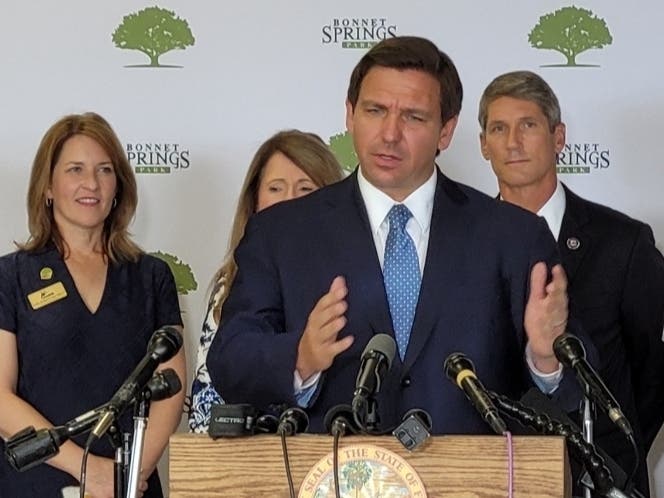
DeSantis — joined by Republican leaders Lt. Gov. Jeanette Nuñez, House Speaker Chris Sprowls, Senate President Wilton Simpson, Sen. Danny Burgess and House Commerce Committee Chair Blaise Ingoglia — introduced the bill after former President Donald Trump was banned from Twitter following the Jan. 6 attack on the U.S. Capitol. Twitter contended that Trump used the platform to incite violence.
DeSantis became more adamant about the bill's passage in April after YouTube removed a video of a DeSantis roundtable discussion with medical and scientific experts on the impacts of lockdowns on the transmission of the coronavirus. YouTube, which is owned by Google, claimed the video contained false statements about the efficacy of children’s mask-wearing.
Find out what's happening in Tampafor free with the latest updates from Patch.
“In Florida, our message to big tech is loud and clear,” DeSantis said. “Big Tech companies have long since abdicated the protection of consumers for the pursuit of profit, and we can’t allow Floridians’ privacy, voices or livelihoods to be violated or diminished. When it comes to elections, Big Tech shouldn’t be in the business of censoring or deplatforming candidates, but rather, voters should be able to make that choice independently."
He said tech companies should not be the arbitrators of what content is appropriate and that Floridians should be able to choose which content to read and which to ignore.
"I want to preserve Florida’s rich, diverse public discourse and not allow corporate-owned, content managing outlets to dominate our voices," DeSantis said.
“A fundamental understanding of what it means to be an American is that we have equal access to the town square — a place where we can share our thoughts, our ideas and our beliefs with fellow citizens,” said Sprowls (R-Palm Harbor). “If democracy is going to survive, we must stand up to these technological oligarchs and demand transparency.”
The law would require Big Tech firms to do the following:
- Publish standards used to ban posts, deplatform and "shadow ban" users.
- Provide equal access for established news organizations and qualified political candidates to reach users free from manipulation by algorithms.
- Stop arbitrarily censoring and/or deplatforming users.
- Give users the power to opt out of algorithms.
- Stop frequent changes to terms of use, clearly communicate and obtain prior consent to changes.
NetChoice, a trade group for internet companies, testified against the legislation, saying private companies should have the right to decide whether to remove content that they deem harmful.
"The First Amendment makes clear that government may not regulate the speech of private individuals or businesses," said NetChoice President Steve DelBianco. "This includes government action that compels speech by forcing a private social media platform to carry content that is against its policies or preferences."
He said it isn't the intent of social media companies to limit free speech, but they should have the right to set standards and delete comments they feel are inflammatory, incite violence or spread false information.
However, Burgess (R-Zephyrhills) said Big Tech has gone beyond protecting the public by banning people simply because they don't agree with their viewpoint.
"Twitter and Facebook and others cannot be the sole judge, jury and executioner of American’s First Amendment rights," he said. "For better or for worse, this is the new town square, and social media has become a major part of our everyday life and society."
State Rep. Carlos Guillermo Smith (D-Orlando) said there's an easy solution that doesn't involve passing a new law that will likely lead to a protracted court battle.
"Stop trafficking in conspiracy theories," he told GOP leaders. "That's the solution. Stop pushing misinformation if you're a candidate or an incumbent elected official. Stop lying on social media. Stop inciting insurrection against our republic."
See related stories:
Get more local news delivered straight to your inbox. Sign up for free Patch newsletters and alerts.