Weather
Forecasters Look Back And Predict Impact Of Direct Hurricane Strike On Tampa Bay
As the 100th anniversary approaches of the only hurricane to make a direct strike on Tampa Bay, planners have predicted the impacts today.


TAMPA BAY, FL — As Florida nears the end of the 2021 Atlantic hurricane season, forecasters warn residents not to put their hurricane survival kits in storage quite yet.
The season runs from June 1 to Nov. 30, and weather experts at Colorado State University said there's still a chance a major hurricane will form in the Atlantic Ocean in the coming month.
"We believe that the most likely category for Atlantic hurricane activity in the next two weeks is normal (60 percent), with above-normal and below-normal both assigned a 20 percent chance of occurring, respectively," said Phil Klotzbach, a research scientist at Colorado State University.
Find out what's happening in Tampafor free with the latest updates from Patch.
Colorado State University's latest update comes as the 100th anniversary of the last major hurricane to strike Tampa Bay approaches.
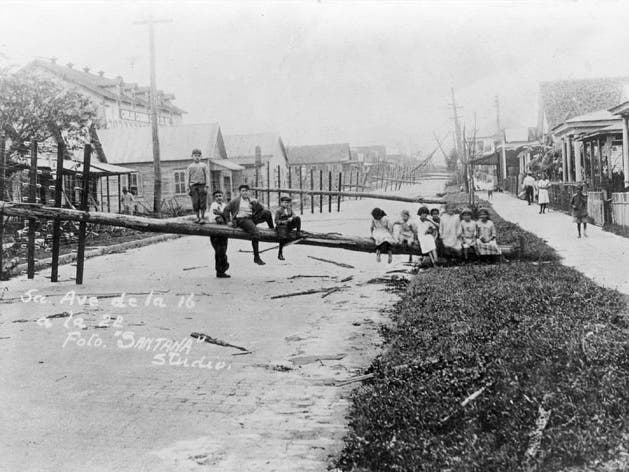
Daniel Noah, warning coordination meteorologist for the National Weather Service in Tampa Bay, said the Tampa Bay hurricane of 1921 (also known as the 1921 Tarpon Springs Hurricane) caused widespread destruction across west-central Florida on Oct. 25, 1921.
Find out what's happening in Tampafor free with the latest updates from Patch.
The NWS, which has put together a presentation to commemorate the anniversary, said no storm since has had such a profound impact on Tampa Bay.
The hurricane began as a tropical storm and became a Category 4 hurricane on Oct. 24 with maximum sustained winds of 140 mph. The following day, the hurricane weakened to a Category 3 before making landfall near Tarpon Springs, hammering Tampa Bay with 120 mph winds and 11 feet of storm surge.
Eight people perished in the storm. Three drowned as storm surge inundated residential areas. Others were killed by falling debris and one died after touching a live wire.
Featuring photos from the storm, facts about the damage it caused and a documentary video, the presentation is meant to remind people it can happen again, said Noah.
Like this article? Sign up for our newsletter and get it delivered every weekday. It's free!
"Tampa Bay hasn't had a direct impact from a major hurricane for 100 years," Noah said. Since then, the population has since grown to more than 3.1 million people. Noah said if the Tarpon Springs Hurricane were to strike Tampa Bay today, there would be widespread destruction and loss of life.
Noah said the Tarpon Springs Hurricane serves as a reminder of why Tampa Bay residents should never let down their guard.
A Look Back At The 1921 Hurricane
As the 1921 hurricane came ashore in Tarpon Springs as a Category 3 hurricane, it cut through Hog Island in the Gulf, creating two smaller islands, known today as Honeymoon and Caladesi islands.
Eyewitnesses described the devastation.
"Big trees were falling one after the other, and sometimes as many as three fell at the same time," said Karl Brown who lived near Boca Ciega Bay in southern Pinellas County when the hurricane struck.
Across the bay in Tampa, residents were trapped by twin walls of water bearing down on them.
"We saw an enormous wave coming at us from the east. We then saw, at about the same time, the same kind of wave coming at us from the west. Somehow, we got up on top of the wood-frame house and survived," said Arnold M. Wilson, who lived at Hooker's Point.
After the storm passed, survivors had to deal with the flooding it left behind.
The storm "completely inundated Clearwater Beach," Arlos Ogg of Clearwater said. "Only the palm trees stuck out above the water. It tore down all the private docks that extended from Clearwater to the channel."
"I lived on 18th Avenue North on Beach Drive, and water was 3 to 4 feet deep there," St. Petersburg resident Joseph Dew said. "Water came up Central Avenue to First Street, and the Gulf beaches were covered."
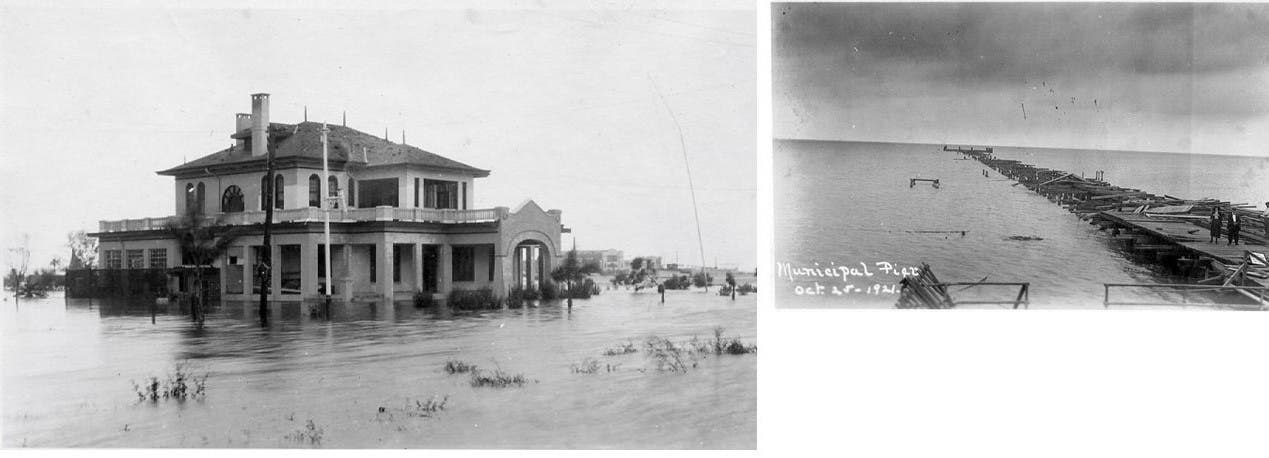
The highest storm surge inundated areas in downtown Tampa and Tarpon Springs. Many vessels, like the steamer “Favorite" and the “Thomas B. Garland,” were smashed against the docks by the waves.
Other ships became unmoored and smashed into the docks and seawalls, causing additional destruction. Still other vessels moved inland with the surge and became beached as the water receded.
Waves from the bay were almost breaking in the streets of Ybor City.

Left, a photo shows the destruction wrought on Bayshore Boulevard. Right, businesses in Ybor City sustained wind and water damage.
What Could Happen
Noah said residents shouldn't be lulled into complacency because the hurricane season is nearly over. Late-season storms are always a possibility. In fact, the month of October is when Atlantic hurricanes peak.
"We have all these tiny little systems, and every once in a while one of them can grow into a monster," he said. "Those are the ones that make landfall on our coast. It's not a matter of if a hurricane is going to hit our area; it's a matter of when. Those that are prepared will have a much easier time of surviving that disaster."
In the 2021 update to the Project Phoenix hurricane simulation commissioned by the Tampa Bay Regional Planning Council, forecasters imagined what impact a direct hit by a Category 5 hurricane would have on Tampa Bay today.
In 2009, the council developed the Tampa Bay Catastrophic Plan: Project Phoenix to help address response and recovery issues during a catastrophic event. The fictitious Hurricane Phoenix was created to simulate the effects of a worst-case scenario in Tampa Bay — a direct strike from a Category 5 hurricane.
A 10-minute video portrays the scenario using realistic weather reports and archived video footage.
Under the imaginary scenario, 21 of the region's 37 hospitals would be damaged and the region would lose power for up to 60 days.
Immediately following Hurricane Phoenix, 40 percent of small businesses would permanently close and 90 percent of small businesses would fail within two years after the hurricane, according to estimates from the Small Business Administration.
In Hillsborough County, 90 percent of the 873,711 homes and businesses would have no power and 61.4 percent of businesses would be damaged or destroyed.
In Pasco County, none of the 438,958 homes and businesses would have power and 52.7 percent of the businesses would be destroyed.
In Pinellas County, none of the 758,244 homes and businesses would have power, 72.7 percent of the businesses in the county would be damaged and 52.7 percent completely destroyed.
A year later, 20 percent of Hillsborough County businesses and homes would still have no electricity, and virtually all downtown Tampa businesses and the Port of Tampa Bay would remain closed.
A year later in Pasco County, search-and-rescue teams would have found fewer than 100 bodies in the destruction of mobile home communities west of U.S. 19, and thousands of people would remain missing.
A year later in Pinellas County, only 10 percent of homes and businesses would have power restored, and the barrier islands would be cut off from the rest of the county due to washed-out roads caused by storm surge.
See related stories:
Get more local news delivered straight to your inbox. Sign up for free Patch newsletters and alerts.