Politics & Government
Mail-In Voting In Florida: Deadlines, How To Get A Ballot
Follow these steps on how to properly cast your ballot by mail in Florida.


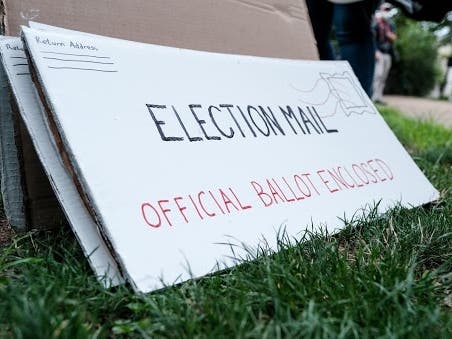
ACROSS FLORIDA — More than 500,000 mail-in ballots went uncounted during the 2020 primary season nationwide, many of them because they were deemed incomplete or because they arrived too late.
During the presidential primary election in Florida in March, 18,504 mail-in ballots were not counted toward the overall results of the election, according to an analysis by HealthyElections.org.
The March primary had a low turnout in Florida due to the coronavirus. The issue could grow for the general election as more Floridians stay away from the polls due to coronavirus concerns and opt to cast their ballots by mail.
Find out what's happening in Tampafor free with the latest updates from Patch.
To help ensure your vote is among those counted in Florida, follow this checklist:
- In Florida, a request for a vote-by-mail ballot may be made in one of the following ways:
- Online application on your county supervisor of elections' website;
- By other writing (email, fax, mail) to the supervisor of dlections;
- In person at the supervisor of elections;
- By telephone call to the supervisor of elections.
- The deadline to request that a vote-by-mail ballot be mailed is no later than 5 p.m. on the 10th day (Oct. 24) before the election. The supervisor of elections must mail the ballot out within two business days after a request and the last day for a supervisor to be able to mail out a ballot is eight days before the election. Ballots mailed after this date will not be counted.
- Voters can pick up their own vote-by-mail ballots at any time once the ballot becomes available, including Election Day. A voter's designee can pick up a ballot but no earlier than nine days before Election Day. A designee is limited to picking up vote-by-mail ballots for two other voters per election (not including their own ballot and the ballots for immediate family members). The designee must submit an affidavit to pick up the voter’s blank ballot.
- Instructions are included with the vote-by-mail ballot. If the voter decides to go to the polls to vote, the voter should bring the vote-by-mail ballot (marked or not). The vote-by-mail ballot will be canceled and the voter can vote a regular ballot at the polls. If the voter comes to the polls without the vote-by-mail ballot, the voter can vote a regular ballot if the supervisor of elections' office can confirm that it has not received the voter's vote-by-mail ballot. If it is confirmed that the supervisor of elections office has already received the voted vote-by-mail ballot or it cannot be determined, the voter cannot vote a regular ballot at the polls. However, if a voter believes that he or she has not already voted, he or she shall be allowed to vote a provisional ballot.
- A returned voted ballot must be received by the supervisor of elections’ office no later than 7 p.m. on Election Day. Other return options are available for Military and Overseas Voters under certain circumstances. The United States Postal Service recommends that domestic nonmilitary voters, mail back their voted ballots at least one week before the Election Day deadline to account for any unforeseen events or weather issues. The Federal Voting Assistance Program provides recommended earlier timelines for absent military and overseas voters.
- Vote-by-mail ballots may also be returned at secure drop boxes at Supervisor of Elections' main and branch offices and early voting sites in your county. Contact your supervisor of elections office or visit its website for the location of all vote-by-mail ballot secure drop boxes in the county.
With guidelines changing in many states, more than 80 percent of all American voters will be eligible to receive a ballot in the mail for the 2020 election, by far the most in U.S. history.
Find out what's happening in Tampafor free with the latest updates from Patch.
That’s a result of 20 states loosening vote-by-mail laws this year due to the pandemic. As of Aug. 25, data from The Washington Post indicates 100 million people will be eligible to vote by mail either with no “excuse” or citing fears of the coronavirus as a reason. Among them, 51 million people will be automatically sent a ballot in the mail and 44 million people sent an application for a mail-in ballot.
Only six states still require a valid excuse other than coronavirus fears to vote absentee. Five states had already conducted elections solely by mail even before the pandemic.
But will your vote actually count?
In the primary election, a study by the Post showed 534,731 ballots were nixed in 23 states, and NPR found even more — 558,032 in 30 states — in a similar study. In New York City alone, more than 84,000 mail-in ballots were tossed and lawsuits were filed over the legitimacy of the outcomes of some close races.
Millions of people will cast their ballots by mail for the first time in the 2020 general election. Pew Research numbers show the number of people who vote by mail had already been on a sharp increase for years. In 2016, more than 20 percent of voters nationwide voted by mail, a total of about 27 million.
Of the 14.6 million votes cast by mail in the 2016 and 2018 general elections, officials found just 372 possible cases of double voting or voting on behalf of deceased people, according to Electronic Registration Information Center data analyzed by the Post. That equates to a 0.0025 percent fraud rate. The Brennan Center for Justice has described vote-by-mail fraud as “infinitesimally small.”
Why are people concerned about a legitimate election with so few documented cases of actual fraud?
Partly, it’s problems with the U.S. Postal Service. But equally troublesome are problems that exposed themselves during the primaries. The Post data shows more ballots were rejected in 23 states than the number of absentee ballot rejections reported in the 2016 general election nationwide, in large part because of mistakes in filling out the ballots.
That means a lot more opportunities for inexperienced mail-in voters to make mistakes — which Daniel A. Smith, a political science professor at the University of Florida, says could pose a significant problem in the rejection rate come November.
“Experience matters,” Smith told the Post. “If you lack experience voting by mail, the odds of you casting a ballot that doesn’t count will go up.”
To make sure your ballot is counted:
- Register to vote: In most states, you can do that online.
- Follow directions: "If it says fill in the oval, fill in the oval," Amber McReynolds of the National Vote at Home Institute told NPR.
- Send it back: Make sure to mail in your ballot well ahead of the deadline.
President Donald Trump, who voted by mail in the Florida primary and praised his home state’s absentee voting system, has often said — with no supporting data — that the upcoming election will be the “most rigged” in American history due to the amount of mail-in ballots expected to be cast.
Legal cases are ongoing involving the Trump administration and several states over mail-in voting.
Charles Stewart III, a political science professor at the Massachusetts Institute of Technology, said if the election between Trump and Democratic challenger Joe Biden is close, the mail-in ballots will create “a mess.”
“The two campaigns will be arguing over nonconforming ballots, which is going to run up against voters’ beliefs in fair play,” Stewart told the Post.
There’s also growing concern over the governmental entity tasked with handling the influx of mail-in ballots.
Under Trump, the Postal Service has come under fire for increasingly slow service, mail backlogs and planned changes that some have feared will have an effect on their ability to handle the expected massive increase of mail-in ballots this year.
Postmaster General Louis DeJoy told senators on Capitol Hill in recent testimony he was unaware of certain changes at the Postal Service until they caused a public uproar. But he also said there are no plans to restore mailboxes or high-speed sorting machines that have been removed. His testimony raised fresh questions about how the Postal Service will ensure timely delivery of ballots for the November election.
The Associated Press contributed reporting to this story.
Get more local news delivered straight to your inbox. Sign up for free Patch newsletters and alerts.