Neighbor News
Where Does Tampa Bay Hurt? Local Pain Map Reveals a Surprising No. 1
Tampa pain-management physician Dr. Myrdalis Díaz-Ramírez asked residents to show where they hurt. The results reveal pain from head to toe.


Where does Tampa Bay hurt? Well, the answer, it turns out, is: "pretty much everywhere."
Throughout September, Tampa pain-management physician Dr. Myrdalis Díaz-Ramírez invited local residents to anonymously mark where they experience pain as part of “Where Does Tampa Bay Hurt?”, an interactive community pain map created for Pain Awareness Month.
On Friday, Sept. 25, Díaz-Ramírez revealed the results live on her social media, and the most commonly reported area wasn’t the back, hips or knees. It was the head.
Head pain accounted for 16 percent of all pain points marked on the map, making it the No. One response. Lower back, hip and knee pain tied for second at 14 percent each. Neck pain followed at 12 percent, with upper back pain at 11 percent, shoulders at 10 percent, feet at 6 percent and hands at 3 percent.
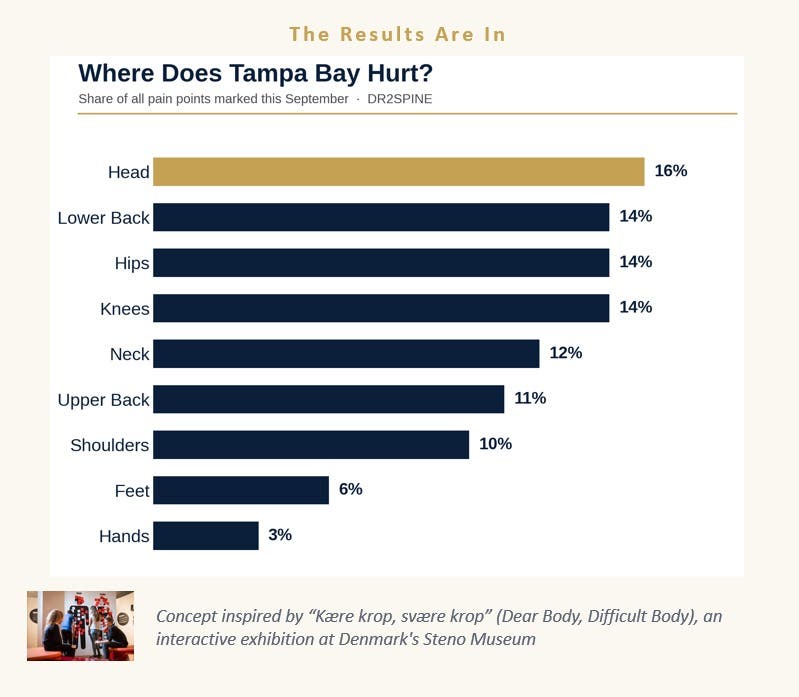
“I expected certain areas of the body to dominate the map, but the number one response surprised me,” Díaz-Ramírez said. “The results also showed just how widespread pain is. Tampa Bay really does hurt from head to toe.”
Find out what's happening in Tampafor free with the latest updates from Patch.
Pain can be incredibly isolating’
Díaz-Ramírez, a double board-certified physician in anesthesiology and pain medicine and founder of DR2SPINE in Tampa, launched the project earlier this month to encourage people to talk about something that can often be difficult to see: chronic pain.
The interactive project asked participants to mark the area where they experience pain on a human figure. Responses were anonymous and combined to create a snapshot of where participants reported hurting. The project was designed as a community art and education initiative, rather than a scientific survey, and its results are not intended to represent the entire Tampa Bay population.
“Pain can be incredibly isolating because you can’t always see it,” Díaz-Ramírez said when the project launched. “We wanted to give people a way to show us where they hurt and, hopefully, remind them that they’re not alone.”
Find out what's happening in Tampafor free with the latest updates from Patch.
Starting a Conversation About Pain
The results also illustrate how broadly pain can affect the body. While back pain is often associated with chronic pain, participants reported problems ranging from headaches and neck pain to discomfort in their hands and feet.
Díaz-Ramírez has spent more than 25 years treating patients with chronic pain. She said one goal of the project was to encourage people not to simply accept persistent pain as something they have to live with.
“People can live with pain for years without really talking about it,” Díaz-Ramírez said. “Sometimes we accept it as part of getting older or something we simply have to push through. I want people to know that pain deserves a conversation.”
The “Where Does Tampa Bay Hurt?” project was inspired by Hjerterummet, part of the Kære krop, svære krop(“Dear Body, Difficult Body”) exhibition at the Steno Museum in Aarhus, Denmark. The original installation invited visitors to reflect on and share their relationships with their bodies. The Tampa Bay project is an independent adaptation and is not affiliated with or endorsed by the Steno Museum or Rosan Bosch Studio.
For Díaz-Ramírez, the map’s value is about making pain visible and starting conversations about when persistent pain warrants medical attention and what treatment options may be available.
“Pain is personal, but it is also something millions of us share,” Díaz-Ramírez said. “If we can get Tampa Bay talking about it, we’ve already taken an important first step.”