Schools
Canterbury Expands Mandarin Chinese
The St. Pete prep school strengthens its language studies, with Mandarin Chinese offered at all grade levels: pre-K through high school.
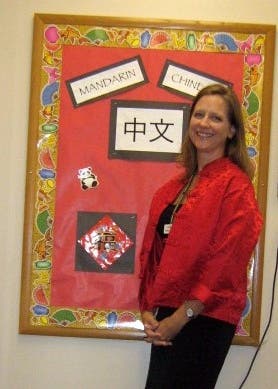
ST. PETERSBURG – At the beginning of the Mandarin Chinese class, the fifth-graders called out, "Ni Hao," or "Hello!" to greet a classroom visitor.
This group of students took Chinese last year, when it was first introduced at . They are a little restless, as they arrive from physical education class for their last class of the day.
"Ting," said teacher Nicole St. Leger, as she raised her fingers in the air. Her command to "Listen!" in Chinese gets their attention, and the room quiets down.
Find out what's happening in St. Petefor free with the latest updates from Patch.
St. Leger begins class by reviewing tones. She repeats the Chinese words, "ma," "maa," "maaa." While it sounds almost the same to a visitor, the students know the difference. The extra emphasis on the "a" sound changes it to a different word.
"We all realized we would be in trouble if we called our mom a horse," said St. Leger, as she explained the first sound was the word, "horse," and not "mama."
Find out what's happening in St. Petefor free with the latest updates from Patch.
St. Leger is passionate about teaching Mandarin Chinese. Her two oldest kids attend Canterbury. When she first heard the private school was considering adding the class to its International Studies curriculum, her response was immediate.
"I thought I'd be on a committee, or something, then I ended up teaching it," she said with a laugh.
Her educational background made her the perfect candidate to teach.
St. Leger earned a degree in International Studies, specializing in East Asian Studies at George Washington University. She also has minors in Chinese Language and Literature and in Economics.
She worked at the Smithsonian, volunteering in the Freer-Sackler Library, the museum's Asian art resource library. Her daily work and social life required that she speak Chinese.
"At one point, I would dream in Chinese," said St. Leger.
Canterbury researched the best ways to introduce the language to their students. They examined the benefits of introducing the language one year at a time or offering it to all the grade levels at once. Last year, the school decided to offer the language at pre-kindergarten through sixth grade.
This year, the school expanded the course to 7th grade and made it an option for 8-12 grades. Chinese is being introduced in 7th grade, so 8th-graders can choose the language for their high school language credit.
Canterbury requires its high-school students to complete three years of language, one additional year than required at public schools.
St. Leger believes that all students should have the option of taking Chinese.
"One in four people on the planet right now speaks Chinese," said St. Leger.
With those statistics, St. Leger says the students' future will require knowledge of Chinese, in their educational, social or business life.
St. Leger says the language is rich in meaning, not only of the words communicated but also of the history and culture.
"Good means both woman and child. Why? In history, what was considered a good life? Marrying, having a good wife... How did you make an income? It was mostly through farming, so how did you work your farm? By having lots of kids who would farm," said St. Leger.
She also studies the latest research about the Chinese language and its benefits.
In England, one study looked at how people process their own language. As people listened to their native languages, a brain scan showed what parts of the brain processed the sounds into words. The scan on Mandarin Chinese speakers showed both temporary lobes lit up, as both the left and right brain are stimulated to learn the language.
A study at Indiana University showed the benefits of the written language on brain development.
Since Chinese characters require writing in left, right, up and down movements, both sides of the brain are stimulated. The order of strokes in the written language also increased the ability to group or sort, relating to math skills.
St. Leger teaches the language through games, a way to avoid the dread she experienced in high school Spanish class.
"It's important to me that they enjoy learning. We'll do hopscotch...rock, paper, scissors, and it clicks," said St. Leger.
She presents the concepts in as many ways as possible, not to drill it into their minds, but to offer options for everyone to learn in the way they do best.
"Some people learn by listening. Others from telling someone else. Some one else learns from reading," said St. Leger.
A fun curriculum doesn't translate to lax. She's strict on the tones and practicing but also wants the students to enjoy the journey.
"I want them to know they can do it. They can learn this," said St. Leger.
Her room is decorated with word cards depicting the Chinese symbol and its translation.
The purpose is to make the symbols familiar to the kids, even before they actually learn writing. It's another way to introduce the language into their life.
The bell signals the end of the school day. St. Leger assigns homework: a page of practicing Chinese symbols. The kids tell her, "Zai Jian," or goodbye, before taking their handout.
"I tell them, practice makes progress," said St. Leger.
The traditional phrase of practice makes perfect doesn't apply in her classroom. She wants the students to love the process of learning, which will translate into the confidence and joy in learning the language.
For more information on Canterbury of Florida School or its Mandarin Chinese class, visit their International Studies website, or call (727) 525-1419.