Neighbor News
The Florida Sun is Changing: Why We’re Seeing a Melanoma Spike in 20-year-olds
Historically, melanoma, the deadliest form of skin cancer, has been viewed as a disease that affects older adults. That's quickly changing.


The Florida sun is an undeniable part of life here in St. Petersburg. We pride ourselves on our active, outdoor lifestyle — from weekend trips to Pass-a-Grille to afternoon runs along the Downtown waterfront.
But as a dermatologist practicing right here in St. Pete, I’m noticing a deeply unsettling trend in my clinic this summer.
Historically, melanoma — the deadliest form of skin cancer — has been viewed as a disease that affects older demographics after a lifetime of accumulated sun damage. Today, that narrative is completely breaking down. Over the course of this grueling summer heatwave, my clinic has seen an unprecedented influx of melanoma diagnoses in patients in their 20s and 30s.
Find out what's happening in St. Petefor free with the latest updates from Patch.
Even for a specialized practice in the Sunshine State, this represents a stark statistical anomaly. If you are a young adult living in Florida, the old rule of thumb of waiting until your 40s or 50s to start worrying about skin cancer no longer applies.
Here is what is driving this early-onset spike, and the non-negotiable rules for protecting your skin in the modern Florida climate.
Find out what's happening in St. Petefor free with the latest updates from Patch.
The Perfect Storm: Why Young Adults Are at Risk
Why are we seeing this shift now? It comes down to a combination of demographics, history, and our current environment.
- The St. Pete Influx: St. Petersburg has welcomed thousands of young professionals and families moving from northern states over the last few years. Many of these new residents are unaccustomed to the sheer velocity of the Florida sun, which burns much faster and harsher than UV rays up north.
- The Tanning Bed Hangover: Today’s 20- and 30-somethings grew up during the peak popularity of indoor tanning beds in the 2000s and 2010s. UV radiation from tanning beds is a known carcinogen, and the cellular damage can take 10 to 15 years to manifest as a visible skin cancer.
- Record-Breaking Heat: With local heat indexes reaching historic highs, our skin is facing more intense, sustained radiation during outdoor social hours, beach days, and outdoor markets.
4 Non-Negotiable Skin Rules for Florida 20 & 30-Somethings
To protect yourself without sacrificing your outdoor lifestyle, you need to upgrade your sun defense toolkit.
Not all sunscreens are created equal. You must look for the words “Broad-Spectrum” on the label, which ensures the formula protects against both UVA rays (which cause aging and cancer) and UVB rays (which cause burning). If you are sweating or swimming, reapplication every two hours is mandatory — no exceptions. Mineral sunscreens, like those with Zinc Oxide, typically work better than chemical sunscreens.
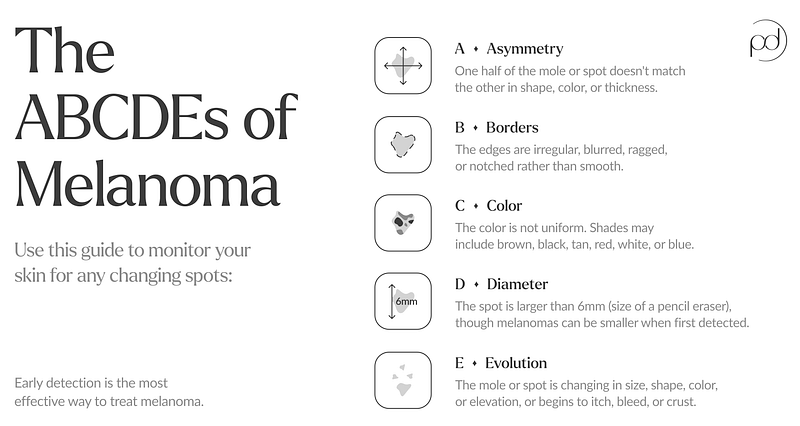
2. Learn the ABCDEs of MelanomaBecause melanoma can grow aggressively in younger skin, you should perform a self-check once a month. Look for any mole or spot that displays the following:
- A — Asymmetry: One half of the spot does not match the other.
- B — Border: The edges are irregular, ragged, or blurred.
- C — Color: The color is not uniform; it may have patches of pink, red, white, blue, or varying shades of brown/black.
- D — Diameter: The spot is larger than 6 millimeters across (about the size of a pencil eraser), though melanomas can sometimes be smaller.
- E — Evolving: The mole is actively changing in size, shape, color, or is newly bleeding or itching.
There is no such thing as a “healthy tan.” A tan is a cellular distress signal; it is your skin producing melanin in a desperate attempt to protect damaged DNA from further radiation. If you want a summer glow, opt for high-quality sunless tanning drops or sprays instead.
4. Schedule an Annual Professional Skin CheckIf you used tanning beds in your youth, have a family history of skin cancer, or have a large number of moles, you are “too young” to skip the dermatologist. A trained eye using a dermatoscope can spot microscopic changes in a mole long before it becomes an obvious problem.
Prioritizing Your Health This Summer
Enjoying everything St. Pete has to offer shouldn’t come at the cost of your health. Melanoma is highly treatable when caught early, but it requires us to shift our mindset and realize that youth is not a shield against skin cancer. Pay attention to your skin, watch for changes, and respect the Florida sun.
About the Author: Dr. Neha Chandan, MD, MPH, is a board-certified dermatologist and Mohs Surgeon at Prime Dermatology in St. Petersburg, Florida. She combines clinical expertise with a passion for public health to help the Tampa Bay community maintain healthy, beautiful skin. If you are overdue for a skin cancer screening or notice an evolving spot, schedule a consultation with Prime Dermatology here.