Business & Tech
Green Alternative to Cremation
A St. Pete funeral home is the first on this continent to introduce an alternative to cremation that chemically breaks down the body.
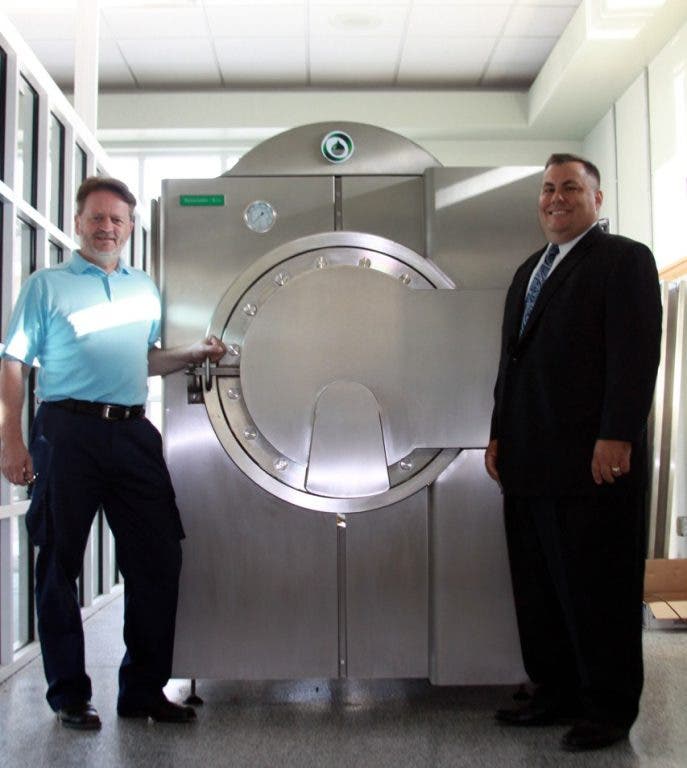


ST. PETERSBURG – The traditional methods for disposing of human remains are to bury or burn.
Now Anderson-McQueen in St. Petersburg is about the introduce a third: Resomation.
This month the 60-year-old St. Petersburg funeral home will be the first in North America to use a pioneering technique developed by a Scottish biochemist that is gaining recognition as environmentally friendly.
Find out what's happening in St. Petefor free with the latest updates from Patch.
Dubbed "Resomation," the process involves using a mixture of water and potassium hydroxide while increasing the air pressure inside a steel chamber to chemically break down the body.
The result is a small amount of sterile liquid and soft bones that are crushed and placed in an urn for loved ones.
Find out what's happening in St. Petefor free with the latest updates from Patch.
There is no fire, ashes, smoke or pollutants, as there is with cremation.
The new alternative can reduce a funeral home's greenhouse gas emissions by as much as 35 percent, end mercury emissions into the air from burning tooth fillings, and remove DNA traces from wastewater.
The process takes approximately 2-3 hours, which is about the average time of a traditional cremation.
Resomation was invented by biochemist Sandy Sullivan, who is assisting Anderson-McQueen in the start up.
Sullivan's Resomation, Ltd. has been developing the system since 2007, and it is distributed by Matthews Cremation of Orlando. Sullivan has a patent pending on the process.
Chambers sell for approximately $400,000 and the cost to clients is slightly more than a typical cremation.
Nikki McQueen, vice president of Anderson-McQueen, offers insight into the cutting-edge process.
Q: Why the move to the new technology?
A: We've always been a leader in the funeral industry throughout the nation so we wanted to take this step forward. It's a huge commitmen,t but we felt it was worthwhile and something we wanted to bring to the community.
Q: You are the first in the U.S. to offer it to the public?
A: Currently we're the only one in the world that has this Resomation unit. The alkaline hydrolysis process has been in use by the University of Florida and the Mayo Clinic for some years. This is the first time it's being offered to the public. Behind us the next funeral home to offer this will be Bradshaw Funeral Home (in Minnesota) late this year.
Q: What approvals were you required to abide by?
A: We had to go through the State of Florida for approval as a form of cremation then we had to go through local authorities for the permitting process. We also had to add to our existing cremation tribute center to house some of the equipment.
Q: How is the preparation different?
A: In traditional flame cremation anything like pacemakers could explode. It's very dangerous for the crematory operator. In this case they do not have to be removed ahead of time.
Q: What is the dress code?
A: With flame [cremation] the deceased can wear clothing and with Resomation they must be in 100 percent silk. All the materials have to be green (environmentally speaking). There is also a container that goes in the unit made of cornstarch.
Q: The family receives the traditional urn?
A: That's been the question families have asked: Am I still going to get back cremated remains? They do get the remains back in an urn. Typically it can be about 20 percent more [ashes].
Q: What was the motivation to bring the technology to St. Petersburg?
A: At Anderson-McQueen we have 60 years of serving the St. Petersburg community. One thing with cremation, it's been around for so long but there's never been a choice. When the opportunity came and Matthews asked us to partner in the first one, we wanted to give St. Petersburg and the surrounding areas this choice.
Q: Has there been a demand for "green" cremation?
A: Families have asked about it. When the opportunity came to be able to offer something they say leaves less of a carbon footprint, we wanted to be able to provide for families that wanted that service.