Health & Fitness
Sustainable Tarpon Springs - Earthships!
An invitation to be part of a 'Conversation and Action Network' of friendly folks with a vision to see a 'greener' and more Sustainable Tarpon Springs.



For anyone who loves the concept and reality of sustainable living, building an ‘off-the-grid’ home is the ultimate dream. I dreamt about it for many years before I accepted we could do everything else as sustainably possible until totally off-grid living manifested in our lives.
I first heard the term ‘Earthship’ when I was visiting The Farm in Summertown, Tennessee, during my sabbatical in 2006 with my friend, Jill. We visited The Farm’s Eco-Village Training Center to take a class in mushroom cultivation and to learn about natural building techniques, meeting students and interns from all over the world who were studying sustainability.
Find out what's happening in Tarpon Springsfor free with the latest updates from Patch.
While we were enjoying fresh peppermint tea with a young architect from Vienna, we asked what her favorite natural building design was. Without an instant of hesitation she beamed, ‘Oh, the Earthship is, by far, the best!’
Find out what's happening in Tarpon Springsfor free with the latest updates from Patch.
‘Earthship?’ We hadn’t seen one or even heard about them up till then. The young woman described them to us, and we were eager to get more information. When Jill and I got back to Memphis, we had some time before we caught our homebound train. We ended up at the library, starting to research the intriguing new term we’d learned - Earthship.
The more I learned, the more I yearned to see one for myself. Later that same year, I extended a business trip in Colorado Springs by dropping down to Taos, New Mexico, to visit the Greater Earthship Community and take their introductory week-end seminar.
The Earthship concept is an extension of a traditional passive solar ‘high thermal mass’ design, where a building is constructed partially underground with the north side completely bermed with earth. The south side is mostly glass, designed so the low light of winter will completely fill the depth of the rooms and bring warmth into the structure, while the higher summer sun only comes in as far as the front of the rooms, mostly only into the greenhouse area.
The difference in Michael Reynold’s Earthship design is that the outer walls (or long ‘U’ structure) is built with old tires that are tightly rammed with earth. These are naturally plastered over with an adobe-like mud, and the inner living space is built within the outer ‘U’. Reynold’s designs also incorporate the greenhouse and rain harvesting system into the house.
The house is ingeniously designed for maximum air-flow, so when we entered a closed home, vents in the ceiling were opened and vents along the bottom of the ‘greenhouse’ windows were cracked, which instantly changed the temperature of the house through convection.
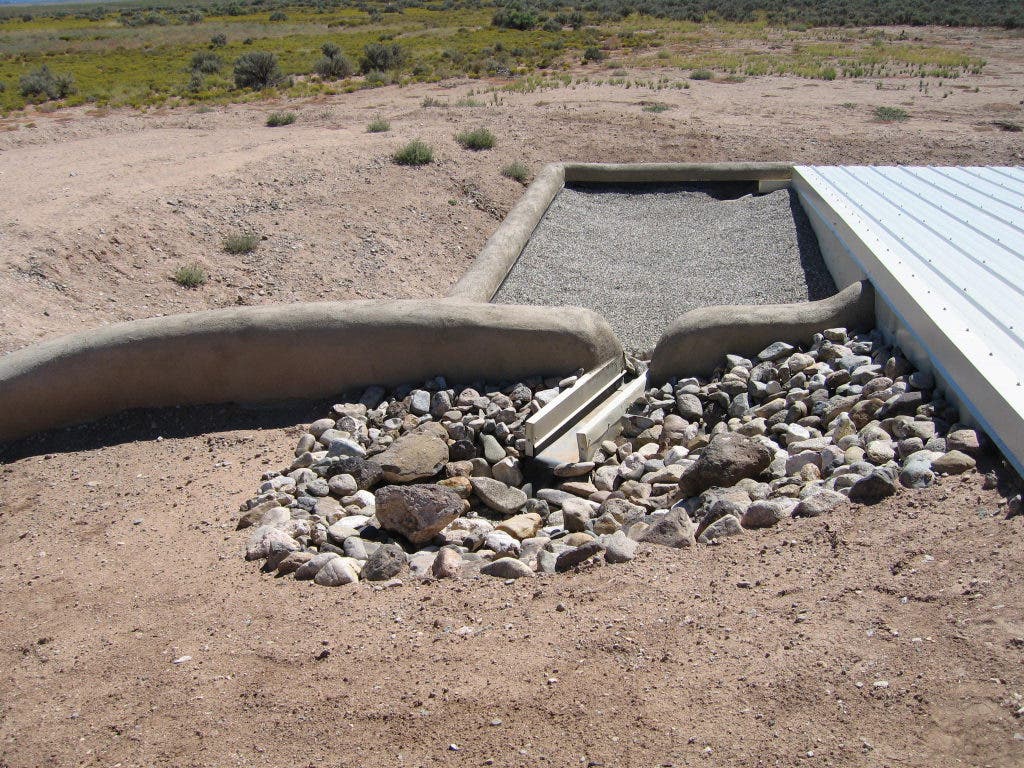
The entire roof is a water catchment system, so even in an area like Taos that only receives 8” - 12” of rain per year, rain flows to either end of the building through a series of natural filters, into bermed cisterns whose size is dependent upon the number of people intended to live there.
The water from dish washing, laundering, and bathing circulates into the botanical cells where plants are grown in the ‘greenhouse’ along the south windows. We saw banana trees, tomato plants, and other edibles and herbs growing indoors in most of the homes.
After this gray water has been twice used, it ends up in the toilet. There are several ways the waste water can be directed, (depending upon the rules of one’s municipality.) Even in the Greater Earthship Community (around 60 homes), some have composting toilets, and others are directed in a way for solids to be contained, naturally treated in a similar fashion to a wetland, then water is leeched into outside botanical cells for more food growing.
All power in the house is from solar, converted and stored in battery banks. The system is called a POM or Power Organizing Module. The land is excavated and the homes are built using the POM that will eventually be used to power the house.
Hot water is both heated by solar or using an on-demand hot water heater (very localized, with no water wasted in heating). When we stayed in an Earthship, it was quite an amazing treat to shower using soft rainwater.
It is actually necessary for these homes to function with people using the water regularly in order for the plants to be watered. Second homes are often rented out when they aren’t occupied by the owners, or they become a place for interns to stay in order to keep the symbiotic flow going! One has the feeling of complete integration with this ‘living home’.
The on-demand water heater, stove, refrigerator, washer and dryer are run on propane, although Michael Reynolds is still trying to figure out ways to eliminate even this annual expense. They are also extensively experimenting with biodiesel as a fuel option.
(In my personal dream, I envision a whole community powered by collective waste processed in a methane digester, much the way modern local dairies are capturing and using methane to power their facilities without impacting the environment.) That is the ultimate poo-power!
I am hardly able to scratch the surface of the genius of the Earthship in a short blog, so please, check out http://earthship.com or http://earthshipbiotecture.com for more complete information and visit the gallery of these beautiful homes. If you are as intrigued as I was, go visit the Greater Earthship Community and rent one for a weekend. You will never view conventional homes as practical again. This is the future; we just don’t know it yet!