Community Corner
Can PRP Help a Receding Hairline or Widening Part? What Jupiter Patients Should Know
Refresh explains how PRP hair restoration supports weakened, still-active hair follicles rather than replace follicles no longer functioning
This is a paid post contributed by a Patch Community Partner. The views expressed in this post are the author's own, and the information presented has not been verified by Patch.
Can PRP help a receding hairline or widening part? For some patients with early-to-moderate hair thinning, platelet-rich plasma may help support existing follicles, reduce shedding and improve hair density over time. Refresh - Aesthetics & Wellness explains what patients in Jupiter, Palm Beach Gardens, Tequesta and throughout Palm Beach County should know before starting treatment.
Hair loss does not always begin with obvious bald spots.
For many people, the first signs are much more subtle: a hairline that seems slightly farther back, more scalp showing through a part, a ponytail that feels thinner or less density around the crown.
Those early changes are often when patients begin asking:
Can PRP actually help before my hair loss gets worse?
Platelet-rich plasma hair restoration is a non-surgical treatment that uses concentrated components from the patient's own blood and places them into areas of the scalp where follicles are thinning or producing weaker hair.
At Refresh - Aesthetics & Wellness, PRP Hair Restoration may be considered for early-to-moderate thinning, receding hairlines, widening parts, reduced density and pattern hair loss when follicles are still active.
Why Does a Receding Hairline or Widening Part Happen?
Hair thinning can develop for many reasons, and identifying the pattern matters before choosing treatment.
One of the most common causes is androgenetic alopecia, commonly called male or female pattern hair loss.
In men, this may appear as:
- A receding hairline
- Thinning at the temples
- Reduced density at the crown
- Progressive thinning across the top of the scalp
In women, the pattern may look different.
Common signs can include:
- A widening center part
- Greater visibility of the scalp
- Reduced overall density
- Thinner hair through the crown
- A smaller-feeling ponytail
Hair shedding can also be influenced by hormonal changes, stress, pregnancy, nutritional issues, medications, illness and other medical factors.
That is why hair restoration should begin with an evaluation rather than assuming every patient has the same type of hair loss.
What Is PRP Hair Restoration?
PRP stands for platelet-rich plasma.
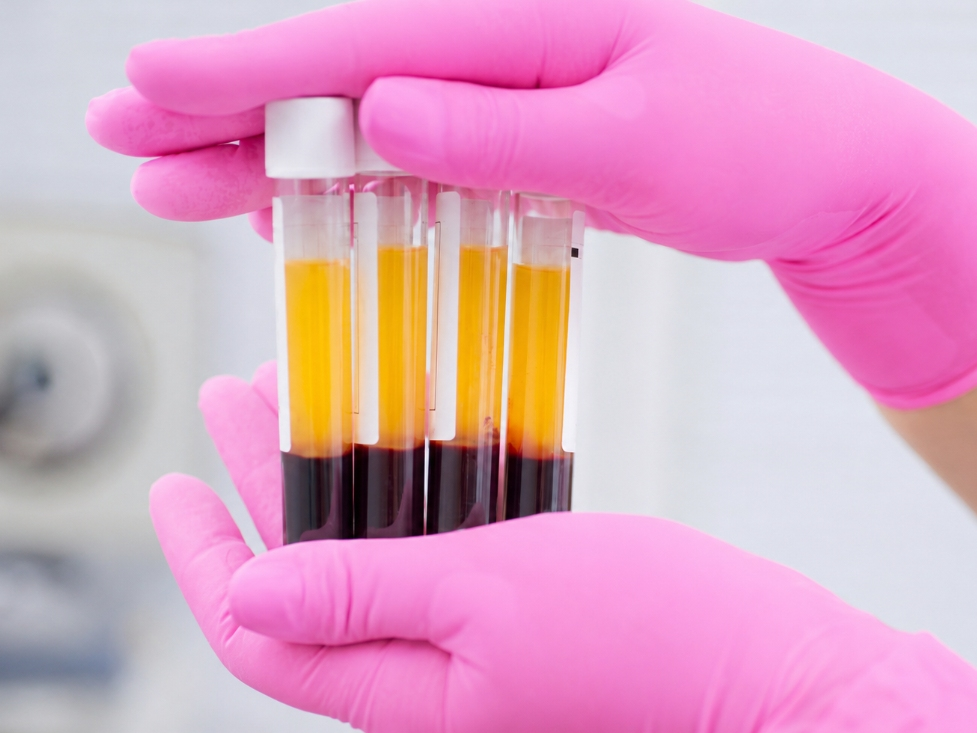
Treatment begins with a small blood draw, similar to routine laboratory testing.
The blood is then placed in a centrifuge, which separates and concentrates the platelet-rich portion from the other components.
That concentrated PRP contains platelets and growth factors naturally found in the patient's own blood.
The PRP is then injected into targeted areas of the scalp at the level of the hair follicles.
At Refresh, the goal is to support follicles that are still present but have become miniaturized, weakened or less productive because of thinning.
Learn about PRP Hair Restoration
How Can PRP Help Thinning Hair?
Hair follicles naturally cycle through different phases of growth, transition and rest.
With pattern hair loss, follicles can gradually become smaller and begin producing thinner, shorter hairs.
Over time, those hairs may become less visible and overall density can decline.
PRP is used to support the follicle environment by delivering concentrated platelet-derived growth factors into areas of thinning.
For an appropriate patient, treatment may help:
- Support healthier follicle function
- Improve the quality of existing hair
- Reduce noticeable shedding
- Support a longer growth phase
- Improve the appearance of density over time
PRP does not create entirely new follicles.
Its greatest potential is generally in areas where follicles are still present and capable of responding.
Why Earlier Treatment Can Matter
One of the biggest misconceptions about hair restoration is that patients should wait until their hair loss becomes severe before seeking treatment.
With PRP, the opposite may make more sense.
The treatment relies on existing follicles.
A follicle that has become weaker or miniaturized may still have the ability to respond.
An area that has been completely bald for a long period may be much less likely to respond because there may no longer be a viable follicle to stimulate.
That makes early changes worth paying attention to.
If you are beginning to notice:
- A widening part
- Greater scalp visibility
- Receding temples
- Reduced density
- More hair in the shower
- A noticeably thinner ponytail
it may be useful to have the scalp evaluated before the thinning becomes more advanced.
Can PRP Help a Receding Hairline?
It depends on the condition of the follicles.
A receding hairline caused by pattern hair loss may contain follicles that have gradually become smaller and weaker.
If those follicles are still active, PRP may be incorporated into a treatment plan designed to support their health and improve the quality of the hair they produce.
However, PRP cannot guarantee that a significantly receded hairline will return to its original position.
Areas that have been completely bald for a prolonged period are less likely to respond.
This is why patients should be cautious about before-and-after images suggesting that PRP can recreate an entirely new hairline in everyone.
Can PRP Help a Widening Part?
A widening part is one of the most common ways women notice early hair thinning.
Instead of losing all the hair from one specific area, individual strands may gradually become finer and overall density decreases.
That allows more scalp to become visible through the part.
When follicles remain active, PRP may help support thicker, healthier hair growth over time.
The goal is not to fill the scalp instantly.
Hair growth is a slow biological process, so any improvement in density develops gradually.
Can PRP Wake Up Dormant Hair Follicles?
The word “dormant” can be misleading.
PRP may support follicles that are weakened, miniaturized or still biologically active but producing poor-quality hair.
It is much less likely to regenerate hair in an area where follicles have been permanently lost.
This distinction matters.
A patient with early thinning and visible miniaturized hair may be a very different candidate from someone who has had a smooth, completely bald area for many years.
A scalp evaluation helps determine whether there is enough active follicular function for PRP to make sense.
.png)
What Happens During a PRP Hair Appointment?
At Refresh, the process generally involves several steps.
First, the provider evaluates the scalp, hair density, pattern of thinning and relevant medical history.
A small amount of blood is then drawn from the patient's arm.
The blood is processed in a centrifuge for approximately 10 to 15 minutes to isolate and concentrate the platelet-rich plasma.
A topical numbing option may be used before treatment.
The PRP is then injected into the areas of the scalp showing thinning or reduced density.
The injection portion generally takes approximately 20 to 30 minutes, depending on the area being treated.
Because PRP comes from the patient's own blood, there is no foreign filler material being added to the scalp.
Does PRP Hair Restoration Hurt?
Most patients describe the treatment as a series of small pinches or pressure across the scalp.
The scalp contains many nerve endings, so some areas may feel more sensitive than others.
A topical numbing option is typically used to improve comfort.
Tenderness may continue briefly after treatment, but most patients do not require significant recovery time.
Is There Downtime After PRP Hair Restoration?
Downtime is generally minimal.
Patients may temporarily experience:
- Scalp tenderness
- Mild redness
- Minor swelling
- Sensitivity at injection sites
- Small areas of pinpoint bleeding
These effects commonly improve within a short period.
Most patients can return to their usual daily activities relatively quickly, although post-treatment instructions should be followed carefully.
How Many PRP Hair Treatments Are Needed?
PRP hair restoration is usually approached as a series rather than a single treatment.
At Refresh, the exact number of sessions and spacing are customized according to the patient's degree of thinning and response.
An initial series may involve treatments separated by several weeks, followed by periodic maintenance.
The appropriate schedule can depend on:
- Type of hair loss
- Amount of thinning
- Follicle health
- Age
- Hormonal factors
- Treatment response
- Other hair-loss therapies being used
There is no universal number that guarantees the same result for every patient.
When Will I Notice Less Shedding?
Hair does not respond on the same timeline as an injectable wrinkle treatment or facial.
The biological process is much slower.
Some patients begin noticing reduced shedding or improved hair quality within a few months.
That may be one of the earliest indications that the treatment is having an effect.
However, patients should not expect to see dramatically thicker hair several days after treatment.
When Does New Density Become Visible?
Changes in visible density generally take longer.
Hair needs time to progress through its natural growth cycle and produce strands that are long enough to become noticeable.
More visible improvement may develop gradually over a series of treatments and the months that follow.
Progress can be difficult to judge day to day, which is why standardized photographs can be useful.
Comparing photos taken several months apart under similar lighting and angles can provide a clearer picture than looking in the mirror every morning.
Is PRP Better for Men or Women?
PRP hair restoration can be considered for both men and women.
The pattern of hair loss may be different, but the underlying goal is similar: support follicles that are still active and producing progressively weaker hair.
Men may seek treatment for receding temples or crown thinning.
Women may be more likely to notice a widening part or diffuse reduction in density.
What matters most is not gender alone but the cause, stage and pattern of the hair loss.
What About Stress-Related or Postpartum Shedding?
Not all hair loss is permanent pattern thinning.
Stress, illness, pregnancy, hormonal shifts and other major changes can sometimes trigger a temporary increase in shedding.
Refresh includes postpartum and stress-related shedding among the concerns that may be evaluated for PRP Hair Restoration.
However, identifying why the shedding is happening remains important.
If an underlying medical, hormonal or nutritional issue is contributing, addressing that factor may need to be part of the overall plan.
PRP should not be used as a substitute for evaluating unexplained or sudden hair loss.
PRP vs. Hair Transplant: What's the Difference?
PRP and hair transplantation solve different problems.
PRP Hair Restoration works with follicles already present in the scalp. There are no surgical incisions or transplanted grafts.
A hair transplant physically relocates viable follicles from one area of the scalp to an area where hair has been lost.
For someone with significant permanent follicle loss, transplantation may offer an option that PRP cannot replicate.
For someone with earlier thinning and existing follicles, a non-surgical PRP approach may be worth discussing first.
PRP may also sometimes be used as supportive care around hair transplantation depending on the patient's treatment plan.
Does PRP Replace Hair-Loss Medication?
Not necessarily.
Some patients may use PRP alongside topical or oral treatments recommended by their healthcare provider.
The appropriate combination depends on:
- Type of hair loss
- Medical history
- Hormonal factors
- Current medications
- Treatment goals
Patients should not stop prescribed hair-loss medication simply because they begin PRP.
A comprehensive plan may involve more than one approach.
How Do I Know if I Am a Good Candidate?
PRP may be worth discussing if you are experiencing:
- Early-to-moderate hair thinning
- A widening part
- A receding hairline
- Reduced crown density
- Miniaturized or weakening hair
- Increased shedding
- Pattern hair loss with follicles that remain active
Patients with long-standing areas of complete baldness may be less likely to respond.
The only way to determine candidacy is to evaluate the scalp and the actual pattern of hair loss.
What Should Palm Beach County Patients Ask Before Treatment?
Patients comparing PRP hair restoration in Jupiter, Palm Beach Gardens, Tequesta, West Palm Beach or surrounding Palm Beach County communities should ask more than whether a clinic offers PRP.
Questions should include:
- What is causing my hair loss?
- Are the follicles in the thinning areas still active?
- Am I early enough in the process for PRP to make sense?
- How many treatments may I need?
- How will progress be measured?
- When should I expect to notice changes?
- Will maintenance be necessary?
- Should other hair-loss treatments be considered?
- What happens if my thinning continues?
A responsible treatment plan should begin by identifying the type and stage of hair loss.
PRP Hair Restoration in Jupiter and Palm Beach County
Refresh - Aesthetics & Wellness provides PRP Hair Restoration at its Jupiter office at:
775 W. Indiantown Road, Suite 5
Jupiter, FL 33458
The Jupiter location serves patients throughout Jupiter, Palm Beach Gardens, Tequesta, Juno Beach, West Palm Beach and surrounding Palm Beach County communities.
Hair Restoration Injections at Refresh are performed by licensed medical providers under physician oversight following an evaluation of the patient's scalp, hair density, thinning pattern and medical history.
Treatment plans are individualized based on the areas of concern, amount of existing hair, follicle activity and response over time.
Frequently Asked Questions
Can PRP regrow a receding hairline?
PRP may help support weakened or miniaturized follicles that are still active. It is less likely to restore hair in areas where follicles have been permanently lost or where the scalp has been completely bald for a long time.
Can PRP help a widening part?
It may. A widening part can result from gradual miniaturization and reduced density. If follicles remain active, PRP may help support healthier hair growth and improve the appearance of density over time.
How many PRP hair treatments do I need?
Most patients begin with a series of treatments spaced several weeks apart. The exact number and maintenance schedule depend on the type of thinning and individual response.
How long does PRP take to work for hair loss?
Hair growth is gradual. Some patients begin noticing less shedding and improved hair quality within a few months, while visible density changes generally require more time and multiple treatment sessions.
Does PRP work on completely bald areas?
PRP is less likely to work where follicles have been permanently lost. It is generally better suited to areas with thinning, weakened or miniaturized follicles that are still active.
Is PRP the same as a hair transplant?
No. PRP works with existing follicles and does not involve surgery or grafting. Hair transplantation physically moves follicles from one part of the scalp to another.
The Bottom Line
PRP Hair Restoration is not a way to create new follicles where none remain.
Its strongest role is earlier in the hair-loss process, when patients are beginning to notice signs such as a receding hairline, widening part, reduced density or increased shedding and the follicles are still capable of responding.
That is why timing matters.
For Palm Beach County patients considering PRP Hair Restoration in Jupiter or surrounding communities, the better question may not be:
“Can PRP regrow all of my lost hair?”
It is:
“Are my follicles still active enough for PRP to help preserve and support the hair I have?”
Refresh - Aesthetics & Wellness offers individualized hair restoration evaluations at its Jupiter location. Treatment recommendations are based on the patient's scalp, pattern of thinning, medical history and individual response.
This post is an advertorial piece contributed by a Patch Community Partner, a local brand partner. To learn more, click here.