Politics & Government
6-Week Abortion Ban Likely In GA If Roe V. Wade Overturned
A draft majority opinion reportedly leaked to Politico hints the US Supreme Court is about to overturn Roe V. Wade. How will that affect GA?


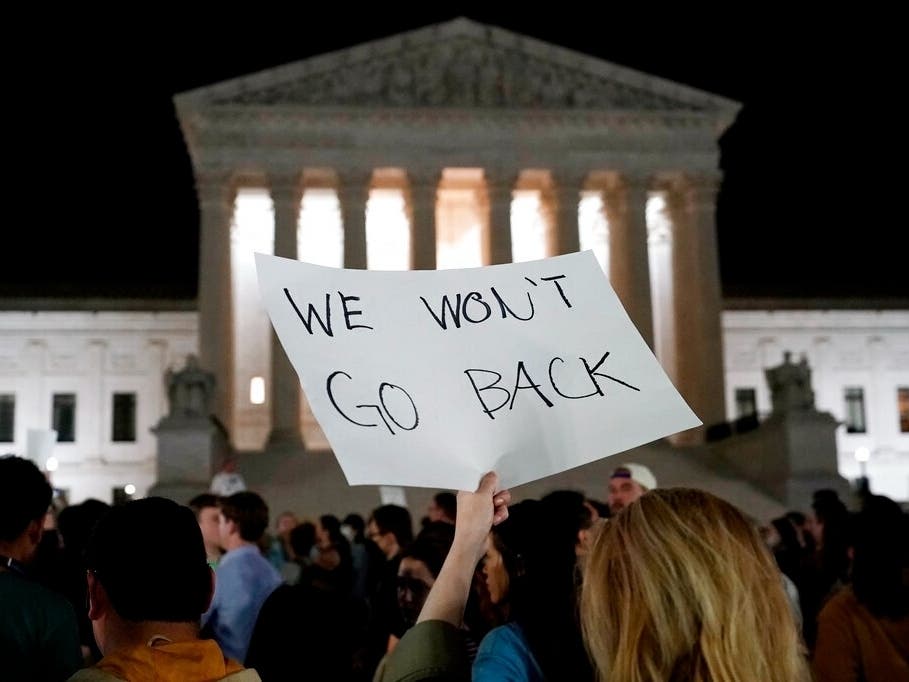
GEORGIA — If the U.S. Supreme Court acts to overturn Roe V. Wade, the landmark abortion ruling, Georgia lawmakers would likely enact a six-week ban, which would be a law prohibiting abortion after six weeks of pregnancy.
A draft majority opinion reportedly leaked to Politico suggests that the majority of the U.S. justices support overturning the federal right to an abortion, and letting states decide if access to abortion will be allowed. A final decision on the case is not expected until late June or July.
Politico reported Monday that it had obtained the draft majority opinion written by conservative Justice Samuel Alito and circulated inside the court that strikes down Roe and Planned Parenthood v. Casey, the case that affirmed a woman’s right to obtain an abortion.
Find out what's happening in Across Georgiafor free with the latest updates from Patch.
Right now, 22 states have laws on their books to ban or restrict abortion, and four more appear poised to do so, according to the Guttmacher Institute, an abortion rights policy group. In Georgia, that would likely result in a six-week ban.
This isn't the first time Georgia has considered limiting abortion access.
Find out what's happening in Across Georgiafor free with the latest updates from Patch.
Federal Judge Steve C. Jones in Atlanta blocked in 2019 Georgia's potential abortion law, known as the "Heartbeat Bill," from going into effect on Jan. 1, 2020.
The bill, which was authored by a suburban Atlanta Republican lawmaker, would have outlawed most abortions after six weeks, which is when a fetal heartbeat is usually first detected. It would have allowed abortions in cases where the mother's life or health is in danger, or in cases of medical emergency. It also said an unborn child at any stage of development in the womb would be included in state population-based counts.
Jones, who was appointed to the bench by President Barack Obama, wrote, "Under no circumstances whatsoever may a State prohibit or ban abortions at any point prior to viability, no matter what interests the State asserts to support it."
Republican candidate for governor David Purdue tweeted Monday night that he and his wife, Bonnie, are hopeful Roe V. Wade may be overturned.
"This potential ruling shows the importance of the three conservative Supreme Court Justices we confirmed working with President Trump while I was in the U.S. Senate," Purdue tweeted. "When I’m governor, Georgia will be the safest place in America for the unborn."
Much can change before the court publishes its final decision. As draft opinions are circulated among justices, votes can and have changed on controversial cases, Politico reported.
Citing a person familiar with the court’s deliberations, Politico reported four other Republican-appointed justices voted with Alito: Clarence Thomas and three Trump-appointed justices, Neil Gorsuch, Brett Kavanaugh and Amy Coney Barrett.
Abortion rights advocacy and other groups were quick to react after Politico published its report.
“Let's be clear: This is a draft opinion. It’s outrageous, it’s unprecedented, but it is not final,” Planned Parenthood tweeted. “Abortion is your right — and it is STILL LEGAL.”
The American Civil Liberties Union said overturning Roe “would deprive half the nation of a fundamental, constitutional right that has been enjoyed by millions, for over 50 years.”
“The breach in protocol at the Court pales in comparison to the breach in constitutional freedoms that the Court is charged with upholding,” the ACLU said.
The National Right to Life organization said it would “let the Supreme Court speak for itself” and would wait for its decision before commenting.
Georgia Senator Raphael Warnock tweeted Monday night saying that if the reports are true, he is, "deeply disappointed. As a pro-choice pastor and voice for Georgia in the Senate, it’s more urgent than ever that we pass the Women’s Health Protection Act. These are decisions that should be made between a woman and her doctor—not the government."
The Democratic Party of Georgia also spoke out on Twitter about the potential overrule.
"Reproductive freedom is a fundamental right," the group Tweeted. "The stakes of the upcoming midterm elections have never been higher – it is more important than ever that we elect pro-choice leaders. Republicans on the ballot in Georgia all have records of opposing or restricting abortion and would ban it outright if given the chance. We must protect and expand our congressional majorities, and elect Democrats at the state and local levels who will safeguard abortion access."
The Supreme Court heard oral argument late last year on a Mississippi case challenging Roe. The case, Dobbs v. Jackson Women's Health Association, challenges a Mississippi law that bans abortions in most cases after 15 weeks of pregnancy.
The law undercuts the standard set by Roe that guarantees women access to the procedure up until the fetus is viable outside her womb, typically around 23 or 24 weeks after conception, and longer in cases where the woman's life or health is in jeopardy.
Mississippi’s lawyers argued that striking down Roe, and the Planned Parenthood v. Casey case that affirmed it, is the only means available to enforce the ban.
In Roe, the Supreme Court said an unwanted pregnancy could lead a woman to "a distressful life and future." In the 1992 case, Casey v. Planned Parenthood, the court upheld Roe, finding that abortion rights were necessary for "women to participate equally in the economic and social life of the nation."
Lawyers for the state of Mississippi proposed an array of mechanisms to uphold the 15-week abortion ban, but said the court ultimately should overturn the "egregiously wrong" Roe and Casey rulings.
If the court "does not impose a substantial obstacle to 'a significant number of women' seeking abortions," the state argued in December, the justices should reinterpret the "undue burden" standard established in Roe and give the state the authority to "prohibit elective abortions before viability" of the fetus.
The Center for Reproductive Rights, which challenged the law with the Jackson Women's Health Organization, argued that although the Constitution does not address pregnancy, courts have upheld the decision in Roe, which was tied to privacy and personal autonomy.
"Every version of the State's argument amounts to the same thing: a request that the Court scuttle a half-century of precedent and invite states to ban abortion entirely," the plaintiffs' brief states.
In oral arguments, Center for Reproductive Rights Senior Director Julie Rikelman said the state's ban on abortion two months before a fetus is viable outside the womb is "flatly unconstitutional under decades of precedent."
"Two generations have now relied on this right, and 1 out of every 4 women makes a decision to end a pregnancy," Rikelman said.
The plaintiffs also argued that denying women access to abortion is detrimental to their physical and emotional health.
Though the leaking of the draft opinion is unprecedented and a blow to an institution that holds the secrecy of its deliberations sacrosanct, the Supreme Court’s shift on abortion rights isn’t unexpected. The 6-3 conservative majority on the court previously signaled that it may be willing to impose new restrictions on abortion.
According to the Politico report, the three Democratic-appointed judges — Stephen Breyer, Sonia Sotomayor and Elena Kagan — are writing dissent opinions. It’s unclear how Chief Justice John Roberts will vote or if he will write an opinion of his own.
Get more local news delivered straight to your inbox. Sign up for free Patch newsletters and alerts.