Community Corner
George Washington Carver: A Gardener's Tribute
He was more than just,"The Peanut Man."
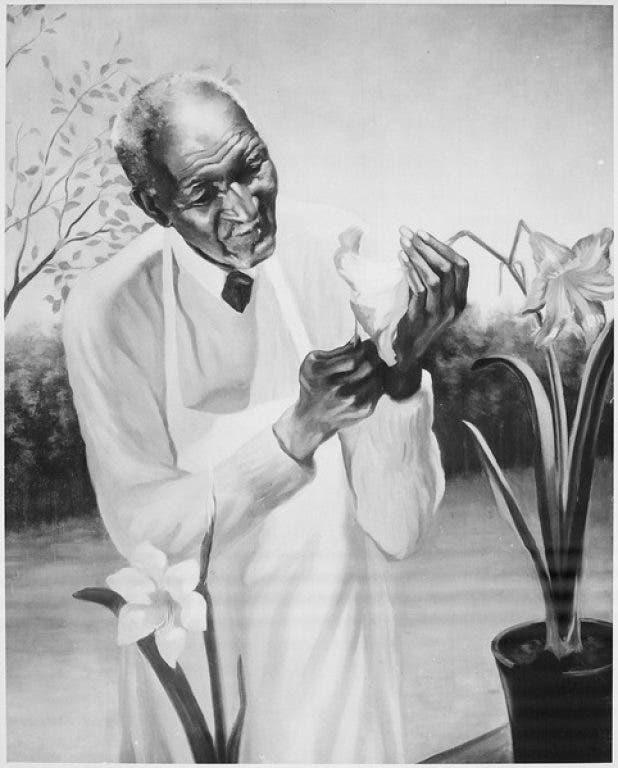
If you and I had a whole day, or even a week, to delve into the meaningfulness of George Washington Carver’s life, it wouldn’t be nearly enough time. In fact, his years were so jam-packed with stories of perseverance, determination, humility, innovation and inspiration, it seems it’d take 80 years, the approximate span of his life, to truly honor this man.
Our lives are hardly relatable to Carver’s, but as gardeners and nature lovers, we do share a common thread: a deep admiration for nature and a burning desire to unlock her secrets.
Before his well-documented achievements in art, music, leadership, biochemistry, humanitarianism and agriculture, there was a love of plants. And it was this love, this ongoing curiosity about their inter-workings, that propelled him step by step, through the tragedies (he’d probably consider them mere set-backs) that punctuated his life.
Find out what's happening in Athensfor free with the latest updates from Patch.
Born a slave toward end of the Civil War, in Diamond Grove, Missouri, Carver’s life almost ended before it even began. While still an infant, the viciousness of American life during that era left him orphaned and sick with whooping cough. Shortly after, however, the war ended, slavery was abolished, and Mosses and Susan Carver, his former owners, took him and his older brother into their home, and raised the boys as their own.
Frail and sickly, young George was unable to perform the heavy-duty work required on the farm. So instead, he helped “Aunt Susan” with household chores, like cooking, cleaning and sewing. Recognizing his innate thirst for knowledge, and keen sense of color and detail, Susan not only taught him to read and write, but also to crochet and paint!
Find out what's happening in Athensfor free with the latest updates from Patch.
Most importantly though, he enjoyed ample spare time with which he wandered freely, alone in the woods. This is a pivotal time in his story, for it was in these woods where his love of botany flourished. It was here where the foundation of his life’s legacy was laid.
I can envision it now: little George trekking through the forrest, his personal laboratory, investigating, collecting, wondering, experimenting. He even kept a secret garden, hidden in the bushes, and stocked it with stones and wild plants that struck his fancy. (Hidden, because it was deemed frivolous to fuss over ornamentals.) And word has it, his ability to coax sickened plants back to vigor was so great, neighbors and friends sought his advice and rightfully nicknamed him, “The Plant Doctor.”
So, here we have a ten-year-old, African American boy, living in a time when simply surviving with one’s spirit intact is a remarkable achievement on its own, who’s already a painter, a textile artist, naturalist, landscape architect, botanist and a horticulture consultant! Did I mention he was a budding pianist and singer too? Well, he was. Incredible, right?
However, soon came a time when life with the Carvers wasn’t enough to satiate his vorocious appetite for knowledge. And so, at eleven years of age, with Mosses and Susan’s encouragement, he left the family’s home in search of education and his own path. He found it, but it was never sun and roses.
The years that followed were filled with poverty, tiresome travel, loneliness and extreme prejudice. Hardly detoured, he blazed forward.
Eventually, he blazed right through a bachelor’s and master’s degree at Iowa State College of Agriculture and Mechanical Arts, as the first African American student and then faculty member.
Earning immense respect and credibility in the scientific communities of scientific research and innovation, Carver turned down an offer to work with Thomas Edison for $100,000 a year in order to work with Booker T. Washington at Alabama’s Tuskegee Institute, a black college, for an annual salary of $1,000. He spent the following fifty years at the institute as a trailblazer, devoting his life’s work to increasing the self-sufficiency of former slave populations.
In fact, he was the first to introduce the concept of crop rotation as a means to reduce plant pathogens and pests. Trailblazer!
He was the first to suggest planting legumes, like the peanut, in place of nutrient zapping crops, like cotton. He knew that legumes have the special ability to feed the soil with nitrogen. And when farmers complained that there was no market for peanuts, other than animal feed, he created one Trailblazer!
He was promoting organic farming, soil building and composting at the turn of the 20th century. Trailblazer!
Who laid the foundation for the use of alcohol based fuels from corn and other plants? You guessed it. Trailblazer!
Remember his Jesup Wagon, the agriculture lab on wheels? Sounds like the first extension agency to me. Trailblazer!
You see, calling him “The Peanut Man” hardly does his life’s work justice. In my book, he’ll always be “The Trailblazer.” He cleared paths, not with a machete, but with his genius and humility.
Thank you, Dr. Carver. You’re an inspiration and a hero to all Americans, black and white. I honor you, not only in February, but always.