

“Into The Woods”
by Stephen Sondheim
Produced by Circle Ensemble Theatre and Co-sponsored by the Morton Theatre Corporation
Find out what's happening in Athensfor free with the latest updates from Patch.
July 12th and 13th at 7:30 pm and July 13th at 2 pm
* * *
Find out what's happening in Athensfor free with the latest updates from Patch.
Part 5
WORDS. We all use them. They help immensely when we’re trying to convey an idea to someone else. Without them crossword puzzles would be much easier. Social media is slowly trying to kill them. Even so, we like words. We put them on street signs, on tee-shirts, and on humongous banners attached to the back of blimps flying over sporting events. Words are also a pretty important part of the theatre. “Into the Woods” has a lot of them. I mean, a LOT of them. Stephen Sondheim and James Lapine had a lot of fun playing around with words twenty-five years ago when they wrote this piece. Some of the words are spoken. Some are sung. Some are sung in harmony with other words from other plotlines meshing into music that might not seem like it would work on paper, but succeeds on stage. Others are semi-sung (that musical theatre thing, that I have mentioned before, where the characters are in between songs and they’re kind of talking but it’s lyrical and catchy and keeps you waiting for the next time that they really sing). The semi-singing phenomenon is a strange one. I don’t think that it would work as well off-stage, though I would love to hear a father order a Happy Meal for his kid and have it be a slow build from dialogue to semi-song to a full-on choreographed song-and-dance number on the McDonald’s playground about all of the emotional reasons why he wants to order a Dr. Pepper instead of a Diet Coke in order to protect his father’s honor. The semi-song is just one of those things that works in musical theatre and pretty much nowhere else.
There are a lot of words in this play. There are a lot of words in most plays, but, even by theatrical standards, there are a lot of words in this play. There are so many words that “Forbidden Broadway”, the Saturday Night Live of American theatre, calls the show “Into the Words”.
The words here are layered with other words. The fairy tales themselves are layered and intertwined and could each be taken out of the show individually and still be familiar storylines with a twist. Together they’ve got that Voltron quality where the component parts are fun to play with, but when they come together to form the super robot toy, they’re big and full of wonder and imposing and make a great birthday present.
Even the spoken words, the dialogue, have a rhythmic quality to them. There’s a flow to the words. Being a word man myself, I really thought that, when I assumed my cricket on the wall perspective to watch this show come into being, I’d at the very least be somewhat familiar with most of the uses of words employed in the making of “Into the Woods”. I was, yet again, wrong. Part of the reason that actors can project a rhythmic intention through all the words is breathing. They actually plan out when to breathe on stage. No joke. Personally, unless my ankle is tied to an anvil and the mob has just tossed me into the Hudson River, I rarely think about when to inhale and when to exhale. This cast is actually planning out every breath. Some of it is even coded (‘) and written into THE BOOK.
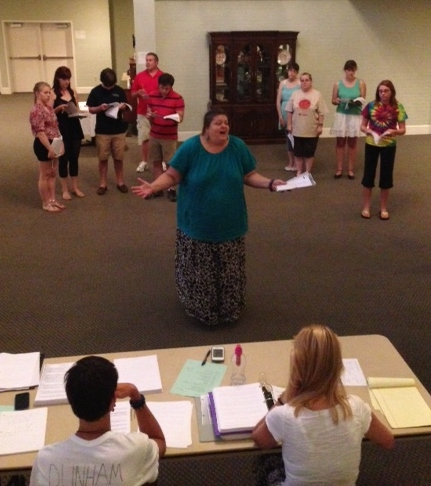
All of the words are in The Book. OK, that one’s pretty obvious. I did assume that there would be a script and song lyrics in The Book. I just didn’t realize how complex The Book would be and how much it’s like training wheels. In the last few weeks I’ve seen actors slowly move the book twice:
Position A---the book is at its first position, usually around a 90 degree angle, held out in front of the body for ready reference, in two hands like a Catholic communion pose or a making-your-grandfather-read-something-without-his-glasses pose.
Position B---the book is moveable and still vacations in Position A, but lives and works next to the body in this position, clutched tightly to the torso, upright and open, there for glances, preferably quick and reassuring glances, for reference only. It’s still held like a security blanket, but a blankie for a five year old where the parent wants the child to put it away but wants him to do so organically, on his own.
Position C---the book is on the table, open, usually open, not always, but clearly on its way towards not being around at all.
Right now the cast is hovering between positions B and C, moving toward C. The show people use the terms “On-Book” and “Off-Book”. It just refers to whether the book is open or closed, with the obvious goal being to not have to open it at all.
Cinderella told me that she thought that the show is, “…a clever, mature version of the musicals we grew up with.” So, the audience will be familiar with some of the words at the beginning of the show and be (pleasantly) surprised at some of the later ones. I don’t want to give away any of the plot twists that Sondheim and Lapine created, using words…a lot of words…an almost unbelievable amount of words.
The Baker’s Wife told me that, “Each word was carefully chosen.” The brilliantly layered writing is what makes this show so complex and what makes it come off so well.
Everyone knows the basic story of Cinderella. We’ve had it read to us. We’ve seen it on movies. We’ve seen it animated. We know the story of Little Red Ridinghood and The Wolf. We know about Rapunzel. I wasn’t familiar with the story of The Baker and The Baker’s Wife but, apparently, they, too, are a part of the canon of European fairy tales (something akin to the Thumbelina tale). The inclusion of this lesser-known fairy tale moves the interwoven story along. It helps. Trust me. Hell, don’t trust me. See for yourself on July 12th and 13th.
As long as words are this week’s theme, I wanted to include a sort of miniature glossary of some of the theatrical words and terms I’ve learned in the last few weeks. I’ve heard waaaayyyy too many to include all of them here, but I want to add a small sampling:
1—Exit Stage Left==you leave the stage, from the actor’s perspective, to the left.
2—Don’t be on the same board==don’t stand on the same horizontal stage plank with your fellow actors.
3--Strike the throne down right, crossover stage left, and enter up left to center apron and freeze in the ghost==as you leave towards the exit closest to the audience, you take the throne (set piece chair) with you, set it down backstage, then go behind the cyclorama (sneak, any rustle of wind moves it!) and get the opposite side of the stage (stage left), then come on the stage for your next entrance farther away from the audience (up left or Up Left) and walk (cross) to the center of the stage at the lip of the stage (the apron), then freeze motionless—your entrance will be in a ghost light, which is likely covered by music or a scene at a different part of the stage…a ghost light is the minimal amount of light you can put on a stage in order for actors and techs to see where they are going. A ghost light is also used to describe the single light left on overnight on a stage.
Yeah, it’s true. It’s messed up, but directors do say that. It comes together. It’s in the moment. It’s real. It is………..the theatre.