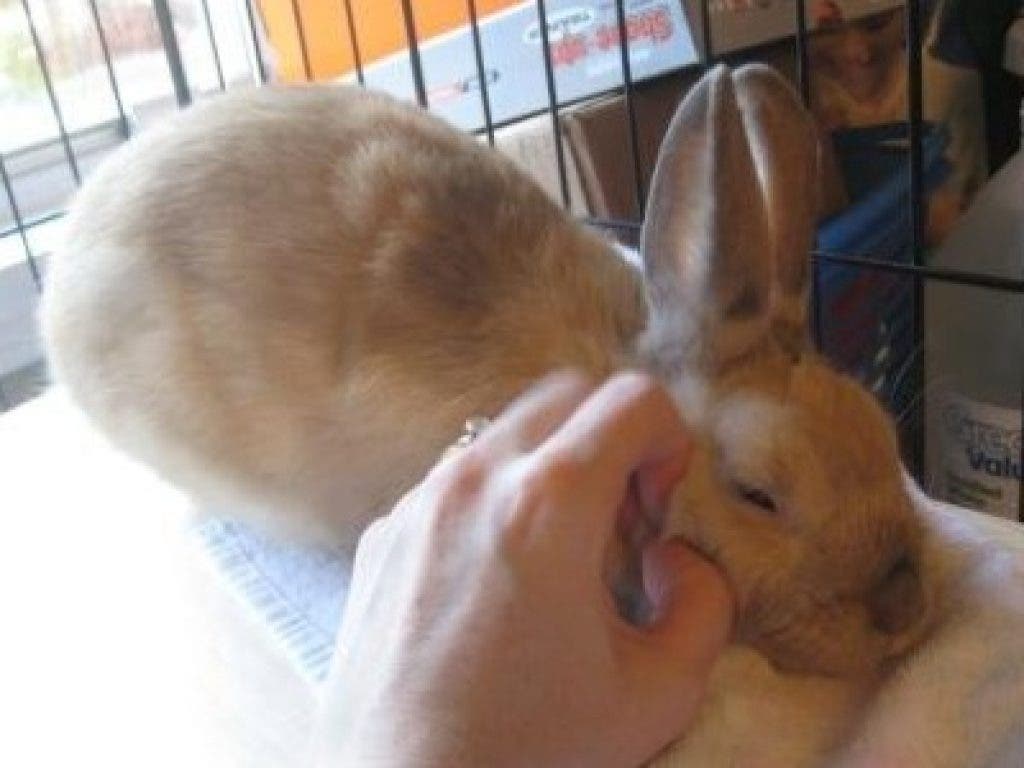

People who spend any time around their animals kind of get attuned to them after a while. I’m not talking about any Dog Whisperer-style Vulcan mind-meld, I just mean that when the dog paws at the door, you know to let him out. When the cat walks to the pantry door, pauses, and then turns to give you the “Uhh, hel-lo, I’m waiting” look, you know she's hungry and it’s time for tuna.
Of course with cats, it’s ALWAYS time for tuna, so that one’s not really a good example. But my point is, most of us understand that when Ms. Priss has had her tuna and comes to you, tail in the air, rubbing against your legs, purring like a little well-tuned motorboat… well even you dog folks know that that’s one happy feline, don’t you?
Find out what's happening in Athensfor free with the latest updates from Patch.
So let’s try another one. What about your pal, Rufus? He’s a bit of this and a bit of that all rolled into a single mutt the size of a small lawn mower. He likes to lie around of an afternoon getting his belly rubbed, and just adores that rope bone you got him the other day. Let’s say he’s on the porch, and that bone’s between his front paws and he’s just sitting there with it. Suddenly his head comes up. He stares out into the yard - and then he pops right up to his normally lazy feet with bared fangs and a growl in his throat.
What’s this all about? Well, lazy as Rufus is, it might be a bear… but I can tell you all the cat people just went to check on Ms. Priss, in case she got out into Rufus’ yard again.
Find out what's happening in Athensfor free with the latest updates from Patch.
But as familiar as cat purring and dog barking has become to us, and as second nature as their body language has gotten, I discovered I was at a bit of a loss when our rabbits began arriving. I could tell that the cats were curious but less than pleased. I could tell the dog was hyper and excited - I mentioned Twiggy in the last post, you might recall. Her two moods in those days were “hyper and excited” or “terrified beyond the capacity for rational thought,” so I was doing well to tell those apart.
But the rabbits? I had NO idea. None at all.
As I look back now with a bit more experience, I can tell you that we probably had a bit of a split decision on our hands. Arwen was calm, out-going, affable… basically, unless you actually tried to scare or upset her, she was fine with most anything. By contrast, Alice was (at the time) a bit smaller and a bit younger, and not very well socialized. This was a big, busy house with a lot going on, and the little thing didn’t know what to do with it all.
Arwen would typically hop about the room a little at a time. Her ears were usually up, whether she was moving or still, swiveling this way and that like a cat’s might. She moved from place to place with purpose, looking at this, sniffing at that, exploring the terrain thoroughly even though she’d just done the same thing the day before. She might “periscope” a bit, she might decide in the middle of things to go explore a completely different corner, but the edges and the middle of the room all got equal treatment.
Alice stuck to the corners, the nooks and crannies of the furniture. If there was something to be under, that’s where she went, and quickly. The middle of the room was crossed only to get under something else. Her ears were up when she wasn’t moving, but they didn’t swivel: they found a target and focused. And when she was moving those long uppy-ears were down flat against her back. Periscoping was a thing not done.
Now, most bunnies love to be under things, so Alice’s penchant for “hiding” didn’t seem completely out of place. (It may also explain why most of the beds in our house now rest directly on the floor, but that’s another story.) But what I was taking for a personality difference was really a major difference in the bunnies' view of the situation.
You see, Arwen was there first. By months.
Since she never smelled any other bunnies around the house (until Alice, etc. came along) the situation was clear: this was HER place. Being the sweet-tempered thing she was, she was more than willing to accommodate others, but when poor, young, unsocialized Alice showed up the situation was just as clear: Alice ‘knew’ she was intruding on another rabbit’s den, and it wasn’t until we moved to a new house (and she got big enough to throw some weight around) that she got over her fear of being confronted by the rightful owner.
As time has passed and I’ve gotten to be around multiple rabbits, I’ve developed something of a "vocabulary." I’ve wandered around the interwebz a bit and found some really interesting primers on not only “hearing” rabbits, but also “speaking” back to them. With that experience under my belt, I can look back now and see clearly at least some of the reason behind Arwen’s confidence and Alice’s skittishness. If I saw a rabbit now acting like Alice did then, I think I'd be much better able to “talk” to her in a way that would let her know all was well.
It’s a bit like suddenly going to another country, but without learning the language first. To start with, you see how people act in different situations, and then you begin to place certain sounds with certain objects and activities. After a while, you develop a working dialect, which you can then use to get around and learn more.
Of course, then you actually learn the language, and you spend a little time being embarrassed by all the silly things you said before you knew better. But that's all part of learning, I guess.
Alice didn’t stay little, growing eventually into a 10-pound Dalmatian-colored rex with every bit of the Queen of Hearts' temper. That rabbit drew blood from me no less than three times in her life. Twice I paid the price for misreading what she was telling me, and once was a completely understandable accident - she mistook my finger for a carrot.
It was an honest mistake. Could have happened to anybody. Sure. Why not? Okay, I'm not 100% sure, but at least she did look sheepish about the whole thing, which is tough for a rabbit to manage, I can tell you.
Eventually, other than letting her in and out of her cage and a few other chores, we generally left Alice to her own devices, and she seemed okay with that. On the rare occasion that she would demand attention, pettings were offered immediately per a lady of her station (read: a rabbit that might nip you if you didn't), but unlike Arwen she rarely gave kisses in return.
If I’d known early on what I know now, maybe some of that misunderstanding could have been avoided. After all, it’s the little scared ones that grow up to be the biggest bullies.
Our nicknames for Alice once she grew up? “Highlander Bun,” “Queen Alice,” or simply “Her Majesty.”
- PT
What sort of cues do your animal friends give you to let you know how they feel or what they want? Did any of your pets' quirks take you a while to figure out, or are there some that mystify you to this day? Share them with us in the comments!