Schools
Review: UGA Symphony offers all-American program
Bernstein, Copland, Griffes and Hanson were featured.
Given that your average attendee at a classical music concert has passed the age of 50 and is likely looking at their sixties in the rear view mirror as well, a concert consisting of all American music, all written in the 20th Century might seem like a pretty tough sell.
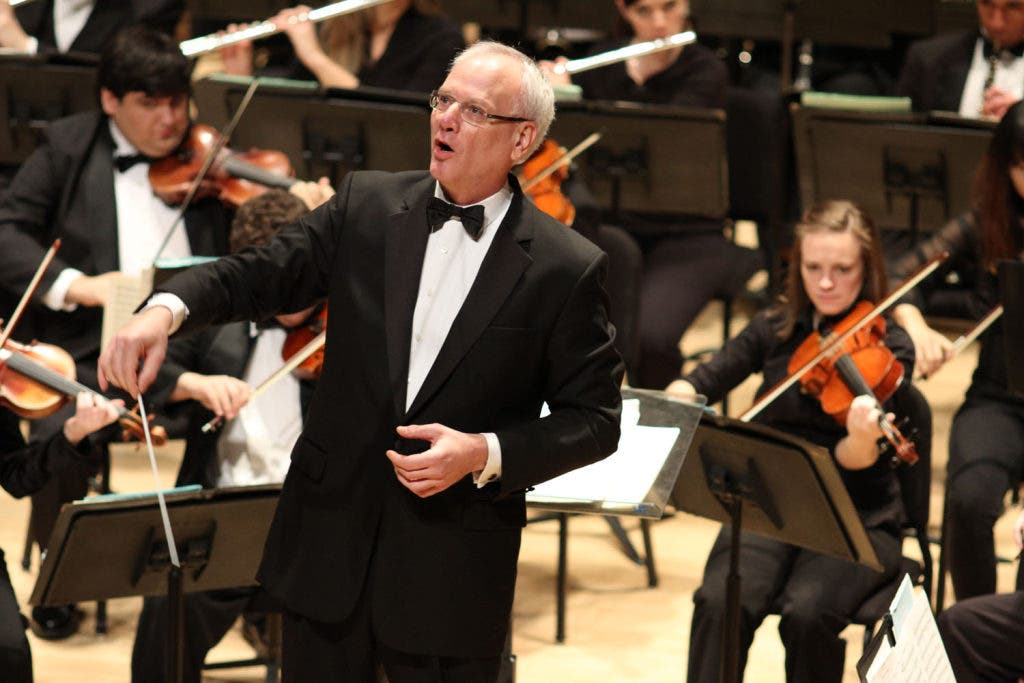
Nonetheless, conductor Mark Cedel and the University of Georgia Symphony Orchestra turned in a performance Thursday night that was not only musically sound but also crowd-pleasing.
Programming, of course, helps. There were no brooding, atonal pieces, no ear-shattering and arrythmic banging of drums, cymbals, and anything else that makes noise when you hit it. The program, while relatively contemporary, was far from radical.
Find out what's happening in Athensfor free with the latest updates from Patch.
The concert featured those well known deans of American music, Leonard Bernstein and Aaron Copland, the unjustly-not-as-well-known Howard Hanson, and the hardly-ever-heard Charles Tomlinson Griffes.
Bernstein's “Overture to Candide” is a perennial favorite, five or so rollicking minutes that are a workout for the musicians and an effervescent experience for the listener. Given Bernstein's penchant for turning rhythm on its ear, the orchestra, anchored by Cedel's presence on the podium, turned in a performance that exceeded expectations.
Find out what's happening in Athensfor free with the latest updates from Patch.
Following the Bernstein was one of those hidden gems of American music, Charles Tomlinson Griffes' “The White Peacock.” Griffes remains sadly underprogrammed in the orchestral world, despite being the pre-eminent American composer in the Impressionist style. Fans of Debussy should find Griffes' work familiar and enjoyable.
On this concert, the orchestra turned in a surprisingly nuanced and delicate performance, one at which even professional orchestras should look with approval. Notable here were two wonderful solos by the orchestra's concertmaster and its principal oboe.
Rounding out the first half of the performance was Aaron Copland's “Billy the Kid Suite,” another popular favorite, and a tuneful tribute to the mythology of the American West. In this piece, one might argue with the orchestra's balance. Despite Cedel's long experience with the hall, overly aggressive percussionists dominated sections of the music, drowning out some of the orchestrational delicacy for which Copland is known.
The major work of the concert, occupying the entire second half, was Howard Hanson's “Symphony No. 2 (Romantic).” For those unfamiliar with Hanson's work, let me suggest you find a recording and give it a listen. The symphony itself is melodic and exciting, and not performed nearly enough.
In places (notably the second movement), Hanson explores the reaches of harmony while never leaving tonality behind. In other sections, such as the third movement, the music predicts the Hollywood sound of John Williams and others.
Special recognition on the Hanson, and indeed throughout the entire concert, should go to the orchestra's french horn section, which turned in a stellar performance on some very demanding music.
As for Cedel himself, allow me to suggest two very appropriate adjectives – competent and workmanlike.
Perhaps terms like competent and workmanlike might seem to be damning Cedel with faint praise, but they shouldn't be seen as such. In his fifteenth year conducting the university's orchestra, Cedel is a consummate professional. He knows his orchestra, his repertoire, and just as importantly, he knows the stage at Hodgson Hall backwards and forwards, the previous mention of overly aggressive percussionists notwithstanding.
If Cedel's interpretations of the music are not extreme and radical, that is entirely appropriate for the educational role Cedel serves. His mandate is to introduce the next generation of professional musicians to the orchestral repertoire, first and foremost.
And so, if his greatest departure from the conductor's canon is a slightly slower-than-expected tempo on the final movement of the Hanson symphony, let's all agree that he did his job well.
But if Cedel is conservative on the podium, Thursday's concert shows that he is anything but staid in the music library. Presenting a concert of solely American, solely 20th Century music (even in the days before we mark the 10th anniversary of the 9-11 tragedy) is a bold choice.
Yes, the program was non-intimidating, approachable in the way a pops concert is, but in this case it was more than a pops concert. It was a concert mixing the familiar and the sadly underrated – an approachable program with intellectual honesty and musical gravitas.
The UGA Symphony will perform "La Boheme" with the UGA Opera Ensemble on November 10 at 8pm in Hodsgon Hall. Tickets are $18, $5 for UGA students.