Community Corner
Tree Tales: Next Door Neighbor Tells All
Nights of revelry, waves of paparazzi, crazed parties--all are part of the life of a celebrity.


Our next door neighbor, age 65, who resides at the corner of Dearing and Finley streets, is very quiet, but has a lot of visitors. Usually they stay just a short time, taking a couple of pictures before they leave.
Our only real complaint is the heavy downfall of leaves, twigs, and seeds from our neighbor’s property that accumulate seasonally on our front yard and driveway. Our neighbor never cleans up any of this downfall, but rather seems to take a youthful pleasure every fall in pelting passing cars (especially ours) with acorns.
Our neighbor is .
Find out what's happening in Athensfor free with the latest updates from Patch.
The Tree Begins Its Ownership
Like most Athenians, we knew the story of this Tree when, in 1996, we moved into the house next door: That William H. Jackson, whose house was across the street, so loved the parent of this tree, a white oak (quercus alba) growing there, that sometime between 1820 and 1832 (between the ages 36 and 48), he willed eight feet of land around the tree to itself.
Find out what's happening in Athensfor free with the latest updates from Patch.
That story was recounted in an 1890 article in the Athens Weekly Herald. But the will was never found, and a natural object like a tree cannot legally inherit property.
In fact, most people now believe that the story was fabricated to keep the city from cutting the grand old tree down because it intruded into part of Finley Street.
If that is true, the story certainly worked. And it was indeed a magnificent tree, by the 1930s towering 100 feet high, its trunk fifteen feet in circumference, its age sometimes estimated at 400 years.
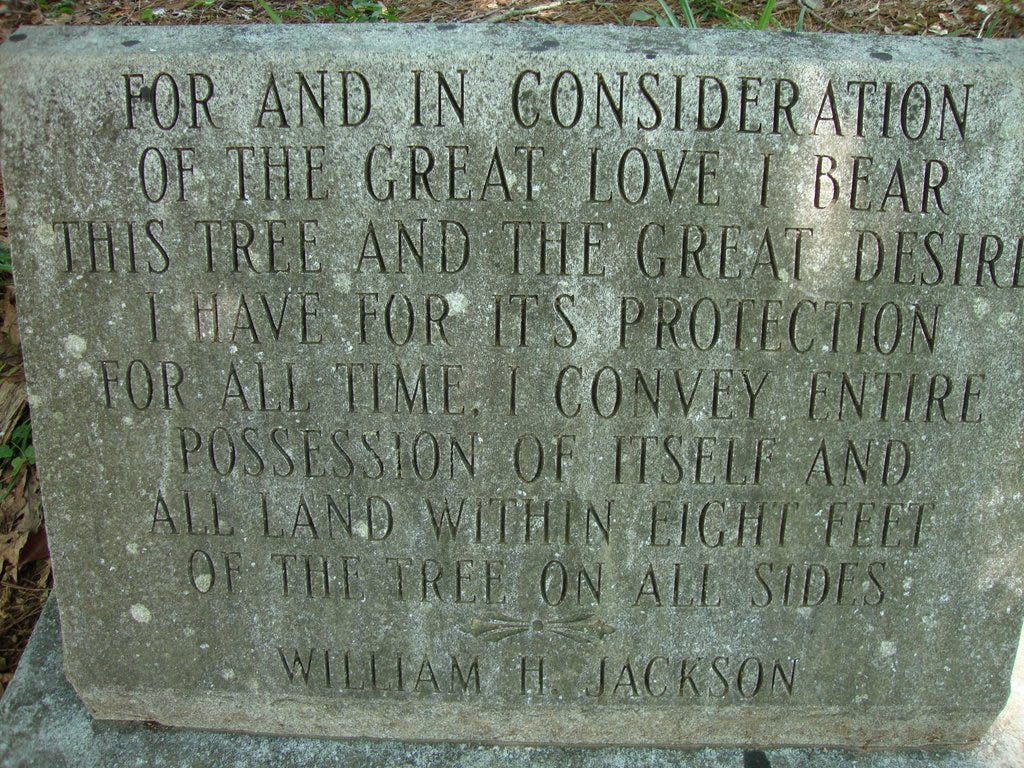
Recognizing the Tree’s unique value, philanthropist and UGA patron George Foster Peabody (of the journalism school’s Peabody awards) had a series of granite posts linked with chains put up around the border of the Tree’s “estate,” and a stone slab bearing a quotation from Jackson’s will (as quoted in the newspaper article) placed there. Several old postcards show the Tree of this era, sometimes labeled “THE ONLY TREE IN THE WORLD THAT OWNS ITSELF,” sometimes with a corner of our house showing on the edge.
The Tree Has Offspring
But by this time the old Tree was suffering from heart rot, and on October 9, 1942, it fell in a wind storm—landing the only possible way it could without harming its neighbors. Its demise left a huge empty space.
Four years later, on December 4, 1946, the Junior Ladies’ Garden Club planted in that spot a three-foot sapling grown from one of original Tree’s acorns. They have since, along with the city, cared for this new Tree, which, although sometimes referred to as the Son of the Tree That Owns Itself, is generally recognized by the same name as its parent and the legal heir.
The heir is now a respectably large tree. We moved into our house in time for its fiftieth birthday party, with speeches and a cake. The celebration was held in our driveway, which adjoins the Tree’s estate. It was our introduction to the esteem in which the Tree That Owns Itself is held and what our role might be as its next-door neighbor.
The Tree Receives Visitors, Gifts and Stardom
Living here over the years, we have watched from our front yard and porch as the Tree changes with the seasons. We have seen Bartlett Tree Experts install a lightning rod. And we have watched admirers attach a bronze plaque, donated by Dearing Street resident Katherine Soule, to the concrete ledge separating the Tree from Finley and Dearing streets.
We have seen parades of visitors come, park their cars, and stroll over to the Tree, cameras in hand. They read the new, larger stone marker (the original is too weathered to read) and pose in front of the Tree while one member of the group takes a picture.
Or they ask me, if I happen to be nearby, to do the honors: I’ve taken pictures of sorority girls, young couples, and church groups perched on the concrete ledge by the road or standing before the Tree.
The Tree is often the site for treasure hunts, and a box remains buried in the Tree’s estate for one national group of hunters to find. Grade school children are regularly assigned to visit the Tree. I’ll never forget one historically aware and politically correct little girl who said to me, “You’re so lucky to live next door to the Son or Daughter of the Tree That Owns Itself!”
There are many other Tree tales to tell. Professional videos have been made of it (an ESPN photographer spent some time videoing it the day before this year’s Georgia-South Carolina game), and Ashley Epting’s movie Not Since You includes a romantic scene of a couple sitting under the Tree (they used electric outlets of our house for the lights illuminating the area).
An iconic sketch of the Tree marked the (now stolen) sign denoting the Dearing Street Historic District. Last spring Joe Imhoff and Sara Tekula of plantawish.org, who were planting a tree in every state, pitched a tent under the Tree and camped there one of the nights they were in Georgia. Then there was the couple who were married under the Tree—this shortly after we’d moved in, and we apologized that our yard was not in better shape.
The Tree Goes Digital
The Tree’s Facebook page is one of the best portraits of the relationship of the Tree to the Athenians I see pass by it every day. The many witty comments on this page are laced with affection (“We’re rooting for you”; “Happy Birthday—go out on a limb and celebrate”; “We hope other trees will follow in your trunksteps”).
The postings sometimes speak in the Tree’s voice: “I’ll put on some orange tomorrow, gold on Friday, and RED on Saturday” (written during football season). Some wonderful pictures of the Tree are posted, from Harold Mulherin’s wintery view (“I’m sorry I caught you without your robe”) to Andrea Striepen’s of its “yarn bombing” (graffiti with yarn instead of paint).
Many comments nostalgically refer to the writers’ memories of the Tree while they were students at UGA. One told of her father’s dropping her off in Athens with instructions to go look at the Tree. When she did, she found he had left roses there for her. And from another student there is an apology: “I’m sorry I peed on you when I was a freshman.”
If the story of the Tree owning itself were a fabrication, a product of a newspaper writer’s imagination, then the Tree is most surely an example of fiction creating reality. I think no one today would dispute that the Tree does own itself—certainly not we, its closest neighbors.