Schools
Want Less to Waste Not, Earth Week Message
UGA conducts a waste audit and finds less waste, but wants numbers to drop further.
One man's trash could be another man's meal. At least that’s what Students for Environmental Action would like you to consider before you grab that extra cookie you might just toss.
As a part of UGA Earth Week, “Consumption Day” focused on the impact of student waste as well as on sustainable food systems.
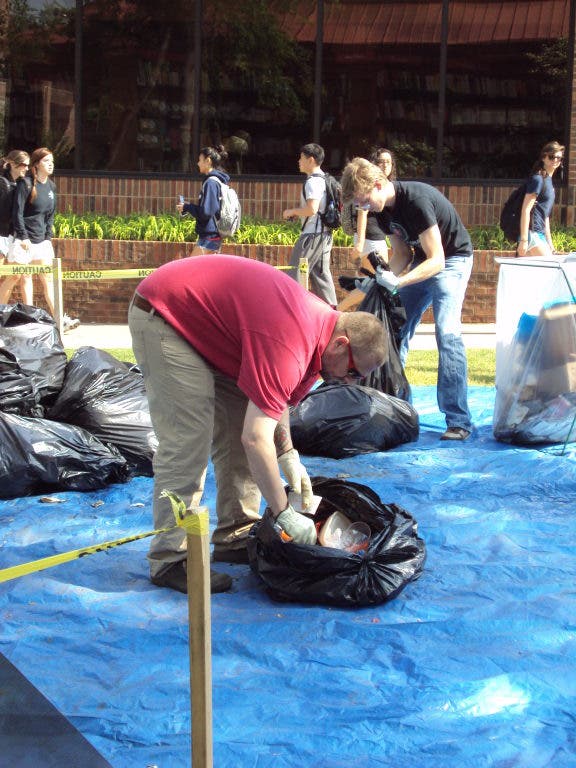
To kick off the day’s events, Students for Environmental Action along with the Physical Plant Division of UGA held a waste audit on the Tate Student Center north lawn.
Find out what's happening in Athensfor free with the latest updates from Patch.
A waste audit is a process used to quantify the amount and types of wastes being generated in a predefined area. In this case, the audit concentrated on the entire amount of waste produced in one day by the Miller Learning Center.
According to Emily Karol, member of GoGreen, a Physical Plant Division Sustainability Initiative, the audit produced 260 pounds of trash. Of that number, roughly 8 percent was recyclable.
Find out what's happening in Athensfor free with the latest updates from Patch.
This number is significantly down from the last audit in 2009, where the MLC produced 750 pounds of trash in one day, and over 55 percent was recyclable.
Matthew Epperson, intern for the Office of Sustainability, said the reduction of waste was a “delightful surprise.” He attributed the success to the increased number of recycling bins in and around the MLC.
Still, the Office of Sustainability is considering more recycling opportunities.
“We found Jittery Joe’s coffee cups in the trash, so we’d like to seek out more recyclable cup options. Also, we’re considering composting at catered food events on campus,” said Epperson.
To continue the day’s events, SEA held a no-waste dinner preceding “Food, Environment, and You,” a panel featuring various local sustainability and food experts.
The panelists discussed ways for the university to become more sustainable and also options that individuals could pursue individually.
Craig Page, executive director of P.L.A.C.E., advocated taking small steps toward living a more sustainable lifestyle. Some of his tips included growing something or committing to buying certain produce locally. Page said that if more people decreased dependency on what is often an exploitive global food system, local farmers and communities will thrive.
Other options for university-wide change focused mostly on dining hall food waste. Sarah Himmelheber, a doctoral student at UGA, suggested that removing trays to limit extra waste and small-batch cooking were feasible changes the dining hall system could make.
Jared Pickard, a local farmer, explained that there are difficulties along the way to living sustainably but the result is a more mindful population.
“There’s no blueprint for how to quit your Wall Street job and become a farmer,” which is exactly what Pickard did a couple of years ago. He now runs his own sustainable farm that helps supply restaurants like Farm 255 and Farm Burger in Decatur.
“It’s all about taking action. People have great ideas but the change comes with just doing it.”