Weather
Winter Forecast For Georgia: What To Expect In 2017-18
An updated 2017-18 winter forecast provides a useful glimpse of what you should expect in Georgia.


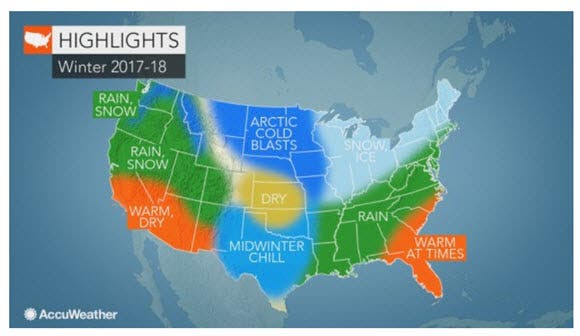
ATLANTA, GA — Georgians, would you be sad if you had a winter without snow? The latest in a trio of winter weather forecasts, this one from AccuWeather, predicts that the Peach State could have temperatures above normal. But residents could see two or three ice storms, which brings life to a halt in that Atlanta area.
Air temperatures will run above normal in most of the Southeast, especially Florida and Georgia, where the risk of a damaging freeze is lower than in past years. Florida, inundated with rain after Hurricane Irma, is expected to remain mostly dry. In the western areas of the region, weather could be colder overall, and forecasters said a few ice storms could hit the area stretching from the Tennessee Valley to northeast Texas.
Tornadoes aren’t out of the question, either. In January 2017, the area from Texas to Georgia was pummeled by 137 tornadoes. Paul Pastelok, the lead long-range weather forecaster for AccuWeather, expects the region to experience tornadoes in February. (Get Patch's Daily Newsletter and Real Time News Alerts. Or, if you have an iPhone, download the free Patch app.)
Find out what's happening in Atlantafor free with the latest updates from Patch.
SEE ALSO: Farmers' Almanac Releases Winter 2018 Georgia Weather Forecast
Residents of the Northeast, Mid-Atlantic states, New York City or Boston may all see more snow this winter than last year's relatively flake-free season. If you live in the Northern Plains and parts of the Midwest, you may want to dig out your wool socks and extra layers, according to a new winter forecast released Wednesday. Temperatures in the northern Plains could plummet to below 30 degrees below zero, the forecast says.
Find out what's happening in Atlantafor free with the latest updates from Patch.
AccuWeather says areas that typically receive large amounts of lake-effect snow — Cleveland, Ohio; Erie, Pennsylvania; and Buffalo, New York — should brace for mountains of snow and frequent shoveling. Both snow and ice are predicted in Wisconsin, Michigan, Illinois and throughout the Northeast. "A very chilly winter is in store," the weather service says.
Winter will be comparatively balmy in the Southern Plains, the Southwest and southern California, where forecasters say winter will be milder and drier than last year.
Pastelok says that winter temperatures in the Mid-Atlantic region should be within a few inches of normal. “Areas in the I-95 corridor will average close to normal, within a few inches,” he said. “Areas away from the I-95 corridor have a better chance at a big snowfall.”
Disagreements on Georgia Forecasts
SEE ALSO: Old Farmer's Almanac Issues Winter 2018 Georgia Forecast
But there is disagreement in the various long-range forecasts. The Old Farmer’s Almanac winter weather forecast released in September calls for winter to be warmer and rainier than normal, with below-normal precipitation. The coldest periods will be in early January and early February, while the best chances for snow will come in early January and early February.
The Old Farmer’s Almanac forecast is a stark contrast to the predictions of competing publication the Farmer’s Almanac.
In August, the Farmer’s Almanac predicted Georgia will experience a cold and soggy winter with "below-normal" temperatures in the region, "with an unseasonable chill reaching as far south as the Gulf Coast, with above-average precipitation." Are you hoping for (or perhaps dreading) some snow in the Atlanta area? If so, Farmer's Almanac thinks it knows when the best chance for it will be.
The periodical is red-flagging January 20-23, February 4-7 and 16-19 and March 1-3 and 20-23 as days when the Atlantic Seaboard is likely to get some heavy precipitation. And, well, we here in the Atlanta area know how that sometimes ends. Snowpocalypse 2018, anyone?
"Good news for skiers and snow enthusiasts, but for those looking to build sandcastles, not-so-good news, but a good time to book that tropical getaway," the Almanac's editors wrote.
Here’s a closer look at the forecast in different parts of the country:
Northeast and Mid-Atlantic States
It will be colder than last year and snowfall is expected to be normal to above-normal, depending on where you live. In addition to Cleveland, Erie and Buffalo, snowfall in New York City and Boston could be about 6 inches above normal, “within a few inches,” Pastelok said.
“Areas away from the I-95 corridor have a better chance at a big snowfall,” he said.
Northern Plains
Arctic cold blasts are expected to plunge Montana, the Dakotas, Minnesota, Iowa and most of Missouri into the deep freeze on a regular basis, but the drier, colder air will carry less moisture, so huge, frequent snowfalls shouldn’t be a problem.
The coldest air — minus 30-degree Fahrenheit temperatures (and that doesn’t include the windchill) — will be in the Dakotas, Pastelok said.
Southern Plains
The chilliest temperatures could come in mid-winter, and arctic air blowing in from Canada could lead to freezes in late January, Pastelok said. Overall, though, a cold winter isn’t predicted.
Despite roller-coaster temperatures overall, southwest Texas could experience above-normal temperatures.
And while some storms are predicted, the winter will be mostly dry in the Southern Plains.
“We do feel there are going to be some storms in northwest Texas at times,” Pastelok said. “Southwest Texas could see some but not as frequent as in past winters.”
Northwest and Rockies
A weak La Niña predicted to develop this winter is expected to provide ideal skiing conditions in the Northwest, including the Cascades, and the Rockies.
“I think the Bitterroot chain all the way down to the Wasatch region in the central and northern Rockies has a good shot to be above normal on snowfall this season,” Pastelok said.
Northern California’s Sierra Nevada mountain range is expected to be less snowy, but the area should receive enough snowfall for good skiing conditions — but it’s not likely to be so significant that people won’t be able to reach resorts, Pastelok said.
Southwest
Dry, warm weather is predicted. In fact, Pastelok said, temperatures could reach into the 90s by early 2018.
Patch file photo
Get more local news delivered straight to your inbox. Sign up for free Patch newsletters and alerts.