Community Corner
Does Atlanta Care About Its Historical Sites?
Atlanta Preservation Center issues list of most endangered sites in the city




It seems Atlanta has always been obsessed with the now and new.
In the period after 1996 the Olympic Games and into the eary 2000s, Atlanta was on a building boom with the city skyline being more notable for the construction cranes piercing the horizon as much as the skyscrapers.
But there seems to be a disconnect with the past.
Find out what's happening in East Atlantafor free with the latest updates from Patch.
It's underscored by the Atlanta Preservation Center's 2011 Most Endangered Historic Places List.
Released Wednesday, the list details the 19 most endangered sites in our city.
Find out what's happening in East Atlantafor free with the latest updates from Patch.
Four of them are in East Atlanta Patch:
Atlanta's Historic Downtown Street Grid
What APC says: Atlanta's historic downtown street grid is all that is left of antebellum Atlanta. Persistent efforts by the Atlanta City Council to rename streets threaten to erode this historic evidence despite neighborhood opposition.
Disregarding a 2003 ordinance intending to make street renaming more restrictive, the Council is known to have often waived the laws' requirements. The proposal to rename Cone St. was altered to include memorial street sign toppers rather than renaming. However, the proposal to rename Harris St. was passed by City Council on May 16th.
Atlanta's Public Monuments
What APC says: Atlanta's public monuments are narrative components of the historic landscapes of the City. They are in jeopardy from ongoing disregard.
Demolition, removal, vandalism, theft and lack of maintenance are also evident in Atlanta's oldest public park, Grant Park. In this park the following are known to be missing; 2 cannon, sculptures of an angel and a stag, a marble sundial and a monument to Colonel Grant.
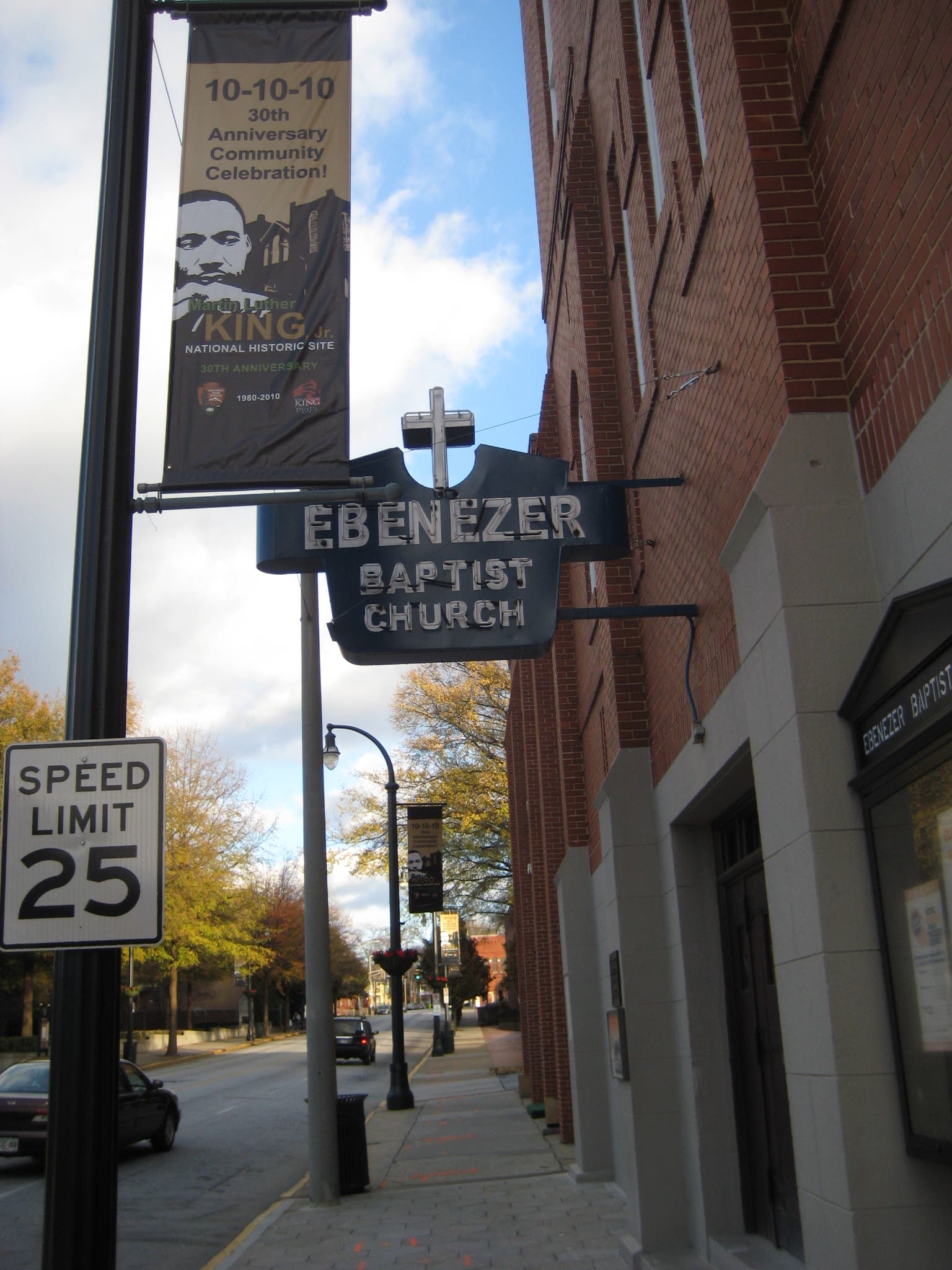
Auburn & Edgewood Avenues Commercial District – Sweet Auburn
What APC says: One of the oldest neighborhoods in the City of Atlanta, its historic significance is greatly enhanced by the fact that Dr. King was born, lived and preached here.
Sweet Auburn was designated a National Historic Landmark in 1976, and the area is part of the city-designated Martin Luther King, Jr. Landmark District. Despite its historic significance, the district has had multiple demolitions in recent years, from redevelopment, neglect, the expansion of Georgia State University and the tornado in 2008. The proposed Atlanta Streetcar travels on these streets and could have a tremendous impact on the neighborhood.
Citizens & Southern National Bank, Moreland Avenue
What APC says: The Moreland Avenue branch of Citizens & Southern National Bank (C&S) was the last of a series of projects designed by architect Kenneth Johnson that were commissioned by Mills Lane Jr. These projects included remodeling of a bank at Little Five Points (now known as the Star Bar), a cabin for a corporate retreat, and a branch bank on Roswell Road.
This building's remarkable design is a response to its site located immediately to the west of Moreland Avenue and adjacent to a shopping center at 25 feet below street level. It is conceived as a curving set of six levels of spaces spiraling up around a central open court connecting the two levels of the site. The building's inward focus emphasizes views of the plantings and fountain of the central court, avoiding the visual cacophony of Moreland Avenue.
Vacant for years, the future of the site is unsure at this time. An application for a demolition permit was filed with the city in late 2010. At the same time, a grassroots effort to raise awareness of the building and seek an alternative to demolition was growing.
So much of our history — our legacy as a city — seems too easily forgotten. And but for a few groups and people dedicated to preserving our past, a lot of the icons that mark historical, architectural, cultural and social points in Atlanta's evolution are prey to neglect and decay.
As a transplant from the Northeast, I was suprised to learn the Fox Theatre in Midtown, where I've seen countless shows ranging from Björk to the Alivin Ailey American Dance Theater, was once threatened with the wrecking ball.
Why is that?
Is it because the city has younger population that's more forward looking than-reflective? Or is it because so many of us are from somewhere else and the ties that bind stretch away from Atlanta to the West Coast, Midwest or East Coast?
Atlanta — even the name is a change from its earlier monikers of Terminus and Marthasville — is a city that suffered much damage and loss during the American Civil War.
The Old Fourth Ward and Sweet Auburn parts of town suffered loss again following the Great Atlanta Fire of 1917.
It always struck me as odd that a city that has seen that kind of devastation seems all too willing shape its future at the expense of the preservation of its past.
Get more local news delivered straight to your inbox. Sign up for free Patch newsletters and alerts.