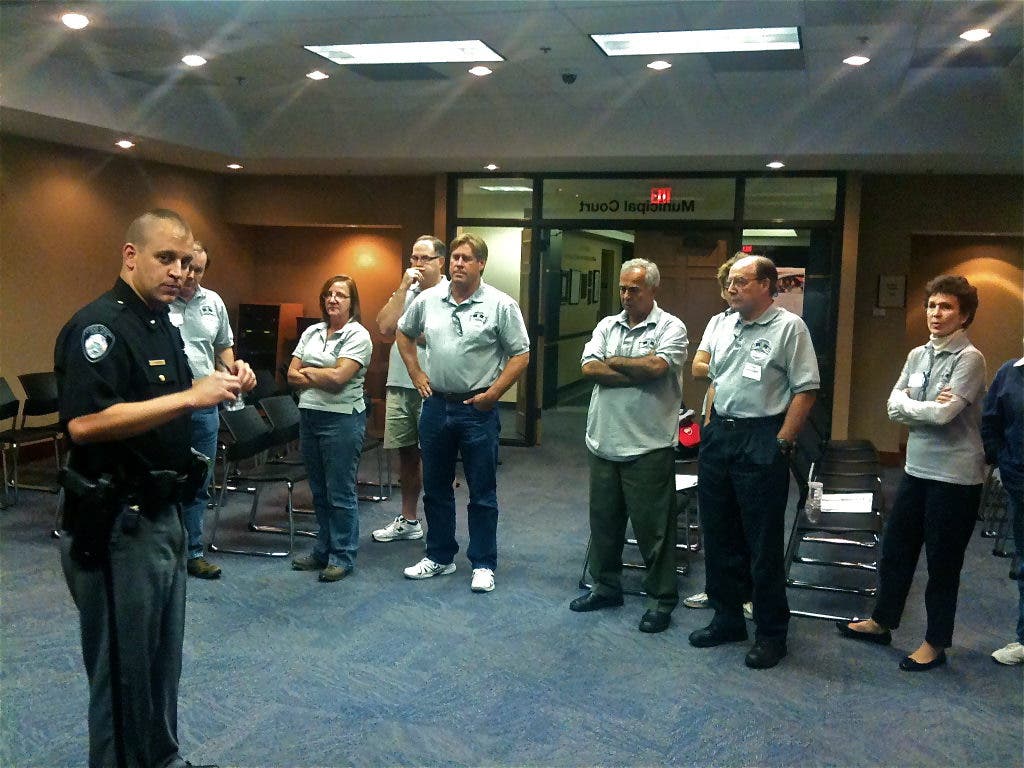


Lt. Jason Harper speaks softly and carries a black steel counterbalanced telescoping baton.
Other tools of the trade include small and standard-size hinge-style handcuffs and a .45 caliber semi-automatic pistol with a 13-round ammunition clip.
And then there’s his semilethal TASER X26 stun gun.
With its reloadable compressed nitrogen propulsion cartridge, the battery-powered clear plastic department-issued pistol deploys two small electrical pulse probes that stops most bad guys flat in their tracks.
“It’s just the newest, latest greatest thing,” Harper said. “And it causes muscle contractions and (short term) pain like I can’t explain.”
Johns Creek Citizens Police Academy cadets hit the halfway point this week in the nine-week course with a one-on-one with JCPD’s lead field training officer and night patrol supervisor over the department’s policies of non-lethal and lethal force.
Police officers in the field assume incredible risk while performing even the most routine duties.
And the second they take anything for granted might be the last one they see alive, Harper said.
“Believe it or not, the public is making judgements about us every day. What we’re doing. How we’re doing. You always have someone out there sizing us up and telling themselves ‘I can take this officer. Or I better not mess with that one.’”
It takes steady nerves and split-second judgement when facing a potentially deadly situation.
And officers must exercise tremendous reserve and tempered response to any threat – real and perceived.
Georgia law, specifically OCGA 17-4-20b, allows sworn law officers to use deadly force when they reasonably believe their life or that of another is at risk.
The United States Supreme Court has also weighed in with broader interpretation of law enforcement's use of force in its 1989 benchmark ruling in Dethorne Graham-vs-Connor et al, setting a precedent for a reasonableness standard in law enforcement’s use of force while performing an investigation or affecting an arrest.
More often than not, an officer’s presence alone prompts a praxis of hegemony in the general public, Harper said.
“You’d be amazed how peoples’ behavior changes when I roll up behind them in my patrol car,” Harper joked. “But it all goes back to the concept of reasonableness and how people’s behavior during an investigation determines the outcome.”
Johns Creek Police policy outlines several techniques officers may employ to achieve compliance in suspects, including officer presence, verbal commands, soft physical techniques, intermediate weapon usage and, ultimately, deadly force.
It’s a balance of the situation with the threat level, a commensurate response from a suspect’s resistance to an officer’s applied level of force, Harper said.
But Harper insisted that officers will avoid the use of deadly force or any use of force if at all possible.
“Just remember,” Lt. Harper warned the cadets. “If you see an officer hitting someone with a baton, that’s a really bad situation.”
Next week, cadets are out of the classroom and go directly into line of fire with Firearm Training Simulator (FATS) training at Sandy Springs Gun Club.
The FATS system is designed to place participants in virtual reality confrontations where they’ll make split-second use of force decisions.
Check back with Johns Creek Patch next week to see how cadets fare against their computer simulated scenarios.