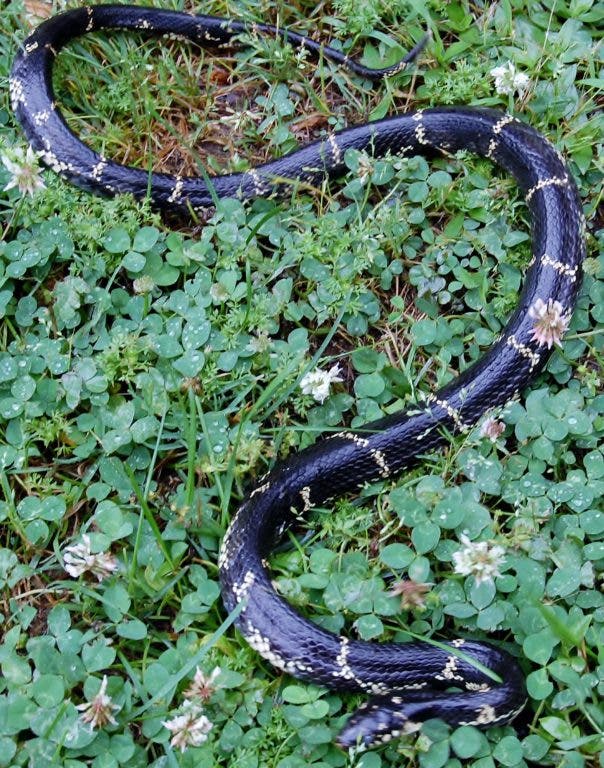

The best days for me are when I have a cool wildlife encounter, and for me, that often means coming upon a snake. Today I didn't even have to go far to find one.
I was actually outside the visitor center on the phone with a vendor, mindlessly strolling about (as I am prone to do when on the phone) and I almost stepped on this Eastern Kingsnake (Lampropeltis getula getula). To be honest, this guy/girl looks as though he hasn't had much luck lately. The animal is very thin, and his/her skin isn't in the best condition.
People tend to forget how hard life is for many species, and snakes are no exception. Snakes have to survive any number of obstacles and challenges if they are to reach adulthood and pass on their genes. Acquiring food, avoiding becoming food, coping with parasites and pathogens, avoiding lethal temperature extremes, and not being killed by people are only some of the challenges facing your typical snake.
Find out what's happening in Johns Creekfor free with the latest updates from Patch.
Kingsnakes are well known for their habit of eating other snakes (hence the common name “KINGsnake”). Over the years, I have seen kingsnakes eschew a few prey items (usually noxious amphibians), but they will generally consume just about any suitably sized vertebrate species. Favorite and frequent prey items are likely skinks of the genus Plestiodon (such as the Five-lined Skinks Plestiodon fasciatus). This makes it strange that this serpent isn't eating better. Five-lined skinks dart to and fro throughout the preserve and are quite plentiful. It did appear as though the snake may have had a small item in its belly, so maybe its luck is changing.
We will never know the story of this little creature's life, but it is fun to speculate and I wish him/her well in his/her quest to survive. If you are interested in learning more about the snakes of Johns Creek, check out our programs or exhibits. Next Saturday (the day after the last day of school for many of our local youngsters) we will be hosting a family event to kick off the summer. “Spring into Summer” will feature a live reptile encounter as well as crafts, games, water slides, and more.