Community Corner
Johns Creek Couple Documents Journey With ALS
"Hope for Steve" went on sale as a digital download on May 3, just in time for ALS Awareness Month.
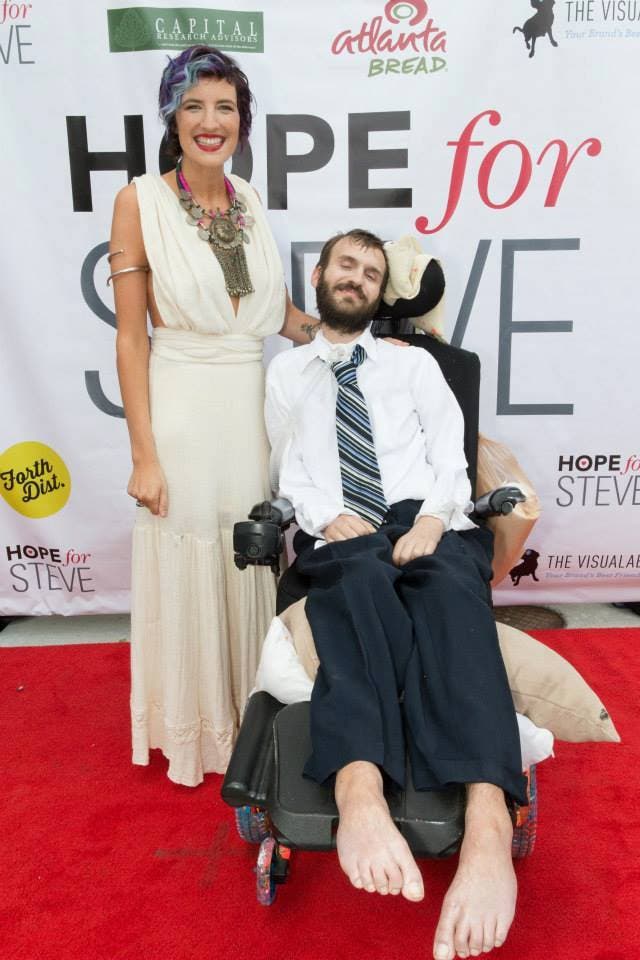

When Steve Dezember II of Johns Creek started having wrist pain in 2009, his doctor told him it was an old injury flaring up. A foot drop was dismissed as a reaction to a metal plate placed in his foot after a college wrestling injury. When he began falling for no apparent reason, however, he knew it was something more serious.
Appointments with four neurologists led to his diagnosis on Aug. 9, 2011. It was ALS (amyotrophic lateral sclerosis, often referred to as Lou Gherig’s Disease). He was 28 years old.
Find out what's happening in Johns Creekfor free with the latest updates from Patch.
Three days later, on Aug. 12, Dezember took his girlfriend, Hope Cross, to their favorite spot along the Chattahoochee River and proposed, saying that if she wanted to leave, he understood, but if not, he wanted her to marry him.
She said yes and they were married Oct. 15, 2011. Their wedding was even highlighted on the television show "Say Yes to the Dress."
Find out what's happening in Johns Creekfor free with the latest updates from Patch.
Steve said that on the day of his diagnosis he knew the reason he was given ALS was to “impact and educate the world."
Hope says “Steve’s always been super relatable and a social butterfly so watching this happen to someone like him will really open people’s eyes up to his disease and hopefully influence them to live fuller lives."
The end result of Steve’s vision is a one-hour-13-minute documentary, "Hope for Steve," which went on sale as a digital download beginning May 3, just in time for ALS Awareness Month.
The documentary is available for purchase for $12.99 or rental for $5.99 from Amazon (http://amzn.to/1qJGwkY) or iTunes (http://apple.co/1S8n4VX).
It was a long journey from the seed of an idea to national distribution.
The beginning, Hope says, was her taking home movies. She chronicled their day-to-day lives at home – deal with the issues of daily life such as mobility, medicines and diet -- and traveling as Steve’s condition began to get worse. By July 2012, Steve was in a wheelchair but still able to travel so he and Hope painted a mini-van with ALS messages and drove to California and back on a “bucket list” trip.
Archival interviews and photos and interviews with Steve’s and Hope’s families give a glimpse into their childhoods. From there the film chronicles their meeting, Steve’s early symptoms and diagnosis, Steve and Hope’s wedding and their journey with ALS. Throughout the film Steve loses his ability to move, breathe, eat and speak. Hope’s role as full-time caregiver becomes more and more complicated as she learns to handle Steve’s ever-growing medical needs.
The film’s message is one of hope. At 5'8'', Steve’s weight at one point plummeted to 64 pounds. By the time it crept back up to 84 pounds, Steve, speaking with a computer-assisted speech device, said “My spirit is not broken and I will not let my quick deterioration discourage me from staying positive.”
The documentary is the work of many people who rallied around Steve and Hope to help them spread their message.
Matt Moore was a friend of Steve’s from their days at Chattahoochee High School.
Moore was a freshman when Steve was a senior and says, “Steve was the cool, older kid." Their dads played golf together so as the years passed, the families kept in touch and Moore learned that Steve had developed ALS.
Moore was an intern at a video production company when a third friend, Taylor Graves, mentioned to Moore that he was working with Steve and Hope on some public service announcements about ALS. Graves said he didn’t have time to edit the videos, would Moore be interested? Moore said he “didn’t really think much of it at the time but somewhere down the line” they all realized that Hope and Steve had a really compelling story and it deserved more than just PSAs. About that time, Sarah Spicer, a college friend of Steve’s, wanted to be involved with telling their story as well.
Moore said he and Spicer met for coffee to talk about their ideas. Moore said “She had perspective I didn’t have,” particularly looking at the story “from a female point of view."
From there, the two got to work going through all of the iPad and cellphone videos Hope and Steve had created. They realized quickly if they were going to do this, they needed funding. A Kickstarter campaign was started to crowd-source the money. Moore said they aimed for $35,000, which he says is “the bare minimum” for a documentary.
He wasn’t sure if they would be able to reach the goal, but says he underestimated the power of Hope and Steve’s social network. When Steve and Hope began their journey, Hope says they knew they had a choice – “shield everyone or share our lives."
They chose to share, mainly through social media, and the Hope for Steve Facebook page has nearly 16,500 followers. The power of social media helped the group reach their goal in less than two weeks.
“This was people’s way to help tell this once in a lifetime story,” Moore said.
Money in hand, now it was time for the real work to start.
“When the money comes you have a huge responsibility,” Moore said. He had never done anything more than weddings or small commercials “so this was a big undertaking."
“It just started getting bigger and bigger,” Hope said.
By the summer of 2013, Hope said she realized their collection of videos was “going to be a legit deal was when the Dave Matthews Band and Michael Franti agreed to let us use their music."
Steve and Hope are both fans of the band Michael Franti and Spearhead and had tickets to a concert in Florida in April of 2013. Knowing it was likely Steve’s last chance to attend a concert, they both sent Franti messages on Twitter asking if it would be possible for them to meet him and the band at the concert. The answer was a “yes” that has led to a lasting friendship between Steve and Hope and Franti .
Hope said Franti’s tour manager is friends with Dave Matthews and got that singer involved in the project as well. “Dave was star struck by Steve,” Hope said.
The documentary was finally completed and ready for the public. The documentary team worked together to secure the Buckhead Theater for the premiere. On June 1, 2014, 700 people filled the Buckhead Theater anxious to see Hope and Steve’s story on the big screen. Hope recalled that night and how it felt “listening to people laugh and cry."
At that moment, Hope said she knew “we had to distribute this." For two months following the premiere, the DVD was available for purchase through Hope for Steve Films. But Steve had bigger goals. He wants to see his documentary on Netflix.
Moore said “We didn’t know the first thing about how to go about getting that." He said they finally realized they needed a sales agent to shop the film around to various distributors. Finally, Moore said, Virgil Film Distributors, a big promoter of documentaries, including Supersize Me, decided that Hope for Steve “met their quality of standards” and picked up the rights.
Steve’s goal of having the documentary on Netflix has yet to be realized, though. Hope said whether or not Netflix picks it up will be determined by sales numbers but she said they should know something by the end of the summer.
“Our goal was never to make money on this,” Hope said. “Steve wants to make an impact … (his) ultimate goal is not only raise awareness for ALS but to teach people not to wait until an illness strikes to live their lives.”
For more on Steve and Hope’s journey visit: www.hopeforsteve.com or www.driveforacure.com.