At the annual JCCA meeting this past week, the Mayor made a bold statement that his vision is to increase the Johns Creek commercial component from 20% to 50%. What this means exactly is somewhat unclear, but it is an enticing statement for homeowners because it implies that their required contribution will decrease from 80% to 50%, and that they will get some help in paying for city improvements, such as street resurfacing, traffic lights, and sidewalks.
We need to take a moment to understand the city’s current revenue sources as outlined in the 2014 budget so that we can be informed participants in the discussion of the merits of the Mayor’s vision for the city. The city estimates general fund revenues of $46,635,802 from the following commercial, residential, or other sources:
Local Option Sales Tax $15,933,342 (Commercial/Countywide)
Find out what's happening in Johns Creekfor free with the latest updates from Patch.
Real and Personal Property Tax $14,933,000 (Commercial/Residential)
Franchise Fees $4,382,775 (Commercial/Utilities)
Find out what's happening in Johns Creekfor free with the latest updates from Patch.
Insurance Premium Tax $3,600,000 (Commercial/Residential)
Business & Occupation Tax $1,777,100 (Commercial)
Motor Vehicle Tax $1,369,000 (Commercial/Residential)
Municipal Court Fees $1,250,000 (Other)
Building and Trades Permits $827,250 (Commercial)
Alcoholic Beverage Tax $750,000 (Commercial)
Recording Intangible Tax $550,000 (Commercial)
Alcoholic Beverage Licenses $412,500 (Commercial)
Other charges for services $266,670 (Commercial)
Financial Institutions $115,000 (Commercial)
Hotel/Motel Tax Transfer $114,240 (Commercial)
Recreation Program Fees $96,525 (Residential)
Real Estate Transfer Tax $90,000 (Commercial/Residential)
Planning, Zoning, Development Fees $81,800 (Commercial)
Interest $52,500 (Other)
Recreational Rental Fees $24,100 (Residential)
Other $10,000 (Other)
Setting aside the argument as to whether all commercial taxes are passed through and ultimately paid by individuals, we see from the above that $1,312,500 of the city revenues come from municipal court fees, interest on savings, and other sources leaving $45,323,302 in revenue for discussion as to whether they should properly be obtained from commercial or residential sources.
Of the $45,323,302 in revenues, currently only $120,625 (0.3%), consisting of recreation program and park fees, is 100% collected from residential sources. $25,210,677 (56%) is currently 100% collected from businesses in the form of any number of permits, fees, and taxes for the pleasure of doing business in Johns Creek.
This leaves $19,992,000 (44%) of city revenues that are subject to some sort of split between commercial and residential sources. If the split between commercial and residential property valuations in Johns Creek is 20-80 as some suggest it now is, then the total revenues collected from businesses is $25,210,677 plus $4,007,400 for a total of $29,209,077. This means that 2/3 of total city revenues are already being collected from commercial sources. If the commercial valuation component is increased to 50%, as the Mayor may be suggesting, then the business contribution will increase to almost 80% of total city revenues.
We relearn from every downturn in our nation’s economy that governments that make themselves highly dependent on business revenues place themselves at financial risk, and ultimately also discourage a vital economy within their confines. An overall revenue source split of 2/3 business and 1/3 residential as we have now, instead of the 4/5 business and 1/5 residential the Mayor proposes, can be argued to make our city more secure to financial downturns while not placing an undue burden on homeowners.
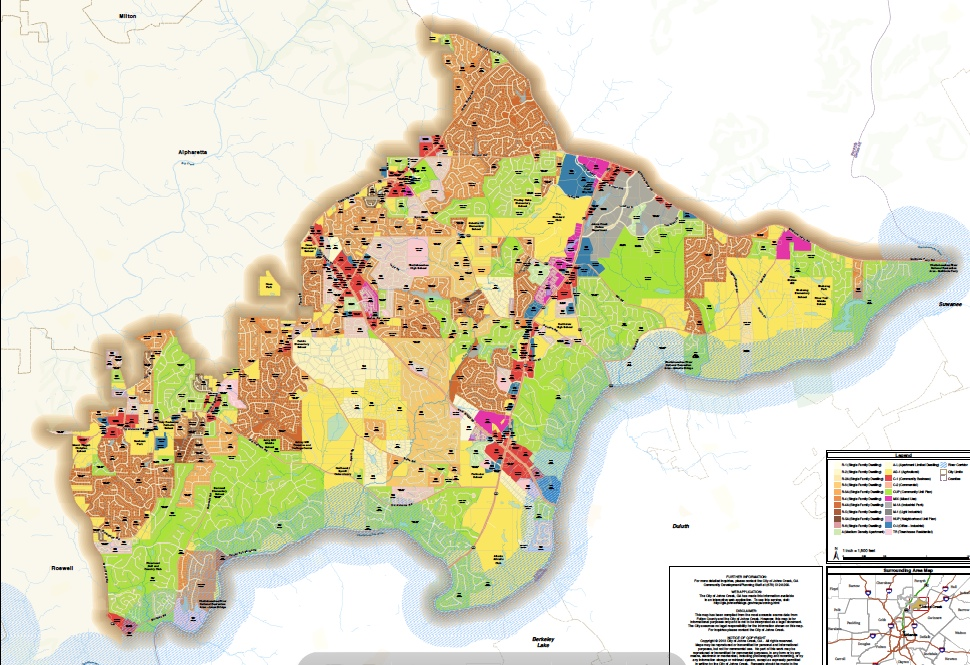
The land use surveys conducted for the preparation of the Johns Creek Comprehensive Land Use Plan back in 2006 found that 56% of the land in Johns Creek is used for residential purposes, 21% is used for commercial purposes, and 23% is used for government purposes (schools, parks, water treatment plant) and green space. At that time, the ratio of residential to commercial land use was therefore 73% to 27% and we know that commercial growth has occurred since then. The statement that the current ratio of residential to commercial valuations is 80% to 20% requires the assumptions that apartments and golf courses are not commercial enterprises, and that commercial properties are not significantly more valuable than residential properties, (which may be true for golf courses). An increase in commercial land use from 27% to 50% will require the consumption of approximately 6200 acres of green space (9.7 square miles) unless new commercial developments have significantly greater valuations than in the past.
With the above facts in hand, we can then ask ourselves is Johns Creek a place for business, a place to find respite from business, or both? I believe we have something very special in our hands right now and we should be careful not to destroy it.