Politics & Government
History Revisited: The Great Locomotive Chase
In 1862, Union spies rendezvous in Marietta to pull off a daring heist, seizing the celebrated General locomotive engine.
This article was originally published on Jan. 11, 2011. Patch is republishing it in honor of the Great Locomotive Chase Sesquicentennial.
On the evening of April 7, 1862, a group of 24 men, two of them civilians and the rest Union soldiers, gathered in a secluded grove just west of Shelbyville, TN. Their leader was an enigmatic smuggler, saboteur and spy named James J. Andrews. In the gloom of the evening with storm clouds forming overhead, he laid out their mission.
Outfitted with civilian clothes and Confederate money, the company was to divide up and make its way across country, traveling 200 miles into enemy territory to Chattanooga. There the men would board a train bound for Marietta. The rendezvous point was Fletcher House, one of two hotels on Marietta’s square.
Find out what's happening in Kennesawfor free with the latest updates from Patch.
Their mission was bold and dangerous: Steal a locomotive and ride it north, severing telegraph cables, destroying tracks and burning bridges as they went.
If Andrews’ men were successful, the Confederates defending Chattanooga would be cut off from supplies and reinforcements. This would enable the Union Army to capture Chattanooga, essentially cutting the Confederacy in half.
Find out what's happening in Kennesawfor free with the latest updates from Patch.
If they failed, Andrews told them, they would almost surely be killed.
After shaking hands, the company dispersed, breaking up into groups of three or four to set out on the journey just as the clouds burst and the rain came down.
Arriving in Marietta
By the time Andrews and company reached Marietta shortly before midnight April 11, they had lost two of their men: Samuel Llewellyn and James Smith had been detained in Jasper and had enlisted in the Confederate Army to avoid capture as spies (this was according to plan–Llewellyn would later desert, making his way back to Union lines). They were also a full day behind schedule, owing to the rain that had slowed them in Tennessee. The delay almost caused them to abort the mission.
But Andrews was resolved to go on. He had spent considerable time in Marietta. He had studied both the town and the railroad. He knew the trains, he knew their times, and he knew their crews and their habits.
He also knew that the morning train from Marietta would stop in Big Shanty and that the crew would disembark to eat breakfast at the Lacy hotel. It was there Andrews planned on making his move.
He and most of his men slept the last few hours before dawn at the Fletcher House Hotel. Two of his men, Martin Hawkins and John R. Porter, slept across the square at the Marietta Hotel.
Enter: The General
Early on the morning of April 12, the men purchased tickets to different stations along the route. Standing on the platform, they pretended not to see or know one another as they waited for the morning train to arrive from Atlanta.
Once again they found themselves two men short: Hawkins and Porter, having failed to tip the bellhop to wake them, overslept and missed the train.
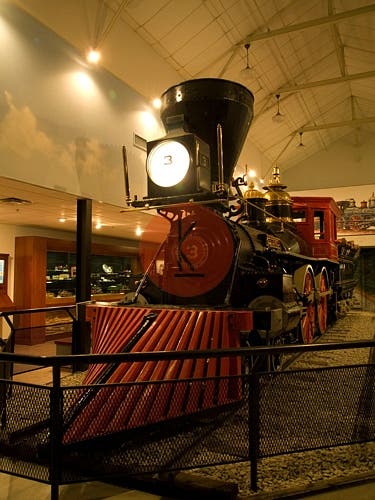
The engine that pulled into Marietta that morning was a beautiful, Yankee-built machine christened "The General." Andrews and his men boarded the train with the other passengers, and the train departed.
Next Stop: Big Shanty
When the General arrived in Big Shanty (modern-day Kennesaw), the young conductor, William A. Fuller, announced a 20-minute stop for refreshment.
Andrews and his men got off with the rest of the passengers. Checking to see that the tracks ahead were clear, Andrews signaled William Knight, an experienced locomotive engineer, to remove the pin and detach the passenger cars from the rest of the train. Then Andrews, Knight and Wilson Brown boarded the engine while the rest of the party climbed into the two remaining boxcars. All of that was done in full view of the idle passengers and the bored-looking Confederate sentries who stood nearby.
Knight released the brake and applied the throttle, and the General lurched forward.
The Pursuit
Inside the Lacy Hotel, Fuller heard a “chug” and looked up from his breakfast in time to see his engine pulling away with its tender and two boxcars. Accounts differ on what was said or shouted, but the hotel quickly emptied.
Thinking that the train had been stolen by rascals or by disgruntled recruits, most of the crowd, including the soldiers, found the scene humorous.
To Fuller, however, it was an outrage, and he took off running at full speed. He was soon joined by the engineer, Jeff Cain, and the crew foreman, Anthony Murphy. The three pursuers ran for two miles until they came upon a section crew with a pole car. Enlisting the crew’s help, they set the pole car on the tracks and added speed to their chase.
The Great Chase
So began “The Great Locomotive Chase,” one of the enduring adventure stories of the Civil War. Many towns in Georgia lay claim to their part in this history.
In Marietta, the first three stories of the Fletcher House, where Andrews and his men staged their exploit, still stand. Today the structure is the Kennesaw House and is home to the Marietta History Museum. The museum includes an exhibit about the Andrews raid and has preserved one of the rooms as it might have appeared when Andrews and his men were staying there.
Other towns also celebrate the chase, as festivals and historic markers attest. The pursuers continued by pole car to Etowah, where they boarded the Yonah, a steam engine used by Cooper Ironworks, and continued on to Kingston. In Kingston, to bypass the congestion, Fuller and company switched to the William R. Smith, continuing until they reached a section of track damaged by the raiders.
Setting out again on foot, Fuller and Murphy flagged down the south-bound freighter Texas, whose engineer, Pete Bracken, expertly backed his freight cars up to Adairsville and dropped them. Then, with a full tender and a fast engine, Bracken, accompanied by Fuller, Murphy and a small group of armed men, put the Texas in reverse and opened the throttle.
This is the point at which the chase may be said to have taken off in earnest. Reaching speeds of up to 60 mph, the Texas soon bore down on the General even as Andrews’ men were attempting to dislodge another section of the track.
The Flight
By the time Andrews and his men reached Calhoun, they had done surprisingly little damage to the tracks themselves, waiting instead to destroy the mountain bridges between Ringgold and Chattanooga. In addition to this, their progress had been delayed by the irregular southbound traffic brought on by evacuees from war-torn Tennessee.
When the saboteurs, attempting to dismantle a section of railing north of Calhoun, looked up and saw the Texas bearing down on them in reverse, they were shocked. Wrongly believing that the Texas was carrying Confederate soldiers from Big Shanty, they abandoned their half-finished attempt at sabotaging the rail and fled aboard the General and her two boxcars.
The half-dislodged railing slowed the pursuers down only briefly. When the Texas began to catch up again, the Northerners tore open a hole in the back of the rearmost boxcar and began throwing crossties into the pursuers’ path. Unfortunately for the Northerners, most of those projectiles, thrown while at high speed, bounced harmlessly off the tracks.
Worse yet, the General was running out of fuel.
Two miles north of Ringgold and 21 miles south of Chattanooga, the General finally gave out. The Andrews crew abandoned the stolen locomotive and set out running, each man in his own direction, hoping to lead the pursuers astray.
This was to no avail. One of the pursuers had jumped off the Texas in Dalton and had sent a telegraph ahead, warning of the saboteurs, just before the telegraph lines were cut. Alerted to the threat, Confederate troops were waiting, and Andrews and his men were soon captured.
Back in Marietta, Hawkins and Porter, who had overslept and missed the train, were also captured once news of the misadventure reached the town.
Afterward
The captured men were taken to Chattanooga to face courts-martial. They pleaded the case that they were U.S. soldiers and had identified themselves as such upon capture and were therefore entitled to be treated as prisoners of war rather than as spies. But the Confederate provost in Tennessee would have none of it. Eight of the men, including James J. Andrews, were tried, convicted and hanged.
Because of the threat of siege, the remaining men were shipped farther south for trial. That probably saved their lives.
Eight of the men, including Hawkins and Porter, who had been captured in Marietta, managed a bold escape and made their way back to Union lines. The remaining men petitioned for their lives, even to Confederate President Jefferson Davis. Treated as prisoners of war, they were eventually released as part of a prisoner exchange.
The Medal of Honor
From 1863 to 1866, Congress awarded the new Medal of Honor to 19 of the men who participated in the Andrews Raid, making them the first recipients of the nation’s highest military honor. Andrews himself, being a civilian, was not eligible.
After the war, several reunions of the surviving participants from both sides took place. An unexpected cordiality developed between William A. Fuller, the conductor who had begun the chase on foot, and William Pittenger, one of the younger participants in the raid. Correspondence between the men has been preserved and shows a friendly humor and respect.
Their mutual respect reflects the attitude of many, North and South alike. The courage and daring of 24 Northerners and the tenacity of a young railroad conductor, all acting out of their own sense of duty and honor, are nothing if not admirable.
To learn more about the Andrews Raid and the Great Locomotive Chase, visit the Marietta Museum of History, located in the off Marietta Square.
For a definitive book on the adventure, read Stealing the General: The Great Locomotive Chase and the First Medal of Honor by Atlanta lawyer and author Russell S. Bonds. For cinematic, loosely based looks at the chase, consider Buster Keaton's classic silent film The General or the 1956 Disney film The Great Locomotive Chase.
The General herself has been fully restored and sits on display at the in Kennesaw.
Interested in the second battle for the General?
For more Kennesaw news, subscribe to our free email newsletter, like us on Facebook and follow us on Twitter.