
Adelma: Sevdalinka in Bosnian culture play a special role. Dear Mrs Sherhart, where does your interest in sevdalinka comes from?
Mrs. Sherhart: I am deeply touched by sevdalinke for a number of reasons. First and foremost by the intense emotion Bosnians hold for these songs. Their reaction to the songs is really what fueled my interest and ultimately what took me to Bosnia for the first time in 2005. As I immersed myself in the genre, the songs revealed their layers of richness – poetic imagery, historic personages and places, cultural references and beautiful melodies. From the great singers like Himzo Polovina, Nada Mamula and Safet Isovic to the most humble singer at a family gathering, these songs are a treasure. The music is the bridge that took me into the greater Bosnian culture and the wonderful people of Bosnia and Herzegovina whose kindness and encouragement has been so generous. I would like to take this opportunity to thank you!
Adelma: Since you are the Head of volunteer organization named “ Sevdah of North America”, tell us briefly how many members do you have, how long this organization exists and what is the primary goal?
Mrs. Sherhart: Sevdah of North America is a non-profit organization formed in 2007 to preserve, promote and document sevdah, the traditional urban music of town centers of old Bosnia and Herzegovina. We are not a member organization, but a group of loosely organized individuals who love sevdah. We recognize sevdalinke as the cultural jewel of Bosnia and Herzegovina and try to encourage it in North America. Sevdah is so much more than simply a beautiful art form, especially for people displaced from Bosnia and Herzegovina. It provides a bridge to the cultural heritage of children born outside of Bosnia, and offers a bottomless well of healing to hearts and souls touched by tragedy, loss and displacement.
Adelma: The readers want to know, if we may ask due to respect, who is in private Mary Sherhart?
Mrs. Sherhart: Truthfully, I am kind of an introvert and love my home and family very much. I am blessed with three wonderful children age 15, 17 and 23. They, obviously, are my top priority. I have always volunteered many hours in their schools. Also, I am a volunteer with the Seattle King County Chapter of the American Red Cross. I love to walk in nature, read novels, write and spend time with friends, too. I love to laugh and can be very silly.
Adelma: What is your definition of Sevdah?
Mrs. Sherhart: Great question, Adelma. A lot has been written describing sevdah and sevdalinke in terms of the music, lyrics and context. For me, it is a window into the universals of the human heart – our hopes and fears, loves and whimsies – as well as into the specific Bosnian heart. Can there be anything more beautiful than the single line, “Snijeg pade na behar na voce?” The picture it paints is so gorgeous, yet at the same time snow on fruit blossoms? Why? What is happening? That single line holds so much poetry and mystery. I get the same feeling from that line as from looking at a masterpiece by Matisse. Words fall short. One cannot define that quality.
Adelma: You are the proof that treasure like sevdalinka does not recognize the borders. You sing sevdalinka really well. How did you overcome language barrier?
Mrs. Sherhart: Thank you very much, Adelma. You are too generous. I speak Bulgarian fluently. Bosnian and Bulgarian both have Slavic roots so that has been a big help. I can understand about 50% of the Bosnian I hear, but cannot speak at that level. As I frequently say: “My Bosnian is totalno bez veze.” That being said, I work very hard when learning a new sevdalinka to pronounce the words accurately and always make sure I understand every word. A sevdalinka cannot be sung with the proper feeling without understanding the text. The singer must know where to put emphasis or a tender touch at just the right time.
Find out what's happening in Lawrencevillefor free with the latest updates from Patch.
Adelma: An interesting story you carry from Bosnia. Can you tell us a little bit about that?
Mrs. Sherhart: While in Bosnia I was the guest of Mr. Omer Pobric and his family in Mulici where the Sevdah Institute is located. On the first night as I lay sleeping in the cardak, there was a dramatic storm with thunder, lightening and wind. During the night I was awoken by something falling in the room. In the morning when I got up I discovered it was the Q’uran. I took it downstairs to show Mr. Pobric and others what page the Q’uran had fallen open to. They explained the text on that page spoke about being on the correct path and staying on this path. What an extraordinary experience and it wasn’t the only one. We all must decide for ourselves if it was coincidence or a sign.
Find out what's happening in Lawrencevillefor free with the latest updates from Patch.
Adelma: Who wrote and composed sevdalinka “The Heart Full of Bosnia?”
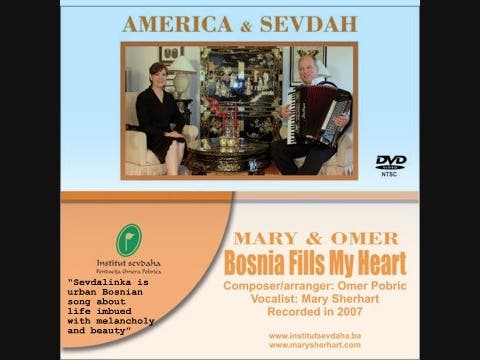
Mrs. Sherhart: The late Mr. Omer Pobric, God rest his soul, wrote "Heart Full of Bosnia" (Srce Puno Bosne). He wrote this song for me to sing knowing that the many Bosnians living far away from home would be especially touched by the lyrics. He was right. It’s brilliant. People love it everywhere and love to sing it. It was a great honor to have someone of Mr. Pobric’s stature take any attention of me whatsoever, let alone write a song for me. A gift beyond measure.
Adelma: It seems that you always radiate with positive energy. What is your inspiration?
Mrs. Sherhart: Life is so precious and tenuous. One never knows when one’s time is up on this Earth. I lost my mother, father and two brothers (one of whom disappeared so there is no grave at which to grieve) by the time I was 21 and had lived in 18 different places by that time. Music and community got me through those rough waters. I feel an enormous responsibility to give back and share that with others. This doesn’t mean I don’t have moments of real despair. In fact, I have episodes of depression, but that’s only normal for my difficult childhood and artistic nature. I believe seeing the dark side of life gives one a unique perspective from which to appreciate life. In a way those troubles were a blessing.
Adelma: Your Website www.sevdahnorthamerica.org records all your shows and performances, but also has an educational character for younger generations. You visited many cities across America. Can we soon expect “The Evening of Sevdah” in Atlanta, Georgia?
Mrs. Sherhart: If we are successful in raising funds, Sevdah of North America will organize an East coast tour of a team of musicians during September 2011 that will include Atlanta. That is a big if. In these tough economic times it is harder to find funding for artistic activities. People are staying home more rather than going out to hear concerts and funders have less money to give. It is in times like this that people need music more than ever, so we will work very hard to reach this goal.
Adelma: How would you describe from your point Bosnian reality today?
Mrs. Sherhart: I am not qualified to have an opinion about this. I am not Bosnian, nor have I lived in Bosnia. The intricacies of the political and religious reality of Bosnia today are confounding. Bosnians have incredible strength and stamina. Your resiliency never fails to amaze me.
Adelma: It is fascinating fact that you very well mastered the Bosnian language, knowing that our language is very difficult to learn. Did anyone help you with that?
Mrs. Sherhart: I wish I had mastered it! Bosnian grammar is so difficult that I believe I will need to live in Bosnia for a year to be immersed in the music and rhythm of the language. Friends here in Seattle have tried to teach me in lessons, but I am a very bad student.
Adelma: Can you say for yourself that you are happy and successful women? What is it that makes you happy?
Mrs. Sherhart: That is a thought provoking question. My reaction is complicated. Yes, I am a happy and successful woman. As I answered previously, I am blessed with a beautiful family and home. I have friends whom I love and am loved, and I get to follow my passion for singing to my heart’s content. However, a shadow of all my early loss and displacement accompanies me minute to minute. It’s kind of like a veil I see the world through.
Adelma: Tell us something about your current projects. For the fourth year in row city of St. Louis is a host of the “North American Sevdah Days.” What are your impressions about these events?
Mrs. Sherhart:The St Louis Festival of Sevdah was another wonderful success. It brought together singers from across America to perform at Grbic Banquet Hall, truly a center of Bosnian life in St Louis, before an enthusiastic audience of all ages. Seattle also held an absolutely wonderful Evening of Sevdah on December 18 and Charlotte combined their sevdah event with the Day of Statehood on December 12. These events, like all community events, are vitally important to maintain fragile new communities and strengthen their identity. Whether it be an Evening of Sevdah, KUD performance, language lessons, all these activities are extremely important for the health of the community.
Adelma: Can you say that you are very ambitious and put your career in the first place?
Mrs. Sherhart: No, my family is first, always.
Adelma: How do you comment the creativity of today’s young performers of sevdalinka, such as: Damir Imamovic, Amira Medunjanin, Divanhana and, can their interpretations of sevdalinka be defined as a kind of urban or modern sevdah?
Mrs. Sherhart: I appreciate their work very much. They are interpreting sevdalinke in a way that younger people will appreciate. There is a place for the traditionalists like me and for those who keep music living, breathing and evolving.
Adelma: It is nearly a year since the death of a legend and doayen of Sevdah, and your friend, Omer Pobric. Is it true that for this occasion you are planning a trip to Bosnia and commemorate the legend of sevdah?
Mrs. Sherhart: That is true. I depart Seattle on January 16 to pay my respects to Mr. Pobric’s family and visit his grave. He was a great man. His energy, drive and creativity combined into an incomparable productive force. His legacy of recordings and publications will provide a wealth of information about sevdah for the future. He touched so many hearts with his music and helped so many musicians and singers in his long and distinguished career.