Health & Fitness
Roxanna Guilford-Blake: Polymer Clay Artist
Artist Roxanna Guilford-Blake talks about polymer clay art.

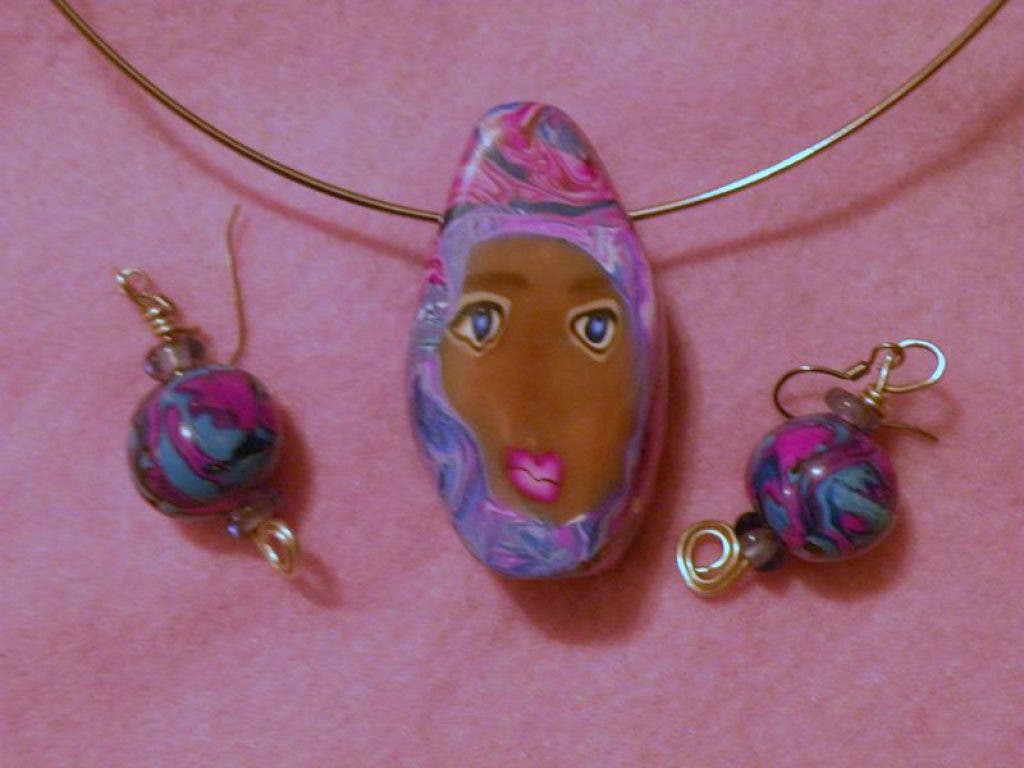


I had no idea what Polymer Clay was, so I’ve asked Roxanna to write about her art. She is charming and her work is delightful.
In Roxanna’s words:
First, let me say that I consider myself a crafter or an artisan. “Artist” seems too heavy a label for what I do, although I will cop to playing at being an artist. “Playing” is fun. And it’s what I do.
Find out what's happening in Lilburn-Mountain Parkfor free with the latest updates from Patch.
I first stumbled into polymer clay many years ago, when someone brought a box of plain while clay to an event I was attending. It wasn’t love at first sight. I tried other media — such as fused glass — but eventually I gravitated back to polymer clay.
Why do I love this medium?
Find out what's happening in Lilburn-Mountain Parkfor free with the latest updates from Patch.
It’s playful.
It’s forgiving: Discarded unbaked pieces and scraps can be turned into something new.
It’s versatile: I can experiment with combining techniques and playing with new tools to define and redefine an object or a design. I never have to be satisfied with what I have; I can always change it to something I like better.
It’s uncomplicated when I want it to be: Other than a sharp blade and a pasta machine, I don’t need any particular tools (though I have collected many over the years). I can “fire” it in my kitchen oven.
It appeals to my senses of sight and touch. I can create an infinite array of colors and textures.
And I love it because it lets me play at being an artist. In school, I never took art classes. Why? I couldn’t draw. I was well into my 30s before I realized that shouldn’t be a barrier.
About my teachers and guides:
I’m largely self-taught in the basics, but I made dramatic advances thanks to three artist/teachers: Carolyn Stearns, Barbara McGuire and Lindly Haunani.
Carolyn led the first workshop I attended. She taught me to make canes, one of the basic techniques in polymer clay. You can see them in at least one of the wings and around the mirror. (I will bring some with me; if you are interested, I can show you.) Perhaps more important, she infused me with her enthusiasm – and emphasized how important it is to pay attention to detail.
Barbara taught me the two techniques that most influence this exhibit: face canes and using polymer clay on canvas. She also is responsible for the themes of this exhibit – the idea of bringing the Feminine to canvas with clay. I’ve made little clay goddess figurines—some of which I will also bring with me--but moving to canvas was thrilling. (Barbara also designed many of the rubber stamps I use to create texture.)
Lindly helped me better understand color: She opened my eyes about how to create palettes and play with tints and shades. She showed me so many different ways to use my favorite technique, mokume gane. Mokume gane (which, as Lindly explains, sounds a lot like “play with clay all day”) is a layering technique. At its simplest, I put several thick pieces of clay in a stack, “distort” the stack by poking it with tools or cutters, and then slice small pieces off. You can see that technique in some of my jewelry and in some of the dresses on my angels/goddesses/fairies.
All three of these women are artists. Polymer clay is still an emerging medium, but we have dozens of gifted artists doing amazing things. I’m learning what I can and having fun in the process.