Business & Tech
The War on Cash By Lewis J. Walker, CFP(R)
The pictures startle...Greeks lined up at ATM machines to withdraw their daily ration of 60 euro per day, about $69 U.S.

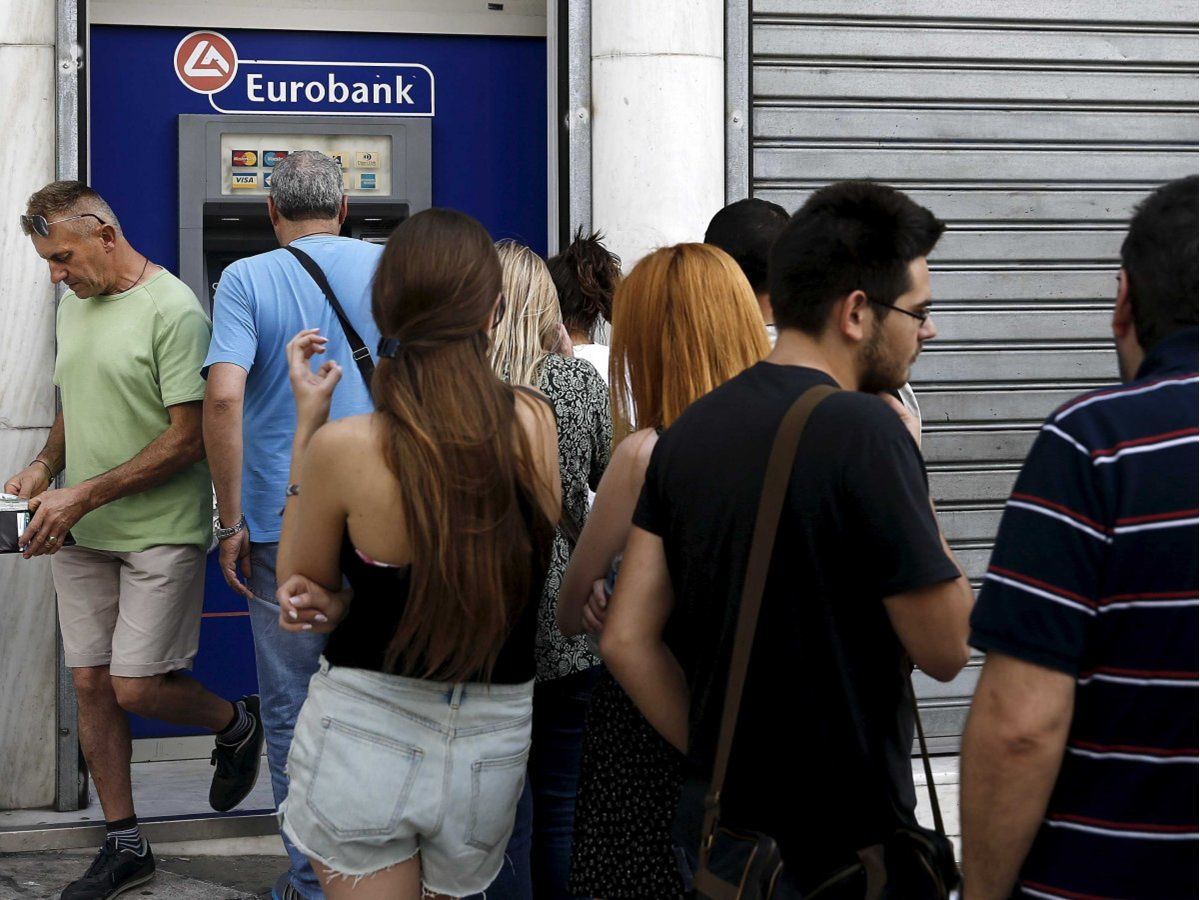
The pictures startle...Greeks lined up at ATM machines to withdraw their daily ration of 60 euro per day, about $69 U.S. at the rate of exchange posted on August 1, 2015. Many banks ran out of physical currency and shut down their machines. Witnessing the dash for cash in Greece, did the voice in your head wonder, “Could that happen here???”
Brian Barrett, Wired magazine, “Greece’s Empty ATM Show the Surprising Power of Cash—in 2015,” 6/30/15, made a thought-provoking statement: “People are realizing that they have far more money in theory than they can get in hand.”
You have net worth. You have money. How much of that can be converted to cash within a short period of time? Are we talking digital cash or currency, and how feasible is spending physical currency?
Find out what's happening in Peachtree Cornersfor free with the latest updates from Patch.
Most of us carry very little currency, relying on credit and debit cards. We rarely write checks, paying bills on line. We largely are a “cashless society.” Barrett indicates that the amount of U.S. currency in circulation fluctuates, but it is about $1.3 trillion, roughly 11% of the total U.S. money stock (M2) of $11.9 trillion. Says he: “The difference seems even more dramatic when you consider that between half and two-thirds of the total value of US currency is held outside of our borders.” The lack of cash is no accident and governments like it that way.
Writing in the July-August 2015 Mises Institute publication, The Austrian, “Why Government Hates Cash,” economics professor Joseph T. Salerno calls it “The War On Cash.” The war is being waged with full support of commercial banks and governments.
Find out what's happening in Peachtree Cornersfor free with the latest updates from Patch.
J.P. Morgan Chase no longer accepts cash from customers making mortgage, auto finance, or credit card payments. They now prohibit the storage of cash or precious metals bullion in their safe deposit boxes.
As a financial planner and investment representative I am prohibited by regulators from accepting cash in payment for securities purchases. Many custodians will not accept third-party checks. Every year I have to complete education in anti-money laundering rules, and that is how anti-cash regulations are sold. The Bank Secrecy Act of 1970 was passed ostensibly to assist U.S. government agencies in detecting and preventing money laundering. But of course, if the government can follow the money trails of criminals, tax evaders, and terrorists, you, too, can be tracked. In our digital age, privacy is gone, by and large.
When you travel there is no limit to the money that can be taken out or brought into the U.S. However, a person or persons traveling together must file a declaration form if they have $10,000 or more in currency or negotiable monetary instruments. If persons or family members traveling together have $10,000 or more they cannot divvy up the currency to avoid the declaration. Can those dogs in the customs area smell money?
On August 1, 2015, rapper Snoop Dogg was stopped by Italian customs for carrying too much undeclared cash, $422,000, about 365,255 euro. Travelers within the European Union are required to declare 10,000 euro or more. News reports said that half the cash was impounded under Italian anti-money laundering (AML) codes. If innocent of AML, Snoop will get his money back minus a fine set by magistrates. Knowing how slow the wheels of justice turn in Italy, Mr. Dogg has made a long-term interest free loan to the Italian government. Que sera, sera!
Once there were $100,000 bills (used by banks to clear money) , 1,000, and 500 American dollar bills in circulation. All were phased out and by 1969 withdrawn from circulation. You still can secure $100 bills and older folks remember when that was big money. People were impressed when you pulled out a Benjamin Franklin! Professor Salerno points out that the hundred dollar bill you stashed away in 1969 now has the purchasing power of $15.50. That’s another example of the war on cash, something to keep in mind if you potentially are a long liver preparing for retirement. How much will your cash cache buy in 20 years? It takes $161 today to buy what $100 purchased in 1994.
Could our government do a Greek job on us? Makes you wonder. Maybe a little “mad money” in hand is not such an outrageous idea.
Lewis Walker is President of Walker Capital Management, LLC. Certain advisory services are offered through The Strategic Financial Alliance, Inc. (SFA). Lewis Walker and Mike Hostetler are registered representatives of SFA which is otherwise unaffiliated with Walker Capital Management, LLC. lewisw@theinvestmentcoach.com