Politics & Government
Residents, Groups Come Together To Share Vision For Sandy Springs
The city held three sessions this week as part of its efforts to update its Comprehensive Plan.




---
With nearly 10 years under its belt, the residents, civic leaders and elected officials who’ve all had a hand in shaping Sandy Springs gathered this week to begin mapping out the city’s future.
Find out what's happening in Sandy Springsfor free with the latest updates from Patch.
The city this week held three meetings to introduce residents to the starting point of updating its Comprehensive Plan, the guiding tool Sandy Springs will use to determine how it develops.
On Monday, the city met with about 120 homeowners association presidents and gave them a chance to discuss the city’s future, said Mayor Rusty Paul.
Find out what's happening in Sandy Springsfor free with the latest updates from Patch.
That meeting, he said, “generated a little bit of heat” during the discussions.
That passion, Paul stated before the start of Tuesday’s session, shows the community “really does care about its city.”
The final session was held Wednesday, and residents took part in breakout sessions where they discussed particular areas of concerns they’d like to see the city address.
The Collaborative, the firm Sandy Springs uses to provide community development, economic development and communication services, facilitated the sessions.
Tuesday’s panel featured the 13 of the city’s most influential organizations, such as Leadership Sandy Springs, Community Action Center, Watershed Alliance of Sandy Springs, Sandy Springs/Perimeter Chamber of Commerce, Sandy Springs Education Force and Perimeter Community Improvement Districts, just to name a few.
The leaders of these groups outlined their challenges and discussed what they believed should be the city’s priorities as it moves into its second decade of incorporation.
For Sandy Springs Education Force Executive Director Irene Schweiger, it’s essential the community lends support to its public schools. The city is ”fortunate” to attract a diverse roundup of companies, but those businesses are going to need a skilled workforce.
About 20 percent of students don’t graduate high school within four years, a statistic Schweiger said the community can help reduce. Embracing these students and getting them on the right path will ensure they are trained to become part of an effective work force, she said.
With that, it’s imperative that the city has some form of affordable housing attainable to middle class residents, she stated.
“Those are the families that will be attending our public schools,” she added.
Chamber President and CEO Tom Mahaffey agreed, stating Sandy Springs needs to see an increase in “moderately priced housing” for its teachers, law enforcement and other public safety personnel.
Echoing those comments were Tamara Carrera, executive director of the Community Assistance Center. Carrera said Sandy Springs should also focus its efforts on working to reduce poverty, supporting before and after-school care, publicizing opportunities for affordable healthcare and supporting mixed-income neighborhoods.
Of course, discussing the future of Sandy Springs would not be complete without opinions about traffic, redevelopment, park space and natural resources protections.
Art Sandy Springs Past President Cheri Morris said the city’s biggest problem is vehicular traffic, a lot of which is using its major thoroughfares such as Roswell Road as a cut-through to get from point A to point B. Additionally, Morris stated she’d like to see the city tackle beautifying Roswell Road to make it more attractive.
Morris also called on efforts to get the city’s business community more involved in what goes on in Sandy Springs. For the most part, those who work in Sandy Springs don’t live in the city. Lastly, Morris also said she’d like to see the city invest in some form of art gallery or art education center and public art projects.
PCIDs Executive Director Yvonne Williams added that while the city is on the right path, more can be done to encourage pedestrian friendly spaces, use of MARTA and finding ways to develop “creative” funding mechanism for transportation projects.
Linda Bain of Sandy Springs Conservancy challenged city leaders to “think big,” and establish a dedicated source of funding for parks and greenspace. She also said the city should explore bringing part of the Atlanta Beltline and Path 400’s trails to Sandy Springs.
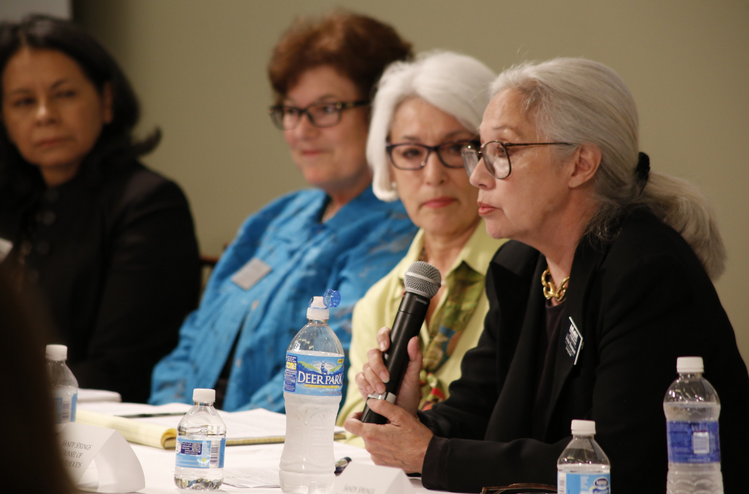
Trisha Thompson of the Sandy Springs Council of Neighborhoods added she’d like to see city leaders come up with a land-use plan that encourages redevelopment while protecting the existing quality of life for current residents.
Sherry Epstein of the Watershed Alliance added the city has to find a balance between supporting redevelopment that does not result in the clear cutting of trees, which has an impact on water quality and erosion.
It’s time for the city to get serious about enforcing its tree ordinance and “set high standards” for developers to live up to if they want to build in Sandy Springs, Epstein said.
Residents on Wednesday braved the rain and packed into Sandy Springs United Methodist Church’s Hitson Center Gymnasium to participate in mini sessions where they opined on what improvements are needed for particular areas -- the Roswell Road corridor, Powers Ferry area and Fulton County’s portion of the PCID. They also addressed what could be done to enhance the environment and quality of life in the city.
Just like the previous two nights, Sandy Springs Mayor Rusty Paul said city leaders were there to just observe what residents had to say, “to watch you work.”
Residents got to work and weren’t shy when it came to sharing their beliefs. Some of the problems along Roswell Road include gaps in sidewalk access, an endless sea of power lines, ever increasing vehicular traffic and limited or no pedestrian crossing access in areas close to residential developments.
The Powers Ferry Road sector of the city, according to residents, will suffer from the inevitable increase in through-traffic when the new Atlanta Braves stadium opens in Cobb County. Some of its other issues include lack of pedestrian friendly spaces, no true identity and no connectivity to the Chattahoochee River, the River’s National Recreation Area or trails in the area.
In the perimeter area, residents called for companies to stagger business hours to reduce traffic congestion, a pedestrian- and bike-friendly bridge that provides direct access to MARTA, improved east-west connectivity from Roswell Road to the PCID, center higher density developments around MARTA stations, amenities catering to children and more gas stations/convenience stores.
Other general needs expressed by residents include more neighborhood parks, more natural greenspace, more dog parks, increase buffers to protect the city’s tree canopy, relocating utilities underground, pushing for modern apartments, increase the inventory of single family starter homes, adhering to the city’s land-use plan on a consistent basis and encourage historic preservation of homes and other structures.
Wednesday’s exercise was a positive experience for resident Helen Tapp, who has lived in Sandy Springs since 1987. Tapp said she likes how the city included residents in the beginning stages of the Comprehensive Plan update “and that they are asking for input in a variety of ways.”
Her hope is for the city to ”set a goal with being the best...place to live, work and play; a place to come to and not just go through.”
Tapp stated she’d like to see the city have a better network of greenspace and trails and a stronger connectivity to the Chattahoochee River and adjacent communities.
Tapp later said she said she felt “great” about the city’s direction, not with just its City Center project, but in other facets where it’s working to improve to residents’ quality of life.
“I think Sandy Springs is coming of age and (is) really being intentional about its future in a very positive way so that we will attract families and businesses in a way that we have long-term vitality,” she said.
---
Photo 1: Trisha Thompson, right, of the Sandy Springs Council of Neighborhoods speaks during Tuesday’s panel as (from right) Linda Bain of Sandy Springs Conservancy, former City Council member Karen Meinzen Mcenerny of Sandy Springs Society and Tamera Carrera of Community Action Center listen.
Photos 2 and 3: residents take part in Wednesday’s breakout sessions.
Credits: city of Sandy Springs
Get more local news delivered straight to your inbox. Sign up for free Patch newsletters and alerts.