Business & Tech
From Tough Economy Home-Based Businesses Are Born
Local women advise to treat a home-based business like a career.

Faced with a tough economy, America’s workforce is adapting. that of America’s 153.2 million workers over age 16, 5.9 million of them, about 3.85 percent, work from home. Lanie White and Loary Coates are two of these workers seeking to find creative career solutions through home-based, direct-sales businesses.
White knew she had to make a change. It was April 2008 and the single mother of two had just been laid off from her job as an administrative assistant at a medical clinic. As she looked for other work, she found that new technology and a tough economy were making her career obsolete.
“My position was being phased out,” White said. “The harder I looked for a position like that, the more I was told that ‘Oh, we’re no longer doing that.’ I was looking at having two kids and having no income in the house and I had to figure out something. So through a series of events I just decided, you know what, I am going to start my own business because I also didn’t want someone to take my only means of income. I figured having a home-based business, no matter what happened to the economy, I’d have a stream of income coming into my home.”
So White became a consultant for Blessing Unlimited, a Dayspring Company that sells Christian-themed books and gifts to clients in their homes.
“The business is my own, but we do have a corporate set of rules we have to follow as would most direct sales company,” she said. “What we do is we take the products you would normally see in a Christian bookstore, the home decor gift products, and we bring them to you in a home setting.”
White enjoys the work she does with Blessings Unlimited because it blends her faith and her entrepreneurial spirit.
“What I love about it is it’s a ministry and it’s a business because I can go into some one’s home and present the religious aspects and the Christian aspects of my faith in a setting that’s non-threatening and it’s welcoming,” she said. “And I’m not pushing my faith on anyone. I’m just telling you what I believe in and allowing you to share that with some friends and family.”
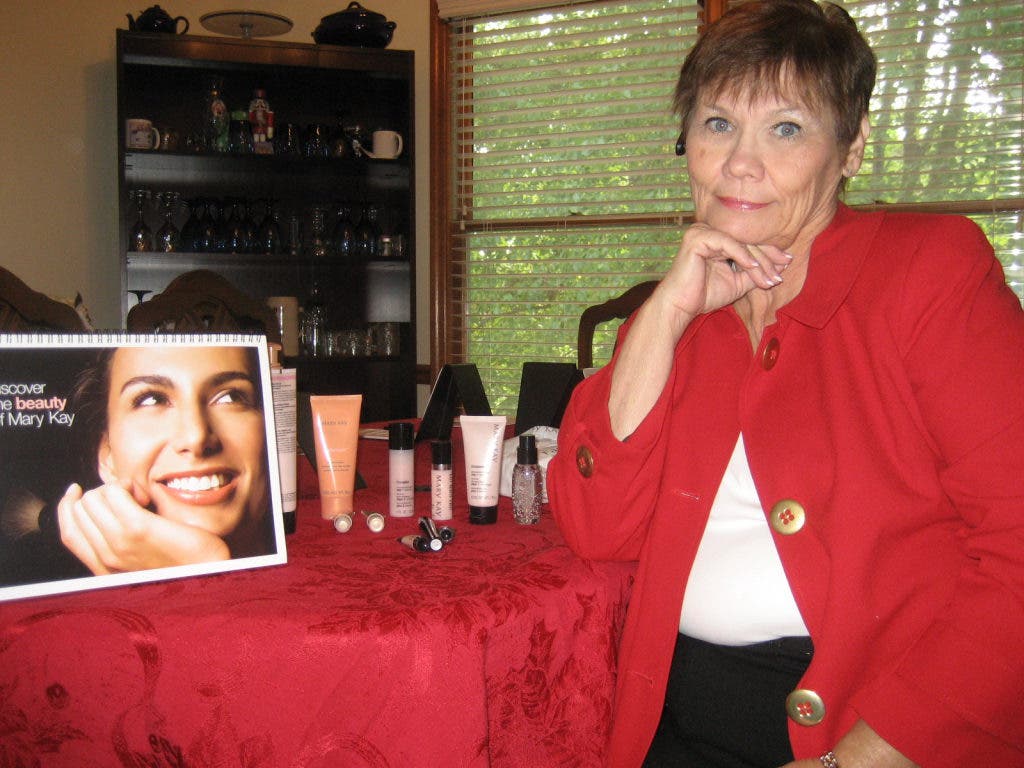
Like White, the economic downturn motivated Coates to pursue a home-based business. She had a successful career as a loan processor until the economy took a turn. At that time, she was already a personal use consultant for Mary Kay, a direct-sales makeup company. As a personal use consultant, Coates received a discount on the products she purchased, but didn’t actively sell to clients.
“When the economy took a turn for the worse, I started paying more attention to the training meetings at Mary Kay,” she said. “And I found out that there were a ton of corporate women out there leaving corporate jobs to build a career in Mary Kay because of the money that was involved in it.”
Eventually Coates left her job as a loan processor and began pursuing Mary Kay full-time. She said she likes the flexibility her job as an independent consultant allows her. She sets her own sales goals from month-to-month based on other demands in her life like church and family.
Though she likes being able to set her own schedule, Coates emphasized that her Mary Kay business is her career, not a hobby.
“Any home-based business you get in, if you want to make a career out of it and make career money, you have to treat it like a career,” she said. “You’re going to have to get up every morning, get dressed, go out. You’re going to have to set goals just like if you were in the corporate world. It’s no different.”
White said this idea is often misunderstood by clients.
“Time is money, but if you don’t approach people in a business-like manner and let them know this is your bread and butter, then they’ll think it is something you’re doing on the side and they will not take you seriously,” she said. “Unfortunately with home-based businesses, we get a lot of that. People don’t think our business is a career because we’re not in a 9 to 5 traditional type of business where they’re cutting us a check. And that can be a challenge that you need to enforce upon people that this is a business.”
Both women use advertising and marketing strategies like any company. White employs what she calls “the three-foot rule.” Whenever she’s within three feet of another person she tries to talk about her business. Coates advertises through the Gary Hill Network and said it’s improved her business “100 percent.”
White and Coates also noted that the key to success in any home-based business lies in a firm belief in the products and the company. White called Blessings Unlimited “a small company with awesome people.” And Coates used Mary Kay for 30 years before she became a consultant.
“I believe in the product,” she said. “And I’m one that if I don’t believe in the product, I’m going to use it. And if I’m not going to use it, then I’m not going to sell it.”