Community Corner
Pace House Gala Celebrates Placement on National Register of Historic Places
Saturday's event celebrates the house being included on America's official list of historic locations.
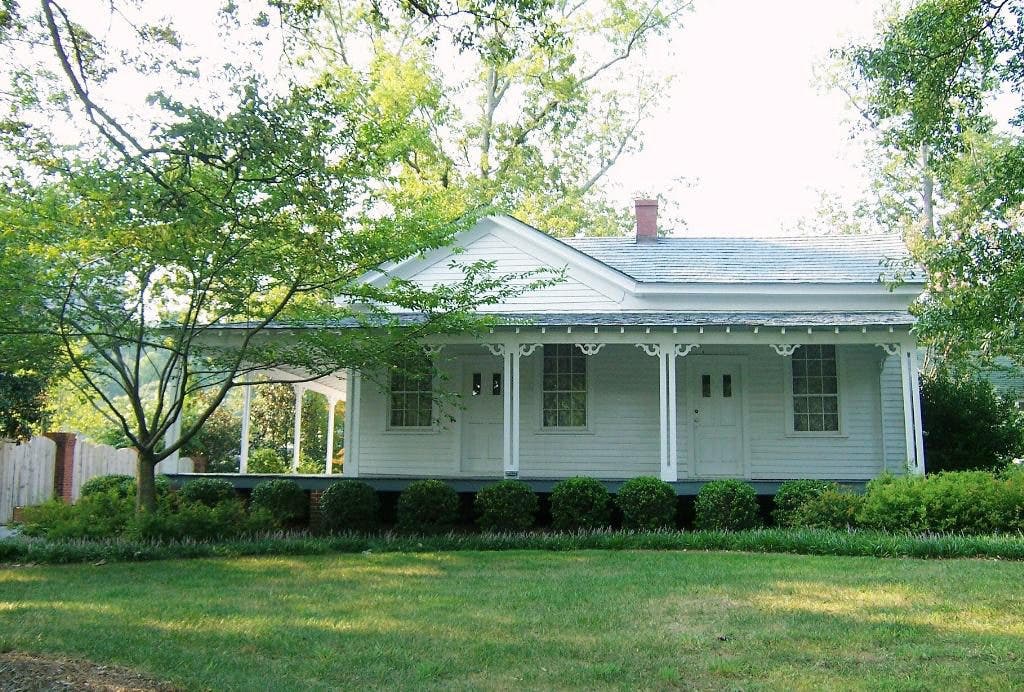
The Solomon and Penelope Pace House in Vinings casts a spell on all who see it. The antebellum era white wood-frame house sits in a lush garden surrounded by trees and greenery. The effect is enchanting and takes you back to a different era.
“Everybody that ever has anything to do with the Pace House gets totally engaged in it,” said Mary Ann “M.A.” Sikes, former president of the Vinings Historic Preservation Society.
Sikes is one of the enchanted. For three years, she and countless volunteers worked to have the Pace House added to the National Register of Historic Places, America’s official list of historic locations. Her efforts will be honored at the Pace House Gala Saturday at 7 p.m.
Find out what's happening in Smyrna-Viningsfor free with the latest updates from Patch.
Sikes admits that getting the Pace House added to the register was no easy task. “It’s so overwhelming to get a designation. It was the hardest thing I’ve ever done,” she said.
There are specific criteria a property must meet to be officially designated by the National Register of Historic Places. According to the NRHP website the property must be old, generally 50 years or more, it must look original and be associated with a significant historic event.
Find out what's happening in Smyrna-Viningsfor free with the latest updates from Patch.
According to Sikes, these criteria don’t even scratch the surface. “You got into the basement of the house and you document any of the original bricks from the house,” Sikes said. “We had the original stone steps, and they were in photographs from the 1800s. It’s just like being a detective. You just go at every angle you can to prove the age of a house.
“They aren’t very lenient about details,” she added. “If you get that designation it’s because you have proved without a doubt the age of that house.”
Some of these criteria were harder to prove than others because of the Pace House’s unique history.
The Pace House was originally built by Hardy Pace, the founder of Vinings. In its original form the Pace House was a 17-room mansion. The Pace family lived therefor years until 1864 when it was occupied by General William Sherman while he planned his siege of Atlanta.
After the war, Solomon Pace, Hardy’s son, returned to find that the house had been demolished. Pace set out to re-build the house using the debris from the property. The house that he built is still standing 150 years later. But after more than century, the house was threatened once again.
“We had a huge amount of development going on in Vinings, and a charming little crossroads Victorian town was changing into more of downtown Atlanta,” Sikes said. “And we were seeing more and more of our old buildings and our old trees getting bulldozed. There was talk of Paces Mill, which is the street that the Pace House is on now, which is two-laned, being four-laned. So we really felt if we had something on the national registry, there was really less chance of that four-lane happening, because they would actually take some of the front yard of that 1880s house to widen the road.”
The Pace House had been denied designation to the register twice when Sikes became president in 2006. But Sikes was under the house’s spell, and she made it her personal mission to have the house added to the list.
“And I really don’t know, why in the world I got into such a fever pitch about it,” she said. “I just kept feeling like it could be torn down at any minute, and it was just vital that I do it right then.”
Sikes set out to work with a team of volunteers, including Clare Isanhour, a local genealogist. The Pace House had worked its magic on Isanhour, too, and she eventually wrote a book about the Pace family titled “Hardy Pace Family: Pioneers in Vinings Georgia.”
Also among the volunteers were two graduate students from Georgia State University, Stephanie Cherry and Kimberly Westcott. Cherry and Westcott were studying historic preservation and made the Pace House Project their thesis assignment. Together the team set up about gathering the necessary documentation needed to prove the house’s age.
Sometimes Sikes felt like she was fighting an uphill battle.
“I just felt as if people took that little jewel of a property for granted,” she said. “I had a hard time even with my own board. They were happy to see me go at the end of my term. With this burning fever I had to get it registered, I wore people out.”
But Sikes and her committed volunteers made great strides.
“I’m humbled by the fact that so many people helped me,” she said. “There were a lot of people that helped before me. It’s just that a lot of things happened. The stars were right.”
Eventually all the hard work paid off, and in May 2009, Sikes got a call from the NRHP.
“Oh my gosh, I could not believe it,” she said. “The executive director called, and I think she left me a message that I should call her right back. I absolutely couldn’t believe it. I really had gotten so discouraged. I thought three years of working on it was enough. I had a few other things to do.”
The Pace House Gala this Saturday will be a celebration of all the hard work put in by volunteers like Sikes, Isanhour, Cherry and Westcott. Money raised from the gala will go to maintaining the Pace House so that it can work its magic on visitors for years to come.