Politics & Government
Q&A: Ga. Attorney General-Elect Sam Olens, Part II
The former Cobb Commission chairman offers his pointed assessment of the local political scene he left behind and the issues facing the county.
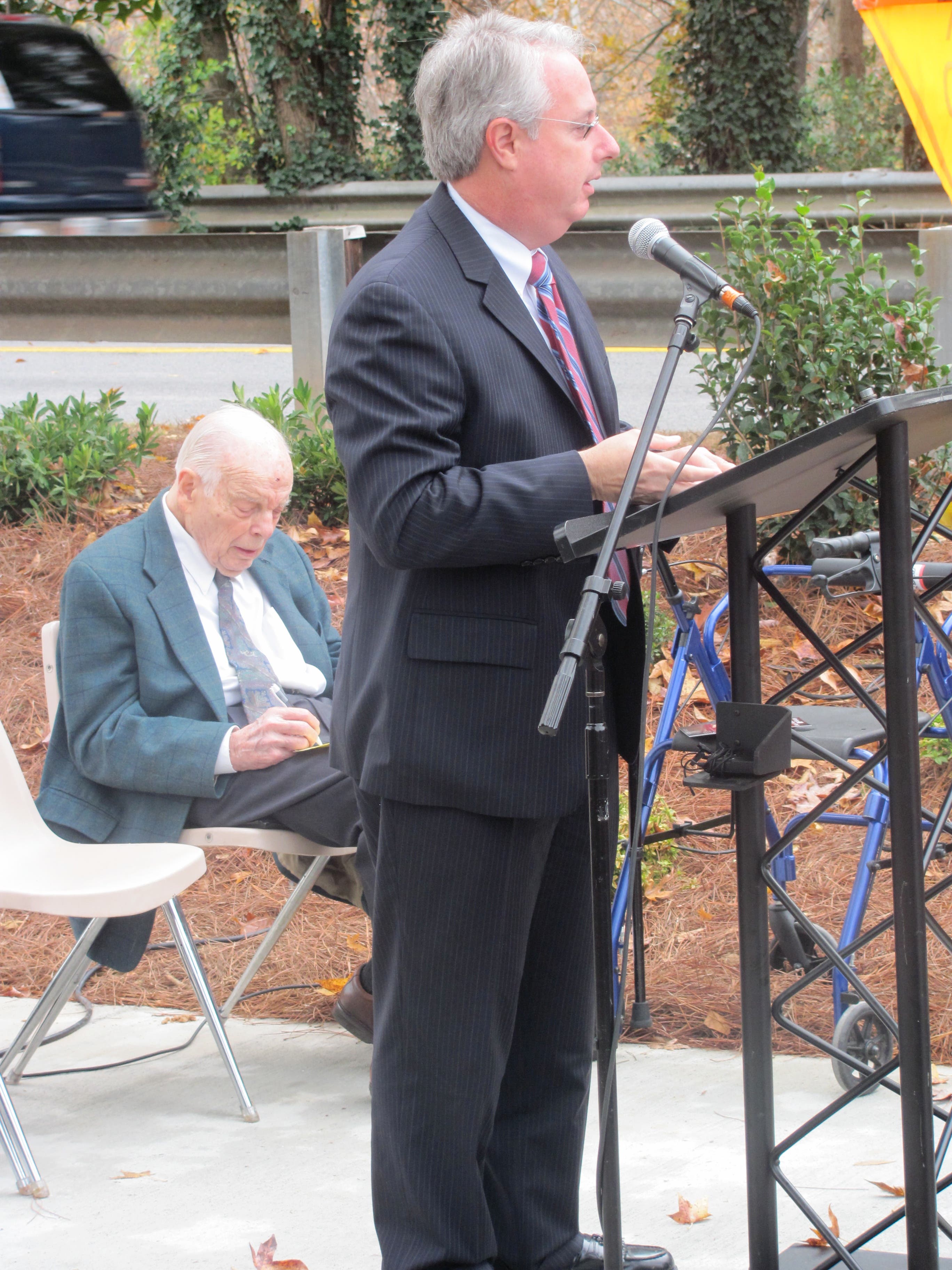
Sam Olens was chairman of the Cobb County Commission for eight years before stepping down earlier this year to run for Georgia attorney general. He was also chairman of the Atlanta Regional Commission for five years. He will be sworn in as the state's attorney general Jan. 10.
Olens, who is 52, lives in East Cobb with his wife and two children. They have lived in Cobb since 1984.
This is Part II of an interview with Olens, focusing on Cobb County. was published Monday. This interview took place before the current commission to hold a March referendum to extend the Special Purpose Local Option Sales Tax.
Find out what's happening in Smyrna-Viningsfor free with the latest updates from Patch.
Q. What was your biggest accomplishment as chairman of the Cobb Commission?
A. I got everyone working on the same page, which is of course not occurring now.
Find out what's happening in Smyrna-Viningsfor free with the latest updates from Patch.
When I took office, the cities and the county were fighting–no longer. When I took office, opinions of elected officials were placed in the newspaper rather than through negotiating and solving problems. And I think we did a lot in those years from both an infrastructure perspective and from a financial perspective–retaining triple A (bond ratings).
The new courthouse, expansion of the jail, the road improvements, the libraries. And I think the parks program was a huge success.
Q. What was your biggest disappointment?
A. I think our public service folks made huge improvements in our areas of high crime. There is still much room for improvement. We need to deal with that Six Flags (area), and there's an area between Smyrna and unincorporated Cobb where we've done a lot with specialized units but there's a lot more that's needed.
Another regret, frankly, is how quickly the commissioners are fighting in public rather than resolving their differences. That's disappointing.
You are elected to solve problems, not elected to highlight problems.
Q. Let's talk about the SPLOST a little. Given how close the last vote was, and the general anti-tax mood of the public, do you think the time is right to ask for a tax extension?
A. The last (2005) SPLOST was very close in large part due to the heartburn many folks had with the school board. That was during the height of the laptop controversy. ... Polling to date shows the public understands the value of SPLOST and the need for it. The polling is favorable, despite the economy.
The discussion that's occurring between needs and wants is very appropriate. ... Let's go line by line of the proposed projects–what's a need, what's a want. Remove all the wants; let's keep it to the needs.
Keep in mind that over 70 percent of the DOT budget is contingent on a SPLOST. So many of the things the public relies on from a transportation perspective are not coming from general funds.
Q. So you think the SPLOST extension is needed for the adequate funding of the government?
A. It would take a property tax increase when you're as lean as Cobb County. And I think the issue for the five commissioners is to pare down the list to assure both themselves and the public that what's being voted on is really what's needed rather than wanted.
Q. Do you think they can do it?
A. I'm unsure.
Q. It's probably not helping much that several public officials, including (County Manager) David Hankerson, have been in the news lately due to fiscal problems in the county.
A. But that has intentionally been placed in the news by folks who want to cause harm to the county. For instance, let's look at the mule issue. (It cost) $80,000 because we weren't able to open up a park. When you have approximately an $800 million budget–that is a statement. ...
The (Dec. 5 Atlanta Journal-Constitution) article that came out on the water system, that preceded me. I chose to solve the problem rather than denigrate my predecessor. The fact that it's getting press now doesn't mean it shouldn't, but you're talking about something that predates me. ...
There's no question that what was done was wrong. ... It's easy now to criticize the county manager, but he was following the directions. And the county commissioners didn't have a clue about it.
Q. These are a lot of public wounds.
A. It's an intentional course of action by about three folks who want a new county manager. And when you've got a county of over 700,000 folks, three folks are getting an awful lot of press.
Q. Who?
A. A couple of them have written numerous letters to the editor in The Marietta Daily Journal.
Q. How will all this affect the government?
A. Much of what we're talking about is inside baseball. ... If you did a poll and asked who the chairman of the county is, I'll bet you over 50 percent don't have an idea. So a lot of this is the political activists, not John Q. Citizen. I think the bigger concern is: Anyone can govern in a good economy. The issue is how you govern in a bad economy. ... It clearly gets harder and harder. That's when you need your elected officials working closer. And I think the real concern here is whether or not the desire to run for commission chair in two years supersedes the desire to maintain the efficient government Cobb residents expect.
Q. David Hankerson has called you "detail-oriented." Is anything slipping through the cracks now?
A. I think David does a fantastic job for the county, and I think the day he leaves, the county will not near be as efficient as it has been. I think Bill Byrne (Olens' predecessor) made an outstanding selection for county manager, and I think there are so many things behind the scenes that David does day in and day out to protect our county.
Q. How do you think the recession is affecting the Atlanta Regional Commission's mission?
A. I think they are doing fine. They are more reliant on federal dollars, so they have been hit less than local governments.
It's all about relationship building (at the General Assembly). And I'll tell you, someone who does it very, very well is (Atlanta Mayor) Kasim Reed, who worked in the state Senate and really understands that. And I would suggest to you that in addition to Mayor Reed and (ARC Chairman) Tad Leithead, we need more of the ARC members to make that same commitment.
Q. Where does Cobb fit into that?
A. It's my hope that Chairman (Tim) Lee will be very active in that regard. He's new (on the ARC), he's attending the meetings regularly, he's learning. There's nothing wrong with spending the first three to six months listening and learning and then getting engaged.
Q. Do you think Cobb will ever see a light-rail system?
A. Cobb needs more transit, and it needs rail transit. Now, what form that takes, other folks will decide. I personally think there's a lot to be said for light rail. ... Clearly we don't have the density nor desire the density for heavy rail. But I think from an economic development perspective and quality-of-life perspective we are going to need more transit than a simple bus service.
Q. When do you see the economy picking up enough to restart the many unfinished housing projects in Cobb?
A. I ran into a builder at the health club who told me he was getting a construction loan and he was building two spec houses. He hasn't started a spec house in over two years. So I think there are signs of improvement, but I think it's going to be a very slow improvement. I think if anyone is expecting a robust economy in the next five years, they are sadly mistaken. It's a new normal.
Q. And that slows down everything?
A. You know there are a lot of positives. Let's face it, we were growing faster than our infrastructure could handle. So, rethinking sprawl ... I mean, when you approve a transportation plan and a decade later you've only done a third of what you promised the public, that's time to rethink. ...
I don't see slowing down as necessarily a bad thing because there was a lot of waste and a lot of inefficiency in the old system.
Q. You started your public career as head of the East Cobb Civic Association. Are lessons you learned there still helping you?
A. You've got to remember I'm an attorney, and a good attorney solves problems. And I think my experience with the HOAs (homeowners associations) really honed my skills to work with people and to solve problems. So I think it was an additional education, similar to my law education. ...
I'm not an accountant. I wouldn't be a good accountant. I'm much more macro.
Q. What does East Cobb look like to you today vs. when you first moved here?
A. Higher quality, less density. When I ran for county commissioner, my example in the campaign was Post Oak Tritt–one subdivision after another of what I called postage-sized lots. Pretty much all built on 7,000-square-foot lots. And the developers were telling the commissioners that the only way they could make money was the smaller lot sizes. Absolutely not true. If you live in a desired area, the developer can make money with a big lot just as much as a small lot. He builds a bigger home. People like the privacy. People like the additional grass.
Q. So you see East Cobb's growth heading in that direction?
A. West Cobb's too. Less density, more quality. North Cobb (the same). And I think in South Cobb there's a push for more quality; it's just more difficult.
Q. How are they going to solve that?
A. It's going to take significant public safety resources. You're going to need more feet on the ground.
Q. You are known for your heavy use of your BlackBerry. Do you text while driving?
A. I can't. My son would report me.