Neighbor News
What will your child be when they grow up? Whatever they choose, math will play a role
Mathematics proves to be a critical skill for every career opportunity. Get a free math booklet to get you started.

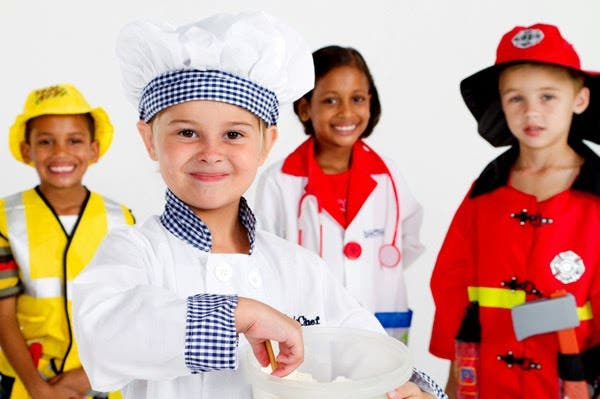
As they ponder their future careers, children may be surprised to learn that mathematical skills and concepts are a part of almost every career opportunity that exists today. Somewhere on the job – whatever that job might be – they are going to use the math skills they learned as early as first or second grade.
“I can not count the number times a child has asked, ‘When will I ever use this stuff?’ The answer is everyday and in almost every profession,” said Richard E. Bavaria, Ph.D., Senior Vice President of Education Outreach for Sylvan Learning. “A child who wants to become a fireman, pilot or veterinarian may be surprised to know how important math is for that profession. Generating excitement for math by relating basic to advanced math skills to real-life uses will help children become more engaged in the subject and develop the confidence and understanding of math that they will need throughout their lives.”
Ask a child to stop for a moment and think of the careers that interests her. They don’t use math, right? Wrong! Math plays a role in many different professions – from a sportscaster to a politician, from a marine captain to a magician.
The math experts at Sylvan Learning, the leading provider of tutoring to all ages, grades and skill levels, spoke with professionals around the country who described how math plays important roles in their jobs. Here’s what various professionals said:
Anesthesiologist: “Before dispensing any medication, I need to calculate my patient’s weight, height and body mass to prevent over or under medicating,” said Jeff Coston, D.O., anesthesiologist at Park Memorial Hospital in Asheville, TN. “Once the patient is medicated, I am constantly monitoring his blood pressure, heart rate, breathing and level of consciousness – I see numbers everyday on the job.”
Computer Game Programmer: “I recently used my math skills to figure out how a camera should be placed in a Law & Order game. The game has several 3D-rendered scenes that the player explores to find evidence for their case. I used math to determine how to rig the camera in the middle of the scenes and to control its movement when a player interacts with the game,” said Stephen Hodnicki, lead programmer, Legacy Interactive.
Nurse: “I knew I wanted a career helping people, but I never thought math would fit into that equation because I thought only accountants and analysts used math on the job. Well, that’s not true!” said Jennifer Wilson, nurse practitioner, Johns Hopkins Hospital. “I use math every day to evaluate a safe dosage of medication for each of my patients. It’s crucial that my calculations are precise to provide safe care to my patients.”
Sportscaster: The role of a sportscaster isn’t just commentating on the game. Much of what he or she does involves tracking players’ performances from game to game during the year and throughout careers. A sportscaster calculates batting averages, earned run averages and other statistics that are basic mathematical foundations learned in elementary school.
Politician: Math plays a key role in helping elected officials manage the budgets necessary to run our Federal, State, and local governments. Politicians determine the taxes that individuals must pay and in turn how these funds will be allocated to support the services and programs that are important to our communities. Another part of the job is using surveys and formulas to understand the issues that are important to his or her constituents.
Marine Captain: “Math is extremely important to the Army and Marine Corps. As an infantry officer, I use maps, compasses and mathematics to help select the best route for my troops, the distance to our next destination and how long it will take to reach a specific location,” said Captain Peter Pace, United States Marine Corps. “An error in route selection can get you lost, late or worse!”
Magician: A magician needs math for a variety of tricks and responsibilities on the job. Many tricks involve understanding probability and counting cards. As well, if a magician wants to entertain a room full of people, he or she needs to calculate how much time can be spent with each person.
Architect: An architect uses math to draw designs for a house, a building or a bridge. The drawings need to be 100 percent accurate because a crew of builders and engineers will follow his or her plans to construct the designs. He or she will draw the beams and rafters used to support the foundation and everything must be drawn to scale.
Pastry Chef: Professional baking often relies on a variety of weights and measurements. Sometimes recipes are given using the metric system that may require the chef to convert a specific number of grams to ounces. Or perhaps a chef is making desserts for 200 people by following a recipe that serves 12, so multiplication will definitely be needed.
Pilot: To safely fly people between destinations, airline pilots must be able to quickly calculate various levels of math problems to determine flight paths, fuel requirements and the maximum weight requirements for a safe flight. Almost every button in a cockpit represents a different calculation that a pilot must understand. One wrong calculation can cause serious trouble for other pilots.
Teacher: “As a former classroom teacher, math was important in every lesson I taught, but also, as the head of the class,” said Richard Bavaria, Ph.D., Senior Vice President of Education Outreach for Sylvan Learning. “In addition to marking papers, calculating test scores and class averages, problem solving was a part of my everyday routine. Whether it was calculating the total cost to take my students on a field trip, or simply ensuring enough individual time for all of my students, I used many of the basic math skills I learned in school.”
Policeman: To reconstruct traffic accidents, law enforcement officials use mathematical formulas to calculate vehicle speed, time and distance. Policemen must be very precise in their calculations because their findings are often presented in courtrooms to prove driver negligence, award property damages, to help accident victims and to improve highway safety.
To encourage math learning and discovery outside of the classroom, Sylvan Learning is offering a free online Math Activity Booklet. Available in the “Parent Resources” area of SylvanLearning.com, the booklet provides 30 days of math writing topics, trivia, questions and puzzles.
Sylvan’s math programs will give your child the edge in the classroom. Learn more about our new Math Edge program and our individualized math tutoring. You can also save up to $100 off our services if you qualify.
For more educational resources for children in grades pre-K through 12, please visit www.SylvanLearning.com or call 888-789-7958.
Susie Hill is the Director at the Suwanee Sylvan Learning, the leading provider of tutoring to students of all ages, grades and skill levels. With 30 years of experience and more than 900 centers located throughout North America, Sylvan’s proven process and personalized methods have inspired more than 2 million students to discover the joy of learning. Sylvan’s trained and Sylvan-certified personal instructors provide individual instruction in reading, writing, mathematics, study skills and test-prep for college entrance and state exams. Sylvan helps transform kids into inspired learners with the skills to do better in school and the confidence to do better in everything else. For more information, call 888-789-7958 or visit www.SylvanLearning.com.