Politics & Government
Governor Responds To Impact Of Coronavirus In Black Communities
Gov. J.B. Pritzker announced plans to expand the availability of COVID-19 testing and alternative housing options for communities of color.


CHICAGO — Gov. J.B. Pritzker and public health officials Friday outlined steps aimed at addressing the dramatic racial disparities of the new coronavirus on black communities in Illinois. Data shows black people in the state have suffered a vastly disproportionate number of infections and deaths from COVID-19, the disease caused by the virus, compared to to white Illinoisans.
"Many could have told you what it would highlight long before the data drew the picture," Pritzker said. "Generations of systemic disadvantages in healthcare delivery and healthcare access in communities of color — and black communities in particular — are now amplified in this crisis, in the city of Chicago, suburban cook County, in greater St. Louis, in cities in towns all across our state and across our nation."
Black people make up less than 15 percent of the state's population but over 43 percent of deaths, more than any other group, according to the Illinois Department of Public Health. As of Friday, 258 of the nearly 600 people who have died from the virus were black. Of the half of confirmed cases where public health officials had demographic information, 30 percent were black people.
Find out what's happening in Across Illinoisfor free with the latest updates from Patch.
Illinois Coronavirus Update April 10: More Than 15,000 Cases in Illinois — Don't miss updates about precautions in the Chicago area as they are announced — Sign up for Patch news alerts and newsletters.
Find out what's happening in Across Illinoisfor free with the latest updates from Patch.
IDPH Director Dr. Ngozi Ezike said her department had created a COVID-19 equity team with community organizations and representatives of other state agencies to focus on addressing the stark racial disparity.
"Health disparities and inequalities are major concerns to me as the public health director and I've always encouraged our agency to use a health equity lens in every aspect of the work we do. In our COVID-19 data we see alarmingly high rates of COVID-19 in the black population. This disparity is true both for cases and in the deaths. Overall mortality rates among blacks are five times higher than whites and when you break it down by age groups the disparities are even higher."
Black people are 10 times more likely than whites to die of coronavirus in their 70s, eight times more likely in their 60s and 12 times more likely to have a fatal case of COVID-19 in their 50s, according to Ezike. There were a range of contributing factors, she said, including black workers having jobs with a higher rate of exposure, fewer black Illinoisans having health insurance and more living in extended family settings. Chronic underlying health conditions also play a role, she said.
"We will not stand idly by while one segment of the population bears an unfortunate heightened burden of this disease," Ezike said, pledging to increase testing among the state's disproportionately impacted populations. "We must address the dramatic disparity we're seeing. We've got to tackle it head on and we hope that these steps will start to do just that."
The state health director also announced a new text messaging campaign for the latest information. People can text "COVID" to 312-500-3836 for updates in English or "COVIDESP" for Spanish language versions.
IDPH data shows that black people make up 13 percent of those tested, compared to 24 percent of white people. But while 18 percent of white people tested positive, the COVID-positive rate for black people was 35 percent. A similar disparity appears when whites are compared with Hispanics, who made up just 4 percent of those tested. As of last week, black people made up over 70 percent of the coronavirus deaths reported in Chicago.
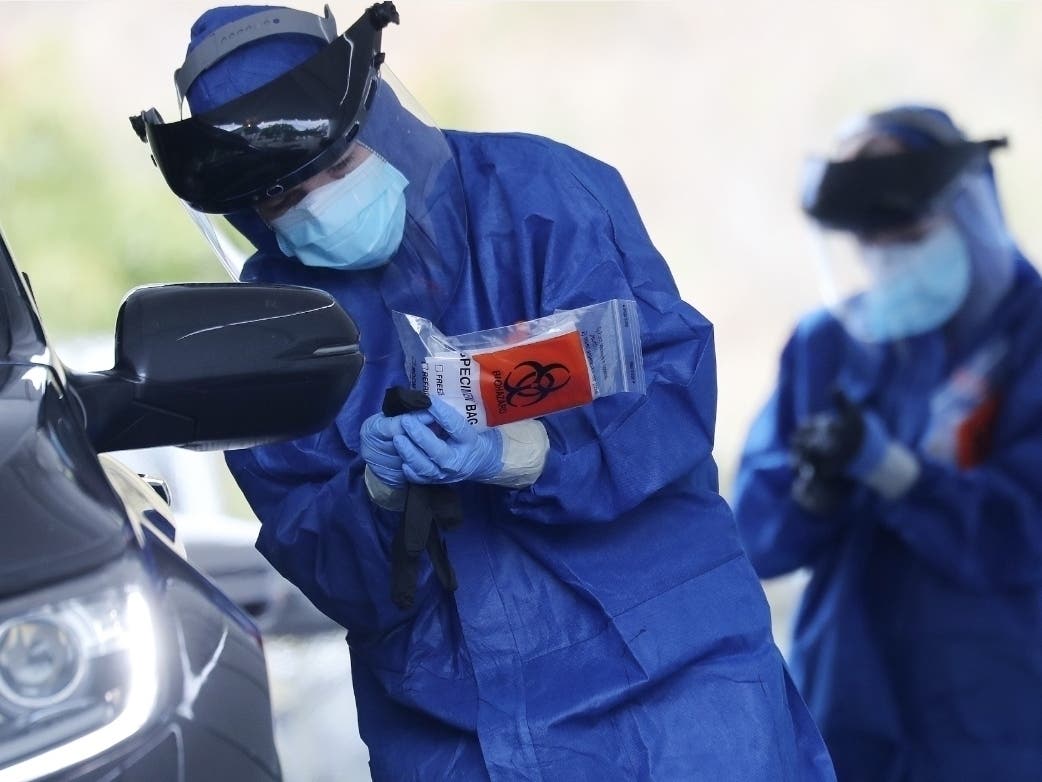
Pritzker said the state would establish new drive-thru testing centers in south suburban Cook County, had prepared alternative housing plans for thousands of people who are unable to quarantine themselves and was distributing Abbott machines capable of processing rapid coronavirus tests to community health centers on Chicago's South Side, West Side and the East St. Louis Area.
The federally qualified health centers are also involved in a partnership with hospitals to expand the availability of testing in black communities, Pritzker announced Friday at his daily briefing on the state's response to the COVID-19 pandemic.
In the greater St. Louis area, three locations of the Southern Illinois Health Care System will collect 470 specimens per day and send them to Anderson Hospital in Maryville. In Chicago, Lawndale Christian Health Center and PCC Community Wellness Center on the West Side, and Chicago Family Health Center and Friend Family Health Center on the South Side, have partnered with the Ann & Robert H. Lurie Children's Hospital. They will collect an addition 400 specimens per day to be tested at Lurie's Chicago hospital.
"What Anderson and Lurie are doing — looking beyond their front doors to see how they can help — this represents the very best of Illinois. I can't thank them enough. " Pritkzer said. "No community is getting through this alone. The fastest way through is maximizing our resources throughout Illinois, and these hospital labs are stepping up to make that happen for all of us."
A state-run drive-thru testing center in the Markham-Harvey area is due to open early next week, according to the governor. It is expected to conduct hundreds of tests a day, with results coming back within 49 hours.
Dr. Horace Smith, a physician at Lurie and the pastor of a South Side church, said he was not surprised by the racial disparities in health care exposed by the pandemic.
"These are issues that have been in these communities for a long time, and oftentimes because of the ability for us to ignore what's happening, it takes something catastrophic for us to really pay attention," he said. "We must, deliberately with all of us together, face the unpleasentries of what's happening in our nation. It is a very unique situation, that African Americans and Latinos and others who have been vulnerable for a long time are hit the hardest."
Smith welcomed the new community testing centers and emphasized the need to ensure adequate health care supplies and to understand the disparity in access to care.
"Health care is a trust issue. If there is a community that does not trust institutions, you can live next door to a hospital, but you will wait until the last minute to go to the emergency room. That is not good health care," Smith said. "If there is no trust, then there will not be accessibility."
Pritzker also announced an alternative housing plan that could allow for up to 2,000 hotel rooms across the state to be activated next week in Springfield, Rockford, the Metro East, the Quad Cities, Schaumburg, Mt. Vernon, Peoria, Carbondale, Quincy, Marion, Macomb, Champaign and the collar counties.
"These hotel rooms are for people who tested positive for the virus but have low-level symptoms and don't need hospital-level care. There are other rooms available for people who were exposed to a COVID-19-positive person, and are therefore a person under investigation, who may need to move out of their home as a precautionary measure to make sure that they don't expose their families or their roommates," Pritzker said. "This extends to our first responder communities especially."
The state health department has set aside $6.8 million of its COVID-19 response funding to support local health departments as they manage the alternative housing arrangements. The hotel rooms are in addition to the state's expanded alternative care capacity at McCormick Place, Westlake Hospital in Melrose Park, MetroSouth Hospital in Blue Island, Sherman Hospital in Elgin and Vibra Hospital in Springfield, Pritzker said.
The governor said the federal government had granted a request to use Veterans Administration facilities to treat COVID-19 patients, as needed.
Pritzker said the 15 Abbott rapid testing machines provided by the federal government were being deployed around the state while officials work to obtain more materials beyond the 120 initial tests provided. Seven of the machines were allocated to the community health centers involved in the testing partnership with Anderson and Lurie; five will be distributed to Illinois Department of Corrections facilities in Stateville, Graham, Logan, Dixon and Menard; and three more will go to Illinois Department of Human Services facilities in Park Forest, Kankakee and Elgin.
"We're making sure that our plans reflect equity in access, in testing and in treatment, and we're asking the same of health care providers across the state. It is essential that health care institutions operate to fulfill their obligations to render health care in an ethical and nondiscriminatory manner," Pritzker said, announcing new guidance on non-discrimination in medical treatment.
"This is a crisis, and providers may have to operate beyond their normal capacity and allocate limited health care resources. No one life is any more important than another," he said. "Today we issued guidance that vulnerable and historically marginalized communities must receive equitable care so that no person of color or person with disabilities suffers a disparate outcome due to a legacy of discrimination. It's in moments like these that we owe each other even greater expressions of humanity."
Get more local news delivered straight to your inbox. Sign up for free Patch newsletters and alerts.