Community Corner
65-Year-Old Algonquin Man Climbs Kilimanjaro With His New Knees
In the late 2000s, he wasn't even able to play with his son. Thanks to a surgery and lots of effort, he mastered Africa's highest peak.


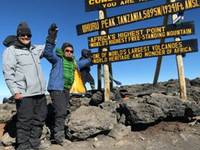
MT. KILIMANJARO, TANZANIA — In late 2010, Jack Groppel was unable to play in the backyard with his son, Shen, due to bad knees. Seven years later, after two knee surgeries and months of physical therapy, the 65-year-old Algonquin resident found himself at the summit of Mt. Kilimanjaro, Africa's highest peak, with now 12-year-old Shen by his side.
In the early '70s, Groppel suffered two knee injuries from playing tennis — one from landing on his foot awkwardly, which twisted and damaging one knee, and another during the Big 10 Tournament in Madison, Wis. when he overcompensated for his injured knee. Arthritis that worsened over the years made him increasingly unable to do the things he loved.
"As a teen, I grew up hiking and camping. I love the outdoors," said Groppel, an Eagle Scout who once accompanied his dad on a road trip adventure to Alaska.
Find out what's happening in Algonquin-Lake In The Hillsfor free with the latest updates from Patch.
As a lover of both the wilderness and tennis, Groppel had a difficult time psychologically as his knees worsened and his joints scraped together, bone on bone. Still, he kept putting off the surgery.
"I put my life on pause," he said.
Find out what's happening in Algonquin-Lake In The Hillsfor free with the latest updates from Patch.
Then, one day, he fell down a stairwell. The accident caused immense pain and more damage to his knees. He wasn't enjoying his life.
"I said, 'That's it. I'm gonna get this done.'"
It was time for him to hit the play button again.
On Nov. 8 of 2010, Groppel finally got a bilateral knee replacement. He was determined to play tennis again as well as play with his son.
Groppel has a PhD in exercise physiology, so he's no stranger to how the body works and what is necessary to recover from such a surgery. So he worked hard in physical therapy, following his medical team's instructions to the T. It was a huge challenge.
In 90 days, just as his physical therapist had said, he was active again and playing tennis regularly. He wanted to use his newfound energy to the max.
Recalling the trip he and his father took to Alaska, he said he wanted to do the same for his son, whom he adopted from China in 2008. "I wanted to have an adventure with my son."
So they began training. Shen trained like crazy in karate, and Jack played lots of tennis for cardio. And they hiked — a lot.
With backpacks and hiking poles, they trekked hills and trails in the area and went on a three-day hike at the Starved Rock River Bluff in the state park. "It was three days in a row with seven hours of hiking each day," he said. "We needed to train our bodies to be ready to hike long distances each day with backpacks and poles."
On Aug. 2, Shen, Groppel and his new knees began their six-day trek up Kilimanjaro. Located in Tanzania, near the Kenyan border, Kilimanjaro is the highest mountain in the world that requires no mountaineering equipment to summit. The local guides and porters nicknamed Groppel "Chuma Mtu," Swahili for Iron Man, because of his metal knees.
Shen was a big reason for undertaking the adventure, said Groppel, who asked himself, "Was I going to be the best dad, person and leader as I could be?"
The base of Kilimanjaro is 15,300 feet above sea level and the peak is at 19,341 feet. At that altitude, the air gets extremely thin, making breathing more and more difficult as the hiker ascends. "It was hard," Groppel said. "You have to stop regularly," to catch your breath, especially if you're not acclimated to high elevations.
Then, on Aug. 7, Groppel and Shen reached the summit.
"I could not have done that before I had the surgery," Groppel said.
At ages 65 and 12, he and Shen were the oldest and youngest people to summit Kilimanjaro that week.
It took them a day-and-a-half to descend the mountain. Anybody who hikes knows that downhill treks are especially rough on the knees — even more so when your legs are fatigued from the hike.
But Jack was unfazed.
"Everything hurt but my knees," he said.
"Everybody faces mountains every day," Groppel added. "I wanted to have a journey with my son, an adventure with him we’d remember for the rest of our lives. That was really the stimulus for the entire trek."
He's got a bit of advice for people with physical limitations who want to push their own play buttons on life again. The most important thing, he said, is to "get your doctor's clearance and work with your medical team.
"Once you have clearance, dream. Set your aspiration. I couldn't play in the backyard with my son, let alone on a mountain. Don't let a physical limitation hold you back if there's something you can do."
Article image used with permission of Jack Groppel
Get more local news delivered straight to your inbox. Sign up for free Patch newsletters and alerts.