“Do not let Alzheimer’s be how you define a person,” is the advice given by Mayo Clinic’s Health Education Outreach Coordinator, Angela Lunde. This view was a result of lessons she learned when she observed a man named Floyd, who provided care to his memory-impaired wife for many years.
Many in the field of Alzheimer’s care are echoing Floyd’s sentiments. For instance, Eric Portnoff, Regional Director of Memory Care and Programming for Sunrise Senior Living, which provides “special neighborhoods for the memory impaired” within their communities throughout the Chicago area, the U.S., Canada and the UK, recently told me, “That is part of the mission of our health care teams, to see something deeper - to show people that we can all look deeper and realize that gifts of wisdom, love and compassion cannot be taken away by a disease”.
When one considers the devastation individuals and families can feel as a result of Alzheimer’s, it’s pretty bold to say “wisdom, love and compassion cannot be taken away by a disease”. But, it makes sense when one considers the most essential nature of anyone’s being.
Find out what's happening in Algonquin-Lake In The Hillsfor free with the latest updates from Patch.
Increasingly, patients and caregivers are coming to the conclusion that no one should be defined by the disease they are facing. When we view someone within the context of a disease, we make their body (and/or brain) the essence of their identity. Yet more medical studies and spiritual, non-medical care practices indicate that this is not the case.
Looking deeper and finding the person beyond the disease, enables caregivers to help patients continue living a productive life. “I know a woman, a former secretary, who was diagnosed with Alzheimer’s disease”, said Sarah Bradford, Associate Director of Operations, Chicago area, Sunrise Senior Living in an interview.
Find out what's happening in Algonquin-Lake In The Hillsfor free with the latest updates from Patch.
“We [the care team] decided to keep her engaged in an activity that made her feel purposeful. She now helps with filing and deskwork. This brings a sense of meaning and purpose in her life and helps to fulfill her basic human need of feeling loved and wanted.
“Two of the biggest components of increasing decline is isolation and lack of engagement. So, one of our real priorities is that individuals with memory loss have plenty of opportunities to stay engaged,” Portnoy stated.
He continued, “We have community service projects that connect people to the outside community and effect positive change. It is important that the individual realizes his life still has meaning, and is important.”
A pioneer in the study of spirituality’s effect on health, Mary Baker Eddy, wrote about the importance of seeing beyond the person engulfed in dementia or any other disease. Starting from the standpoint of spiritual wholeness, Eddy concluded that disease is a false way of identifying ourselves. She urged physicians and theologians to gain an understanding of the powerful effect of defining ourselves and others spiritually.
She wrote in her seminal work on spirituality and healing, Science and Health with Key to the Scriptures, “Man is more than a material form with a mind inside which must escape from its environments in order to be immortal” (p. 258). Her healing practice taught the health benefits of understanding the spiritual nature of man as God’s creation.
We can choose the right definition of each of us - loved and wanted – a healthier way to think about ourselves and others.
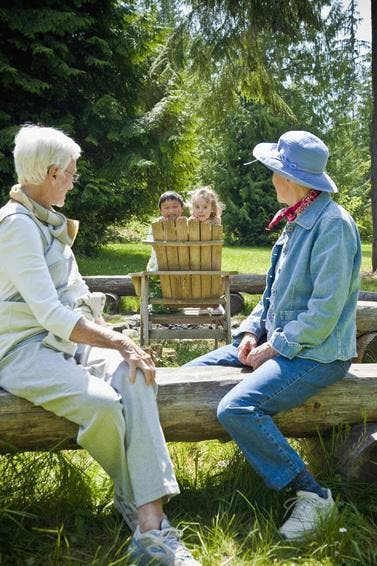
Picture ©Glowimages Models used for illustrative purposes only