Crime & Safety
Chicago Tylenol Murders Still Shock Area, Nation, 40 Years Later
Thursday marked the 40th anniversary of a series of poisoning deaths that changed the way over-the-counter products are packaged.


ARLINGTON HEIGHTS, IL — Forty years ago this week, the nation was gripped with fear. During a three-day span from Sept. 29 through Oct. 1, 1982, what would become known as the Chicago Tylenol murders were tragically playing out across the suburbs of Chicago. In the end, seven people died after the over the counter pain reliever was laced with cyanide in a case that remains unsolved to this day — baffling police and citizens alike not just locally, but across the country.
"I just remember how shocking it was," Patch reader Kerry Neidel told us earlier this week. "And the fact that they never caught the person was even more shocking. I became much more observant of over-the-counter drug purchases to see if they were tampered with."
According to police, the person or people responsible for the deaths of local residents removed bottles of Tylenol capsules from the shelves of several grocery and drugs stores in the Chicago area. They then filled them with cyanide and placed the tampered bottles back on the shelves at the following locations: Jewel Foods, 122 N. Vail Ave. in Arlington Heights; Jewel Foods, 948 Grove Mall, Elk Grove Village; Osco Drug Store at Woodfield Mall in Schaumburg, where two laced bottles were found; Walgreen Drug Store, 1601 N. Wells St., Chicago; and Frank’s Finer Foods in Winfield.
Find out what's happening in Arlington Heightsfor free with the latest updates from Patch.
On Sept. 29, 1982, Mary Kellerman, 12, of Elk Grove Village, became the first victim after taking a capsule of Extra-Strength Tylenol. The Washington Post reported at the time that she had stayed home from school that day due to a cold and was given the capsule by her father. Soon thereafter, she became ill and fell into a coma, dying before paramedics arrived at the Kellerman home.
Hours later, three members of the same family — Adam Janus, 27, of Arlington Heights, his brother, Stanley Janus, 25, and Stanley's wife, Theresa Janus, 19, of Lisle — all died after taking Tylenol from the same bottle. The Washington Post reported that Adam Janus had taken the medicine at his home for aching muscles. He collapsed and was taken to Northwest Memorial Hospital, where he would die.
Find out what's happening in Arlington Heightsfor free with the latest updates from Patch.
Stanley and Theresa were at the hospital with Adam when he died. After his death, they went to his home, grief-stricken over their loss. They then took Tylenol capsules from the same bottle as Adam Janus had. Both collapsed and were taken back to NMH, where they subsequently died.

In the days that followed, Mary McFarland, 31, of Elmhurst, Paula Prince, 35, of Chicago, and Mary Reiner, 27, of Winfield, also died under similar circumstances.
RELATED: Tylenol Crisis Recalled 38 Years Later Amid New Halloween In Flux
Reader Gayll Wright reached out to Patch, saying she bought McFarland's Elmhurst home a few years after the tragedy.
"I sometimes think of her, and the two boys she left behind, and hope they are both doing okay," Wright said. "Whatever monster is responsible for this despicable act is probably long gone by now and took the secret to his or her grave."
PACKAGING REFORMS
Helen Jensen, a retired Arlington Heights nurse, is credited with being the first person to suspect tainted Tylenol bottles were responsible for the deaths of the Janus family members. She found the deadly bottle of Tylenol minus six capsules taken by the family members, along with the receipt showing that it had been bought earlier that day.
“It was when we lost our innocence,” Jensen said of the murders during an interview with Patch on the 35th anniversary of the case in 2017. “[It was] the first act of terrorism.”
RELATED: Nurse Who First Saw Tylenol Connection Remembers Murders 35 Years Later
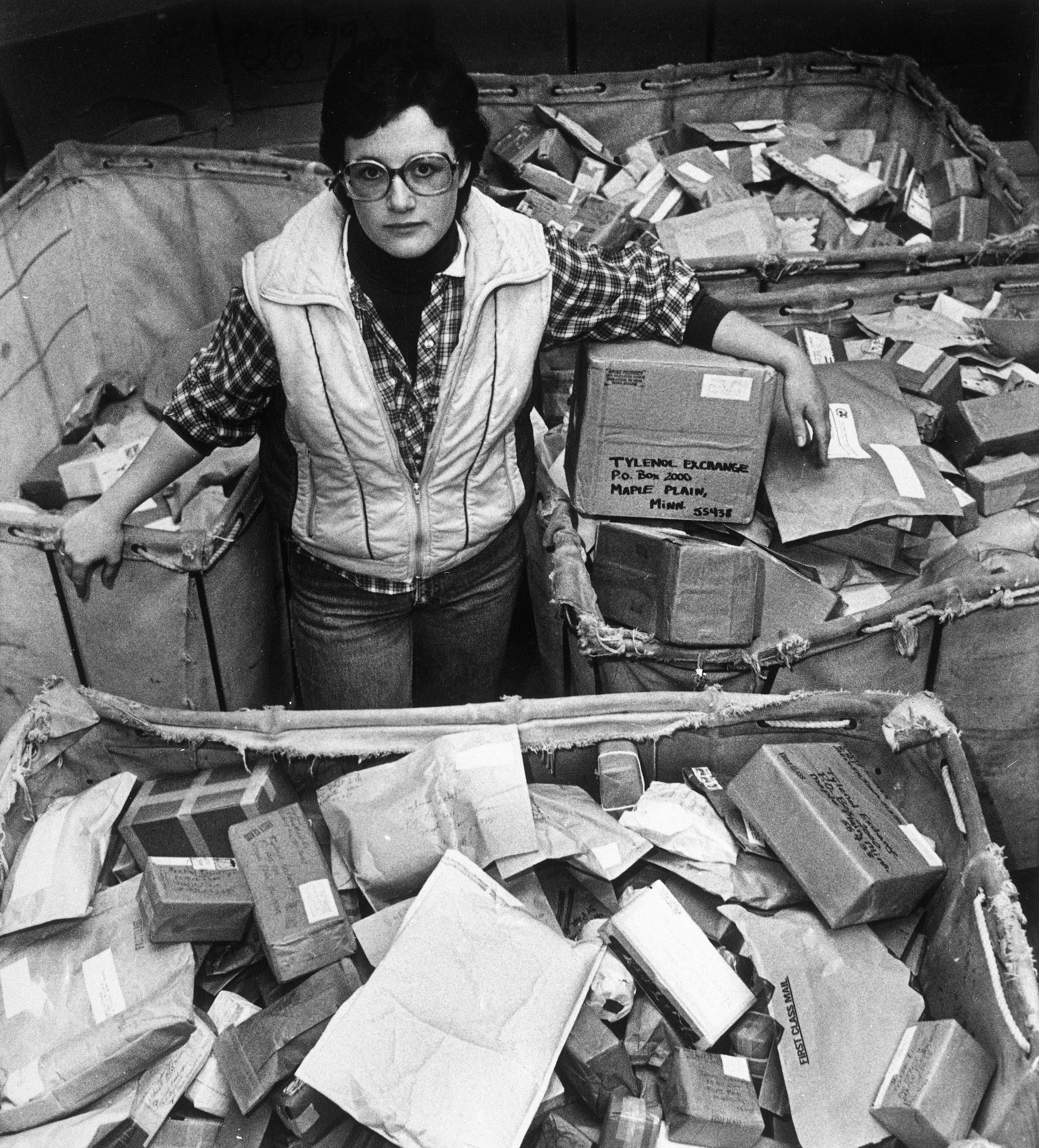
In the months following the deaths, Johnson & Johnson recalled more than 31 million bottles of Tylenol capsules across the country. Customers were asked to mail back to the company packages of the capsules in exchange for caplets or tablet forms of the drug, or for a full refund.
Drug companies like Johnson & Johnson, along with food and other consumer industries, began rolling out tamper-proof packaging for its products, a practice that remains in place today. The FDA also enacted new regulations designed to avoid any future product tampering.
POSSIBLE BREAKTHROUGH IN CASE
Despite numerous leads over the years, the Chicago Tylenol murders remain unsolved, though a sole suspect continues to be investigated. James W. Lewis, a former Chicago resident, was convicted in 1983 of attempting to extort $1 million from Johnson & Johnson, stating in a letter he would stop the killings in exchange for the money. Lewis served a 12-year prison sentence for the crime.
The Chicago Tribune reported last week that investigators have renewed their efforts to pin the Tylenol murders on Lewis, who is now 76 and lives in Cambridge, Massachusetts. Sources told the Tribune that investigators traveled to the Boston area recently to interview Lewis, who maintains his innocence despite the extortion conviction.
Illinois State Police, the Cook and DuPage state's attorney's office and a number of suburban police departments are also involved in the effort to link Lewis to the crime, the Tribune reported. While a lack of physical evidence in the case continues to hold things up, law enforcement officials describe recent findings as a "chargeable, circumstantial case," according to the newspaper. At the same time, it appears charges against Lewis are not imminent and may not come at all.
In 2013, the FBI, which had served as the major investigating body of the case for a number of years, turned the case over locally to the Arlington Heights Police Department. Arlington Heights police recently told the Tribune the investigation is "active and ongoing." Patch reached out to several investigators involved with the case, but has not heard back.
Get more local news delivered straight to your inbox. Sign up for free Patch newsletters and alerts.