Neighbor News
Assessment Update from Cook County Assessor Fritz Kaegi
In 2022, my office reassessed properties in Barrington Township. Why is this important?

As your Cook County Assessor, I want to update you on how assessments and property tax burdens shifted following the just-completed reassessment and appeals cycle for the north suburbs. Why is this important? Because the property tax bill you will receive in the coming weeks is not only affected by your property’s assessment but the assessments of other properties in your neighborhood too.
In 2022, my office reassessed properties in Barrington Township. At the beginning of this process, each property owner receives a Reassessment Notice containing an estimate of the value of the property. Then, property owners have an opportunity to appeal if they believe they were overvalued. The first round of appeals occurs at the Assessor’s Office, and the second round at the Cook County Board of Review. Once appeals are completed by the Board of Review, state law requires that I certify their changes, resulting in the final assessed values (AVs). The final AV is what will appear on your property tax bill this fall.
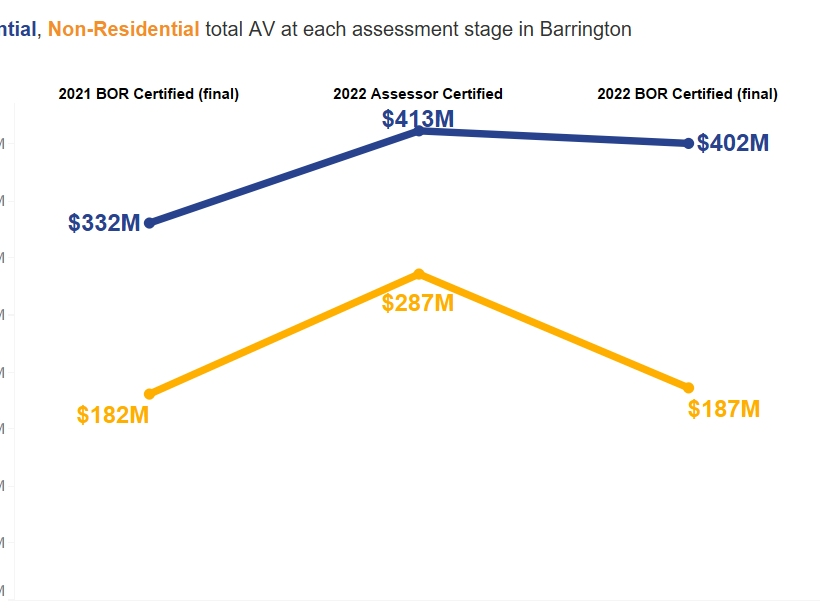
As a result of our reassessment of Barrington, its total AV rose 36% to $700M, with residential AV up 24% to $413M and non-residential up 58% to $287M. This growth reflects higher market prices and new building activity.
Find out what's happening in Barringtonfor free with the latest updates from Patch.
An increase in an individual property’s assessment does not necessarily cause an increase in its tax bill, for two reasons. First, if a property’s assessment increases at the same rate as others and local taxing bodies don’t increase levies, the property tax bill could remain steady. Secondly, if a property’s assessment increases, but by a lesser percentage than other properties, and local taxing bodies don’t increase levies, the property tax bill could decrease.
However, the Assessor’s Office is not the final arbiter of appeals and assessment changes. Appeals that are granted at the Board of Review affect everyone else’s tax bills. Here's why: The reductions given by the Board of Review decrease the total AV, which affects the tax rate, and increases the percentage of tax levies paid by homeowners. Before the Board of Review's appeals, homeowners would have paid approximately 59% of the levy. After the Board of Review's appeals, homeowners are now scheduled to pay approximately 68%.
Find out what's happening in Barringtonfor free with the latest updates from Patch.
In other words, for every $1 of reduction that the Board of Review granted to residential properties, it granted $9 to non-residential properties. As a result, residential property owners bear more of the burden than they would have otherwise.
The good news is that appeal filings are down at the Assessor’s Office and the Board of Review Offices. In the tax year just completed, appeals at the Assessor’s Office were down 21% from 2019, and down 30% from the previous North Triad year of 2016. According to data released by Board of Review, their appeals for this cycle were down 5% from 2019.
So, what happens after the appeal process? The Cook County Clerk calculates property tax rates for every unit of government in Cook County. Then, the County Treasurer sends out the Second Installment Property Tax Bills that are due December 1. Be sure to check the bottom left of your property tax bill to ensure you are receiving all the exemptions you qualify for. If you’re missing any exemptions, please visit cookcountyassessor.com/certificates-error so you can apply for a Certificate of Error, which will enable you to be refunded for property tax you may have overpaid.