Community Corner
Collection Drive Helps Formerly Homeless Vets Turn Empty Apartments into Homes
19th Ward leading way in citywide collection of personal hygiene, household, kitchen and cleaning goods for Chicago's homeless veterans.


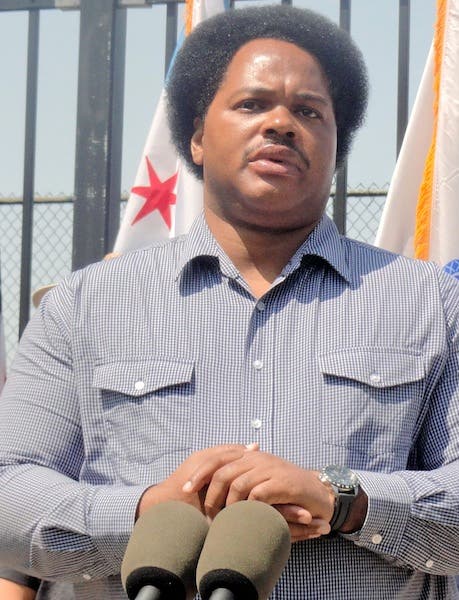


Photos: U.S. Marine Corporal Robin Little, Ald. Matt O'Shea, Mayor Rahm Emanuel and other officials at the launch of Operation Help-A-Hero at Mt. Greenwood Park on May 21, 2016.
Chicago,IL, May 30, 2016 -- The first time U.S. Marine Corps veteran Robin Little walked through the doors of his own apartment he felt his life getting a reboot to the person he was before injuries and lingering trauma from his years in Desert Storm forced his descent into homelessness.
For a while, the 43-year-old decorated military veteran did everything right. He was able to earn a degree at University of Illinois at Chicago with an Illinois Department of Veterans Affairs grant. He seemed to be transitioning back into civilian life, avoiding the pitfalls that disrupt so many other veterans’ transition after military service. But then in 2008, injuries from his time in service -- four herniated discs and sciatica -- came back to haunt him.
Find out what's happening in Beverly-MtGreenwoodfor free with the latest updates from Patch.
“I extended my credit which led me to homelessness,” Little said. “I was living piecemeal and dealing with the anxiety and depression of the uncertainty of where I was going to be.”
Twice he was forced into homeless shelters. He rented out corners of basements from people who were trying to make their own ends meet. The disability checks he received weren’t enough to save properly for an apartment he could afford.
Find out what's happening in Beverly-MtGreenwoodfor free with the latest updates from Patch.
With the help of the Chicago Housing Authority working in tandem with the Department of Veterans Affairs, the 43-year-old veteran was able to move into his own apartment.
“I finally have a place that is totally mine,” Little said. “Only I have the keys. I came in and go out as I please.”
On moving day a brand new bed was delivered to Little’s new apartment, as well as dishes, silverware, glassware, everything he needed to turn his apartment into a home.
“It all came through on one single day and one single delivery,” Little said, who, in addition to his back injuries suffers from anxiety. “This can be done to other vets who find themselves homeless not through self-defeating or illicit behavior but can be from a lone injury that they have incurred during their time of military service.”
With the understanding that for formerly homeless individuals to successfully maintain permanent housing, it is critical that they receive support, including some basic items to independently.
“When a veteran leaves a shelter for transitional housing and then moves in an apartment, they need everything to set up their place and be able to sustain,” said Joe Palmer, a Vietnam War veteran and executive director of Northbrook-based Military Outreach USA.
“If we can initially give them household items to help them out they can spend their money on other things, like paying utilities, buying food or paying for transportation to get to a job or hospital,” Palmer added.
To help formerly homeless veterans set up their households, the city is holding a collection drive called Operation Help-A-Hero. The initiative is being led by Ald. Matt O’Shea (!9th) in collaboration with the Chicago Park District, Mayor Rahm Emanuel and aldermen across the city.
Throughout the month of June, residents are urged to drop off new personal hygiene, kitchen, bathroom and cleaning items at their local wards offices or at 20 park locations citywide. The collection drive is the first program of its kind undertaken by any city specifically targeting veterans and active military.
“Homelessness among veterans is a disgrace and it’s a cause we should all be engaged in,” O’Shea said at the program’s launch.”Today one in 10 adults experiencing homelessness in the United States is a veteran. Unfortunately even after many of our veterans find housing they struggle to afford the most basic necessities the rest of us take for granted, like shampoo or a toothbrush.”
In the past year, building on the White House’s Ending Veterans Homelessness Initiative, the city has housed more than 2,100 formerly homeless veterans. Unfortunately, about 700 veterans -- some with families -- remain in shelters and transitional housing.
The city, through EVHI, is working to create a system that provides a safety net for veterans, where any episode of homelessness is rare and brief, said Victor Lagroon, director of the Chicago Office of Veterans Affairs.
“I have a personal stake,” Lagroon said, an Army veteran who served in Afghanistan. “These are the folks I’ve served and sacrificed with. When I came home I had an opportunity to be gainfully employed and have stable housing. Each and every veteran and their families deserves the same thing.”
So that no veteran or active military member ever experiences housing discrimination, Chicago’s Commission on Human Relations approved Mayor Emanuel’s ordinance making veterans, active military, reservists and National Guard members a protected class.
The city has also launched a new resource website to improve coordination of citywide and private programs to help veterans find the right resources to address housing, financial, employment, medical and mental health needs.
A list of the most commonly requested items by veterans moving into permanent housing can be found at Operation Help-A-Hero. All donations will be collected by Military Outreach USA, which will be distributed through the Jesse Brown Veterans’ Affairs Medical Center.
As for Little, he is enjoying decorating his apartment and paying it forward to help other veterans in his situation.
“I feel like a contributing citizen to society again,” he said. “Instead of going to food banks and always needing their help, now I’m in a position where I can donate to food banks.”
Get more local news delivered straight to your inbox. Sign up for free Patch newsletters and alerts.