Community Corner
Fabric artists are the “mask makers of the Ridge”
Local police receive donated masks



The Ridge communities are home to many creative artists and crafters who work with fabric, needle, and thread. In the past few months, these people have turned their talents to a new project, making face masks.
By now, everyone is aware of the guidelines that have been issued by the Centers for Disease Control and Prevention (CDC) and the World Health Organization (WHO) that face masks or coverings should be worn in public places to help prevent the spread of COVID-19, the virus causing the worldwide pandemic.
Some people may carry the virus but show no symptoms of illness. Since they can still spread the virus through nasal and oral droplets, properly wearing a mask blocks transmission. The masks are just one preventive measure. Hand washing, social distancing (spacing six feet apart), and avoiding crowded places are other important safeguards.
Find out what's happening in Beverly-MtGreenwoodfor free with the latest updates from Patch.
Illinois and Chicago safety rules, taken from the CDC and WHO guidelines, include that anyone over the age of 2 wear a mask or face covering when they leave home, especially if they will not be able to maintain six feet of distance from other people. Exceptions are made for medical conditions that would be aggravated by wearing masks, such as certain respiratory problems.
Wearing masks has been standard procedure for medical personnel for over 100 years. But the idea of the general public wearing masks, a practice common in some European and Asian cities, is entirely new in the U.S.
Find out what's happening in Beverly-MtGreenwoodfor free with the latest updates from Patch.
There are different kinds of masks. It is recommended that N95 respirators and surgical masks be reserved for health care workers and first responders (police, fire fighters) because there are inadequate supplies. For the general public, cloth masks are advised.
With these new safeguards, people initially scrambled to find masks. Those with sewing skills immediately stepped up to start making a supply.
The Quilter’s Trunk, a fabric and sewing supplies shop at 10352 S. Western Avenue, in cooperation with 19th Ward Alderman Matt O’Shea’s office, started community efforts by providing free mask-making kits that included fabric and a pattern. Enough fabric to make 6,100 masks was given away. Although the free mask program has concluded, the store is still collecting finished masks to distribute to medical personnel, first responders and the elderly. Masks may be left in the red bin outside the front door. A pattern for making masks can be downloaded from the website www.thequilterstrunk.com.
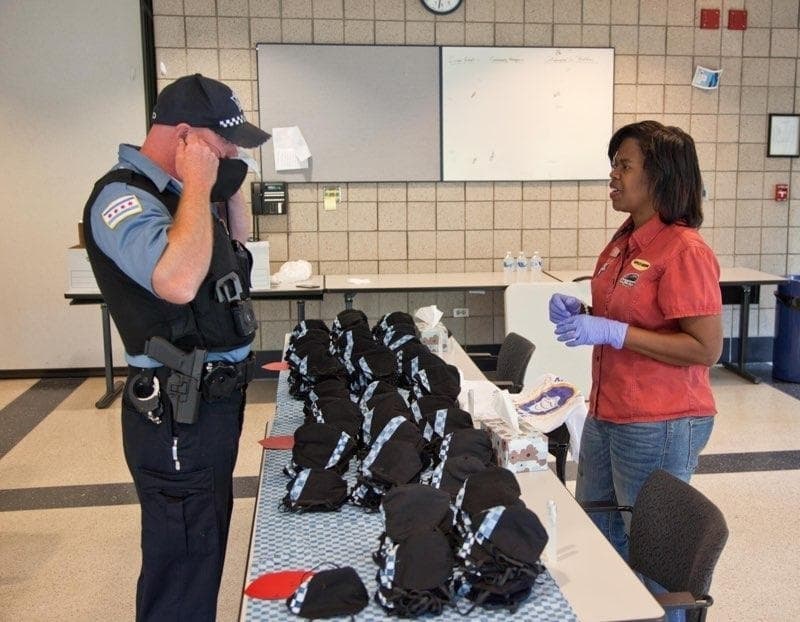
Dorothy Straughter, a Beverly artist whose medium is primarily quilts, delivered masks she made to the local police and fire departments on June 3rd. She made 320 masks in four different sizes for the entire District 22 police force and personally fitted one to each officer present.
“Giving face masks to police officers was a gesture of solidarity. I saw this as something positive that could be done in the community right now, to let good police officers know they have public support,” said Straughter, who began working on the masks in April.
Straughter started researching and adapting patterns and making masks a month earlier than that. Her masks have gone to Marian Joy Rehabilitation Center, Shirley Ryan AbilityLab, Mercy Hospital, Blue Cap, the University of Chicago and individual senior citizens and people with respiratory ailments.
An occupational therapist by profession, Straughter has become known for her quilts which portray themes connected to African American history and culture in the United States. She became interested in quilting when a neighbor showed her an Underground Railroad quilt she had created.
Said Straughter, “My first reaction to quilting was ‘old people do that.’ But through quilting, I am able to merge art and history. Black history is American history and it has been ignored for too long.”
Her work has been featured in many exhibits and articles. Recently, she had an exhibit at the Beverly Art Center, “Hidden Messages – A Hip Hop Quilt Event,” exploring the Hip-Hop movement’s place along the continuum of Black history.
Marcia Thomas was the neighbor who started Dorothy Straughter on quilting. On a whim, Thomas and a friend took a class in quilting, and she fell in love with it.
Thomas, a big fan of Quilter’s Trunk, learned that the store was getting calls for masks. She decided to get involved. Noting that quilters always have a stash of fabric, Thomas used her own resources to make hundreds of masks that she has donated to doctors’ offices, friends in the nursing profession, and other friends for daily use.
Said Thomas, “I am amazed at what has been possible with mask making. I work regularly with four ladies and between us we did easily 1,000 to 1,200 masks. And they were gladly given away. But that is just one corner of Beverly. There are so many more quilters and sewers who did so much more. I’m talking sooo much more. And I can’t tell you how much we valued Quilter’s Trunk. It was a good thing to do.”
Along with a career in sales, Thomas has been an active volunteer at Morgan Park Academy for many years. She became certified in artifacts through a program at the University of Chicago and assists with the archives collection.
Sandra Leonard, another artist living close by, put a project for the Art Institute of Chicago on hold while she made masks using the Quilter’s Trunk kits.
Believing in the importance of giving back to the community, Leonard said, “This was right up my alley. I had the facilities and the time.”
Her completed masks have been returned to Quilter’s Trunk to be distributed, and have also gone to doctors, nurses, police, fire fighters and hospitals in the area. They are also going to college with Leonard’s daughter.
Leonard is known for her “sculptural costumes” used in her performance art productions, as well as in art installations and exhibits that have appeared internationally. She recently completed animal and dinosaur costumes that will be used at the Field Museum of Natural History.
Leonard is also considering making masks to sell commercially. She notes, “People are throwing away paper masks and the heavy-duty ones should go to hospitals and medical personnel. There is a need for washable fabric masks. I would donate a portion of sales to food relief efforts.”
In Mount Greenwood, Michaeline “Mikki” Carping has been busy making over 850 masks, using her own fabric and supplies. Carping has been sewing since she was 13, and she made most of her children’s clothes when they were younger.
“I used to do all the sewing of the costumes for Cassell School when my kids went there. We actually had a roaring twenties dance and I made all the flapper dresses. It was such a great time through the years,” said Carping.
Carping got involved in making masks when an acquaintance “tagged” her on a Facebook post. Her masks have gone to nurses and a woman who works with the homeless, and to friends’ children and grandchildren for going back to school. Masks that Carping made for the Little Company of Mary Hospital pediatrics ward had child-appropriate patterns and themes.
A favorite experience Carping shares relates to a 5-year old girl who was leery of masks. Carping made matching masks for the child, her mother, and the little girl’s doll, which went over so well the fear of masks was soon forgotten.
In addition to the masks, Carping, who worked as an insurance liaison, devotes her sewing and crocheting talents to other charity causes. She makes blankets and hats for Neonatal Intensive Care Units, and was involved with Marlene’s Angel Babies, which made burial gowns for stillborn and deceased infants from donated wedding gowns.
Beverly artist Nicole Burns, who sells her collection of fabric bags, dolls, and other items under the name Ni Bu Design, approached mask making from a practical and personal perspective.
“I knew I needed something to protect myself and my family, like my father who has heath issues. This was also a way to do something for the community,” said Burns. Most of her masks have gone to family and friends.
Burns, who worked in commercial photography and prop styling, has a love for vintage fabrics, and creates sculptures from repurposed and recycled everyday goods. Like many of the other mask makers, she had plenty of fabric on hand. She reports she has a stack of masks still to be completed.
Burns referred to a Facebook page for a group called “Nice Chicks with Sewing Machines,” which describes itself as a “group on the South Side of Chicago, making masks, headbands and ‘mask extenders’ for donation.” The group has been contacted for more information.
Sometimes, at a given moment, it is the little things in life that count the most. Not everyone can go into a laboratory to develop a vaccine against the virus, but they can use their skills and resources to do practical things like make face coverings to help people deal with the virus on a daily basis.
These are just a few of the people who are mask makers on the Ridge. As other contacts are provided, their stories will be shared also.