Community Corner
Historic Charles S. Young House Chooses New Owners
"The People of the Ridge" explores the restoration of an historic home in Blue Island.



From the Ridge Historical Society: The People of the Ridge
History is made every day by people involved in interesting situations. “The People of the Ridge” features articles on local people, past and present. This article explores the restoration of an historic home in Blue Island.
For Joe Leamanczyk and Ben Walker, their purchase of the Charles S. Young House in Blue Island was more than just a real estate deal. It was a commitment to a long-term relationship with a noble house that reached out to them to be saved. They have been restoring and renovating the house for almost a year now, and hope to be able to move in by the end of October.
Find out what's happening in Beverly-MtGreenwoodfor free with the latest updates from Patch.
Although they planned on getting a house sooner or later, the couple, who met in 2012 and married in 2015, was not actively looking when the desolate mansion at 12905 Greenwood Avenue beckoned to them. They currently live in Uptown on the north side of the city.
Leamanczyk was born in Blue Island and grew up in Beverly, attending St. Barnabas School and Marian Catholic High School. He ran an art gallery, Riverbend Studio, for a time in Blue Island. He often takes shortcuts through Blue Island streets on his way to the southwest suburbs, but still, he did not connect with this house until late July 2019.
Find out what's happening in Beverly-MtGreenwoodfor free with the latest updates from Patch.
“I drive down Greenwood Avenue all the time, and I never paid attention to this house before,” said Leamanczyk. “One day as I was stopped at the stop sign at the corner, I noticed the house for the first time. It was so overgrown I didn’t even see the for-sale sign then. I thought to myself, someone needs to do something about that house.”
The following week, as he was browsing on-line for houses for sale in the Blue Island area, the house popped up right away. Intrigued, he told Walker he was going to just take a look at it. He set up an appointment with the real estate agent, and on the day of the visit, while waiting on the porch for the agent to arrive, he kept telling himself, “Do not fall in love with this house, do not fall in love with this house.”
“Then I walked in the door. The house had such a good spirit to it, I fell in love with it right away. It felt like home to me,” said Leamanczyk.
Walker, who was not part of the first tour in person, was kept apprised of the visit by phone.
“I knew Joe was really taken when he kept sending me texts about how many Christmas trees could fit in the house,” said Walker.
Leamanczyk and Walker closed on the house in October 2019 and became the fourth owners of the property.
The house is part of the historic area of Blue Island. It was built in 1886 for Charles S. Young (1849-1910). The architect is not remembered but hopefully the name will resurface one day.
Charles Spencer Young (1849-1910) was the oldest child of Joshua Palmer and Louisa Spencer Young who came to Chicago from New York in 1848. Among other business ventures, Joshua became involved in real estate. In 1856, he purchased 80 acres of what would become some of the most prime real estate in Blue Island, from Western Avenue to Maple Avenue, between Burr Oak (127th Street) and Vermont Avenue. He built a home at 2445 High Street, which is now on the National Register of Historic Places. Joshua was involved in the development of many south side communities, including Beverly, Morgan Park, Englewood, Homewood, South Holland, and South Lawn which became Harvey. Joshua was president of the Village board in 1878-79.
Charles and his younger brother Frank both joined their father’s real estate business. They acquired and developed land holdings ranging from Waukegan to Glen Ellyn to Joliet.
In 1874, Charles married Jennie Alexander, the daughter of Marshall and Adeline Alexander. Alexander was a roadmaster for the Rock Island Railroad and later operated a quarry in Blue Island. Alexander served as a village trustee for many years.
Charles and Jennie had three children, and the family was active in village affairs. In 1891, Charles became the first president of the Blue Island Library Association. Jennie was a charter member of the Blue Island Woman’s Club, started in 1890.
The 1910 U. S. Census shows the house next being rented by George and Nellie Burgan. He was an engineer with the Rock Island Railroad. They reportedly ran a boarding house or residential hotel for employees of the railroad, and several lodgers are listed on the census for that address.
The house was then purchased in 1915 by Theresa Klein. The extended Klein family, well known in Blue Island, has been involved in businesses and civic affairs for generations and owned the Klein Grain Elevator, which was long a local landmark. They are deserving of their own article in the future.
The next owner of the house was Wiktor Czachorowski, a survivor of the World War II Holocaust. According to government documents, he was a Polish Catholic who immigrated to Chicago from a German resettlement camp in 1951 and became a naturalized citizen in 1958. Czachorowski had a local reputation for helping other people in need, such as providing lodging at the Greenwood Avenue house for recovering substance addiction patients. He died in 2010 at the age of 100.
Leamanczyk and Walker bought the house from Czachorowski’s descendants.
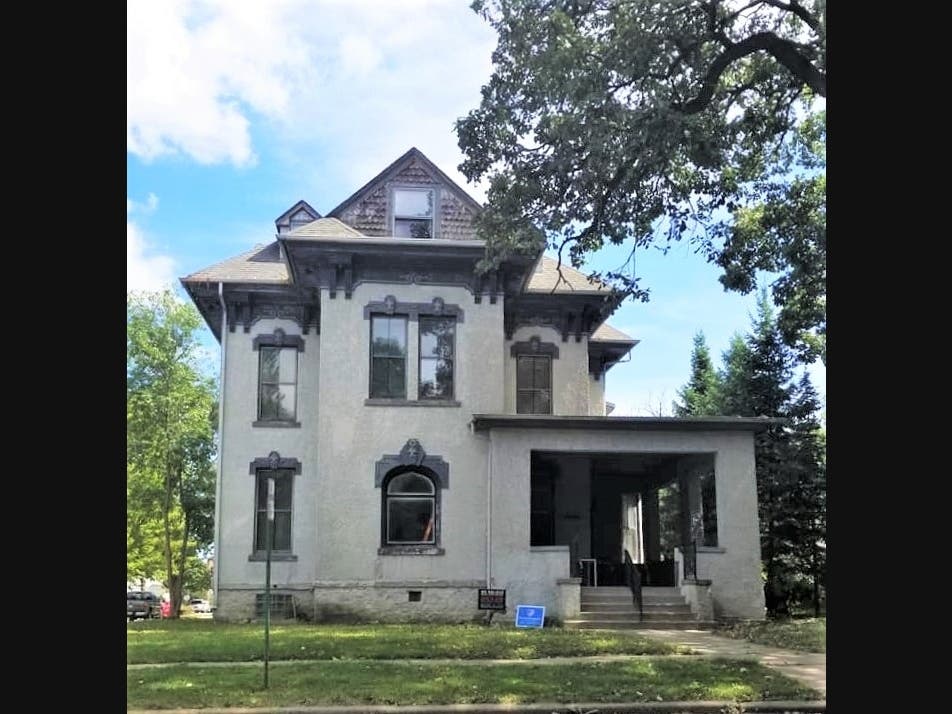
The house, built in the Italianate style, is one of large, dramatic proportions, with twelve to thirteen foot ceilings. There are three full floors of living space and a basement. It is built of brick but was covered with stucco likely in the early 1900s. The original porch and entrance were changed from the front to the side of the house. The third floor, the original attic, was divided into small rooms and baths, probably during the early years when it was used as the residential hotel.
Internally, little is left of the original design elements except for the grand staircase, spiraling up from the original main entrance area.
Vacant and on and off the market for the last seven years, the building became almost completely obscured by overgrown trees. The house had a dark, ominous look about it, and of course, it developed a reputation for being haunted. The electrical and plumbing systems were outdated. There was water damage from a burst pipe. The inside pictures available on the Internet showed that there would be a substantial amount of work involved just to make the place habitable again.
Leamanczyk and Walker realized the seriousness of committing to purchasing and restoring a historic property and while the house appealed to them right away, the decision was not made lightly or in haste. They did their due diligence before making an offer.
In many ways, Leamanczyk said only half in jest, he feels he trained his whole life for this moment. While other children were watching cartoons and the Power Rangers, he was watching This Old House and America’s Castles. With a bachelor’s degree in interior architecture from Columbia College Chicago and a master’s degree in design and fashion from the School of the Art Institute of Chicago, he had the skills to research a project like this one. He had completed coursework in the preservation of landmarks. He has his own business, JL Studio, which offers design consultation and execution for residences and small businesses, and he has helped clients plan renovation projects.
Leamanczyk talked to knowledgeable people, investigated building codes, researched costs, and developed a plan and budget before even starting negotiations. Any offer would be contingent upon a thorough inspection to determine if the house were structurally sound, the most important question to be answered.
Eventually, an offer was made, and an inspection showed the brick house was indeed solid and sound. Negotiations were completed, and the deal was signed. Since then, the new owners have worked closely and cooperatively with the City of Blue Island to complete the renovations according to standards.
This was all a new experience for Walker. He was born in Elmhurst and was raised in St. Charles, a historic town along the Fox River west of Chicago. He has an undergraduate degree from Earlham College in Indiana and a Master of Social Work from Loyola University, and is a Licensed Clinical Social Worker (LCSW).
“I was never into home improvement so this has been a learning experience for me,” said Walker. “This has been a real journey, and my enthusiasm came from Joe’s vision – he could see this house for what it can be, not just what it was.”
At the time they first became interested in the house, Walker was working in case management with Howard Brown Health. Purchasing the house in Blue Island led to a new career opportunity. Wanting to establish a private practice in clinical counseling, he was looking for a group to join. One day heading home after being at the house, he approached Beverly Therapists, a group of psychotherapists in independent private practices who share space and resources at 10725 S. Western Avenue. It turned out to be an “incredible match,” in Walker’s words, and he joined the group in December. He began commuting from the north side, although now he is doing most of his work through teletherapy because of the pandemic.
Once the house is restored, there will be plenty of space for both to set up their practices at home. The enormous three-car garage, built later than the original house, will also allow for Leamanczyk to have a woodworking shop, as he crafts items for his clients.
The demolition, reframing, plumbing, electrical and drywall work were contracted out to licensed professionals. These are jobs that need to be done right the first time so it is the only time they have to be done. Positional lighting was added to showcase the owners’ art collection. New forced air heating/cooling systems were installed for each floor so they can be regulated independently.
There were surprisingly few quirks found in the old house. The roof was sound but for one small hole, and the floors and walls are mostly straight and level except for where there was water damage. The only item of note found behind the walls was a 1905 Pabst beer bottle. But one closet contained stairs going nowhere, and a desiccated racoon carcass did fall out of the dining room ceiling onto a workman’s head.
A locked room in the basement for which there was no key offered some Edgar Allen Poe-like suspense, but once the door was removed, no treasure or bodies were revealed. Old blueprints not for this house were found in the rafters of the room, which appeared to be a root or coal cellar.
Leamanczyk and Walker are doing much of the finishing and cosmetic work themselves. This includes carpentry work, installing floor tiles and a tin ceiling in the kitchen, painting, refinishing the wood on the staircase, and projects of that nature.
Leamanczyk has been finding jobs for the inexperienced Walker to do. For example, they discovered the old floors were too thin for refinishing, so they are going to lay new floors over the old floors to preserve them, and Walker is removing staples from the old floors.
In return, Walker is keeping Leamanczyk supplied with first-aid kits; it was one of his birthday presents. Leamanczyk explained he gets hyper focused on a task and doesn’t always pay attention to his surroundings; plus, he claims a genetic propensity to be klutzy. He did have a bad accident at the house. His foot broke through an old poorly patched soft spot in the kitchen floor, leaving his leg dangling into to the basement below. The leg was badly bruised and cut, necessitating antibiotics. The hole is thoroughly fixed now and the leg is healing.
Because they did their homework, the house has not turned into a “money pit.” They built in a high contingency to all the plans, and even though some costs have been higher than planned, others have been more economical. Tackling the house in phases helps with adjusting the budget as they go along. They plan to finish the first floor so they can move in with a certificate of conditional occupancy. Then they will work on the second floor with less pressure, not having to commute from the north side, and it may be a few years before they get to the third floor. They recognize there will always be a project that needs to be completed and they are fine with that.
The advice they would offer to others thinking about restoring a historic home is to be realistic.
“This is not a decision to make lightly. You have to know when to hire other people, and then find good people to work with and use as resources. You have to break it down into manageable tasks and accept it will not be done overnight,” said Leamanczyk.
“Just know how ever much work you think a project will be, it likely will be twice as much and may cost more,” added Walker. Thus, the need for a plan and budget is important.
For the exterior of the house, their plans respect and embrace its Gothic formality. They intend to repair the stucco, which is in good shape, and refinish it in a dark gray coating thicker than paint. Black and white trim will complete the look. The metal cornices at the top of the house need work, and they have discovered that this is a specialty job that will be expensive.
The landscaping will be formal, with some casual touches. They are planning entrance pillars with boxwood, birch and lilacs, and a vegetable garden in the back of the house. The plan brings to mind a regal English estate.
The formal theme will continue to the inside. They do not want the home to resemble a museum, but a house that has collected a combination of antiques and modern pieces over the years.
Leamanczyk and Walker intentionally chose the South Side and Blue Island because they like the diversity and find it to be an accepting place in which to settle. They feel a sense of community here and consider the people very friendly. They enjoy sitting on the front porch and greeting passersby. Their dog, Winston, a cockapoo, has been a “city dog” for his twelve years of existence, and was at first not sure what to do with the new space, but he has adapted and now likes the house and large yard, and “gets tuckered out” from exploring.
As for the ghost, Leamanczyk says if there is a presence, it feels positive, it is not menacing. He never feels uncomfortable being there alone working
They experienced a few strange things that perhaps were welcoming signs. They had a previous unusual experience that involved a butterfly, and when Walker visited the house for the first time, as they opened the door, two butterflies flew out. Strangely, down in the basement, they discovered a card table on which items had been orderly laid out, including books related to their professions, fashion and art and psychology.
“At the closing, the realtor turned to us and said, ‘You realize you bought a haunted house, don’t you?’,” said Walker. “I think she was surprised when we enthusiastically answered, ‘Oh, yeah!’”
They hope that if there is a ghost, it might be the former owner Wiktor.
One comment left on the on-line Legacy page in tribute to Wiktor when he died lauded his “knowledge of people” and his “spirit and overflowing good nature.”
“We’d like to think he was still around. We like the humanitarian effect he had on this house,” said Walker.
They want to carry on in his tradition, and host fundraisers for worthy causes at the house. They also mentioned they are the only ones of their families left in Chicago and look forward to being able to host family members when they visit. They will have plenty of space to realize both these ambitions.
“We feel that the house chose us,” said Leamanczyk. “It will be many years before we are finished, but this is our forever home. It feels grounded to have all the history of this house, and we are trying to bring it back closer to its original state. People talk about sustainability. Old houses can be better than new homes.”
It is easy to envision Leamanczyk and Walker on a summer afternoon, sitting on the porch, a few friends over, sipping something maybe a little more sophisticated than lemonade but still unpretentious, greeting people as they walk by. Or in winter, with multiple Christmas trees shining brightly through the windows.
The house will be content.