Schools
Mr. Manna’s Opus: A History of the Legendary Marist Band
Decades of dedication from Frank Manna made Marist High School a "band school" that continues to thrive after his retirement.


CHICAGO, IL - High schools are often defined by their best traits. Some are known as “sports schools,” others as “smart schools” and some as “arts schools.” But there’s only one high school in the realm of Chicago’s Southland that can truly be called a “band school.”
“Our school president said at the winter concert this year that the band is the heart of the school and he is absolutely right,” said Andrew Creagh, the band director at Marist High School for the past nine years. “It really has through the years and while we have a bunch of great activities here, yes I would say people do think of Marist as a band school.”
Marist is indeed a band school, and the band at Marist is quite simply legendary.
Find out what's happening in Beverly-MtGreenwoodfor free with the latest updates from Patch.
It's the result of years of hard work by hundreds, rather thousands of people. But there’s one name that will forever be associated with the band’s legacy.
Frank Manna.
Find out what's happening in Beverly-MtGreenwoodfor free with the latest updates from Patch.
Described by at least one former assistant as “the Vince Lombardi of band directors,” Manna built the Marist band from scratch into an entity that would stand out among other area bands and receive national prominence. A “band school” through and through.
“Band school? I don’t know about that,” Manna said in a recent interview with Patch. He was speaking from his condo overlooking Lake Michigan near the city of Chicago’s theater district, a musically-themed space once owned by Chuck Panozzo of Styx fame.
Music has been part of Manna’s life ever since he was a child growing up on the city’s South Side. He remembers taking piano lessons from a nun while in grammar school at St. Martin Catholic School at 59th and Princeton even though his family did not have a piano at home.
“My dad was a barber and he started me on the accordion when I was 10,” he said. “I played until I was 13 and then he sent me to Leo (High School) because they had a music program there…. Dad asked me what I was going to play there and I said ‘hell, I’ll play whatever.”
He ended up playing the saxophone at Leo - the “first band school,” as Manna described - and his family got a break on tuition as a result.
Manna would later earn a degree in music composition from DePaul, but a future in the field wasn’t a sure thing as his first gigs out of college were working part-time at an accordion school and as an assistant band director at area high schools, including Brother Rice.
It was one concert at Brother Rice in 1962 that would end up changing the course of the band hierarchy on the South Side forever.
Manna, then working as an assistant under longtime Crusader band director Leo Henning, had already interviewed with Br. Pius Xavier - a Marist brother who was a founder of the school still under construction on vacant land on 115th Street west of Pulaski.
It was another Marist brother, Br. Patrick Harte, FMS, who went to the concert at Brother Rice to see Manna in action and, according to Manna, came back to respond to Br. Pius that “we really ought to hire him.”
“Br. Pius said he wouldn’t be ready to start the band in ‘63 (the year the school opened), but that they would in ‘64,” Manna remembers.
He was hired to begin that year. The decision paid off.
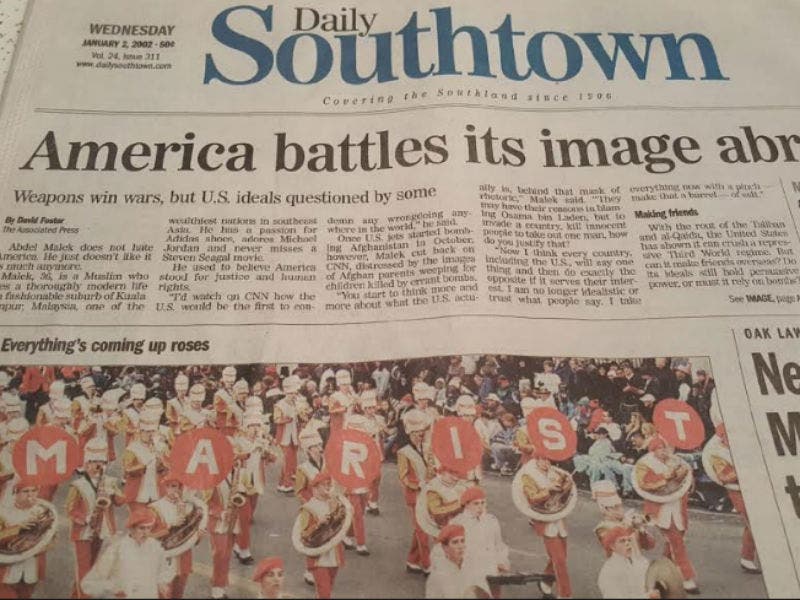
Manna would spend the next 42 years as the band director at Marist, leading the school to wins in hundreds of competitions during concert tours throughout the United States and performances at all of the major college bowl games including a 2002 appearance in the “granddaddy of them all,” the Tournament of Roses Parade that precedes the Rose Bowl in Pasadena, California.
There was something special about being a member of the Marist band. Known to band alums as the “esprit de corps,” being a part of the organization meant you would have opportunities those who weren’t in band - or those in bands at other schools - did not have. The band was a part of something fun seemingly every month of the year, with at least one “band trip” planned every year for decades.
“We wanted to make it fun, and we wanted to be different,” Manna said.

But Marist did not start out as the super band it would become. In 1964, Manna was signed to just a one-year contract. The band began by only performing at concerts and during halftime of football games at Gately Stadium. Marist didn’t have its own stadium and the band room was just a small space in the school's athletic offices.
“It was just an activity, and one that did not get a lot of support,” he said. “We did not have many members (and) could barely make an ‘M’ on the field.”
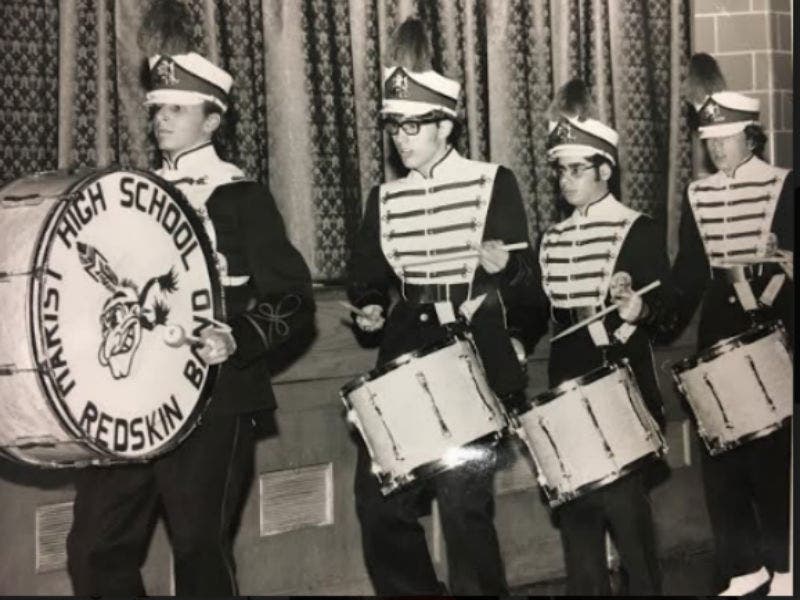
Enter Br. Anthony Iazzetti, FMS, a school administrator who Manna says “really made Marist a band school” by pushing forward a request that band be an accredited course at the school rather than an extracurricular activity.
A few years later, band at Marist wasn’t just a class. It was an honors class. And it was an honor to be in the class.
“We needed it to be a class,” Manna said. “And we needed it to be an honors class because we wanted all the smart kids in band.”
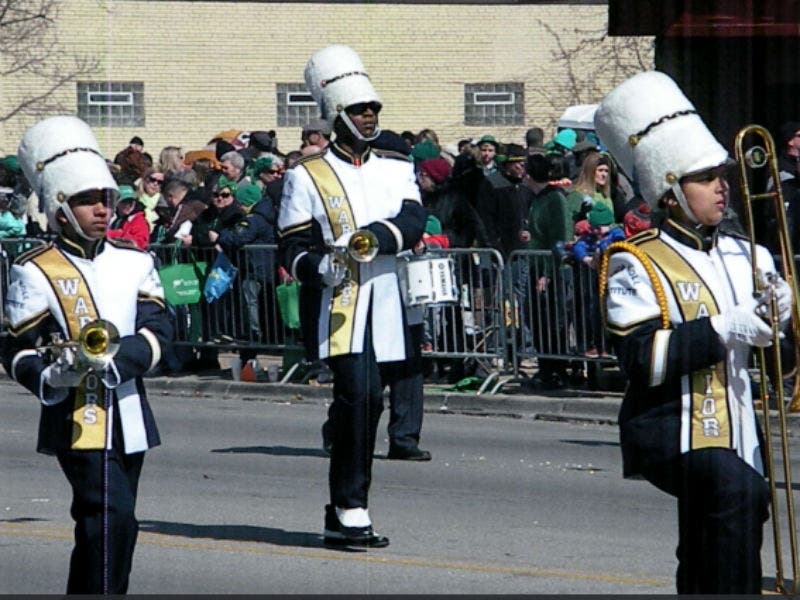
The band ballooned up to 185 members in its heydey during the 1980s, Manna said. Br. Anthony also designed the band’s iconic red, white and yellow uniforms with the busby hat.
“That’s when we became a real band.”
The momentum kept going with the opening of the “premier band room on the South Side,” complete with multiple rehearsal rooms that were all the size of the original band room.
While the Marist band became known for its parade formation, concert tours, bowl game appearances and pop culture spots like one on "The Tonight Show with Jay Leno" when it came to Chicago for a week in 1998, Manna has always been more of a traditionalist when it came to the music itself.
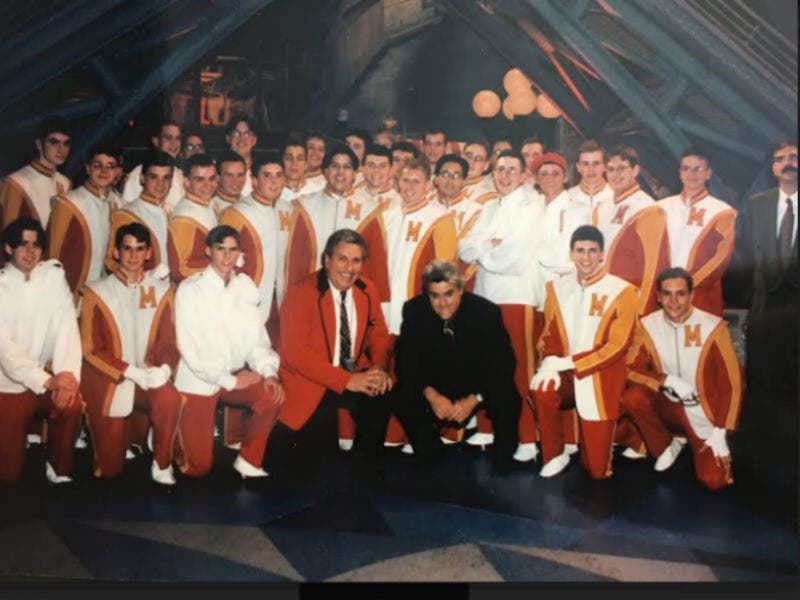
“I always wanted the thread of continuity,” he said, noting his preference for performing at concerts over the “gimmicks” mentioned above. “We ended our Christmas concert with the same piece every year. Our uniforms never changed.”
The tours were also a way for Manna to simulate his lifelong dream of leading a concert tour across Europe on a smaller scale.
Manna would alternate trip themes, with bowl games every other year and concert tours in between. He’s never been shy about his preference for the concert tours.
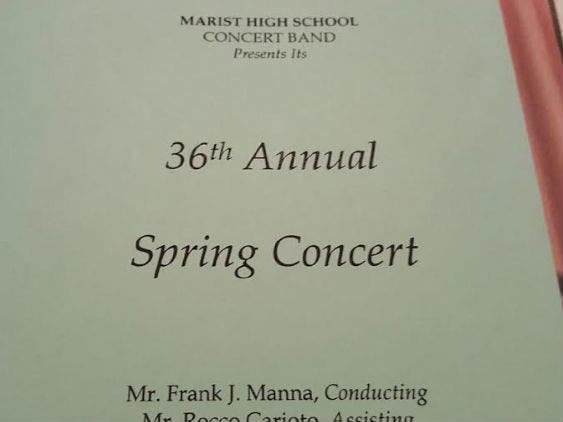
“The bowl games weren’t my idea,” he said, crediting his longtime band moderator Br. Gerard Brown, FMS, for that. “And if we couldn’t get six concerts out of a tour, it wasn’t worth it. The whole point was to get practice on the tours and come back and give a magnificent performance at home.”
The Rose Bowl
When college football teams have a winning record they are usually invited to a bowl game, but historically it was only the conference champion in the Big Ten and Pac-10 conferences that were invited to the Rose Bowl, referred to as the “granddaddy” of them all.
The same can be said about high school bands across the nation, of which hundreds apply every year for consideration in the Tournament of Roses Parade held on New Year’s Day.

For Manna, the "shining moment" of being selected as a parade entry for the 2002 version (and to be lined up directly behind Grand Marshal Regis Philbin) didn’t come until well after Marist was selected.
Manna says one of the parade directors, a man named Ronald Okum, surprised him with 17 tickets to the parade just days before the band was to take off for California so all of Manna’s eight children, their spouses and his wife, Betty, could be in the stands while he led the Redhawks in the five-and-a-half mile trek down Colorado Avenue.
“To have them all there was priceless,” he said. “It was one of those special moments. That’s what made it important.”
Marist was the first Chicago high school to ever be invited to the Tournament of Roses Parade. While other bands that year had members that would not be able to march the whole way, Marist’s “150 Strong” all made it through intact.
“When we finished that last step, every one of our kids made it,” Manna said. “It was exhilarating to march the whole way.”
It was a moment that can “never be surpassed.”
“It seemed bigger than life. Like we just won the world championship.”
The hard part, he points out, was just getting invited.
“We had to send in a tape and hope we got picked,” said Manna, who noted that being a Catholic school in the city of Chicago helped push them through to selection.
Creagh, the current band director who was a member of the band during the Rose Bowl parade, added that the novelty of an all-male high school band also won over those reviewing the applications for that year.
Although it was not known yet at the time of selection, the Rose Bowl became the “last hurrah” for an all-boys Marist. The school went co-ed the following fall.
From Alton to Pasadena
The Rose Bowl was the ultimate moment for a band that made trips a yearly endeavor. It was also a far cry from the first one, an overnight ride to Alton, Illinois to play a concert at a school in the western Illinois town bordering the Mississippi River.
“We stayed overnight in the YMCA. The windows had bars,” Manna remembers. “So of course the kids went home and told their parents that ‘Mr. Manna took us to the ghetto.’”
“But we played our concert and went home.”
Between Alton and Pasadena, Manna’s band made stops at the Orange Bowl, Cotton Bowl, Liberty Bowl and Sugar Bowl among other bowl games and at many schools run by the Marist Brothers - most of which were on the East Coast between New York and Florida.
“The trips were all performance-centered,” he said, remembering the early trip days of “sleeping on gym floors with sleeping bags and resting mats.”
“They were business trips planned around the performances we could get. If we could find a school that would take us, we were there.”
They were also there for the Chicago White Sox’ first ever game at the new Comiskey Park in 1991, playing the National Anthem, and were so popular that they became the Opening Day entertainment at the ballpark every year for the next decade. Some band members also made the trip to perform the National Anthem before the first-ever Chicago Marathon race in 1978, giving the band another permanent spot in Chicago history.
They were the band that would not say "no" to anything.
“I just kept making connections, and all of a sudden people would be calling us requesting us to play,” Manna said. “I remember someone once saying that ‘if you are in a bind and need a local band call Marist, they’ll do anything.’”
Their first-place finish at the St. Patrick’s Day Parade in New York City, playing at Tulip Fest in Holland, Michigan, opening for McDonald’s at their grand opening of their corporate office in Oak Brook and performing at the Alabama State Capitol for Gov. George Wallace were just some of the other unforgettable moments in the history of “the wonderful Marist band.”
Manna’s Band Director Tree
While Manna has been retired since 2006, his influence on high school bands in Chicagoland has not gone away. Creagh was a student of his in the early 2000s and now leads the Marist band. Rocco Carioto, another Manna disciple and former assistant band director at Marist, is the current band director at Bishop Noll Institute in Hammond, Indiana. Carioto has borrowed a number of traditions from his Marist days, including the iconic “busby” hat that bandsmen at Marist donned for decades.
“I see Rocco does a lot of what I used to do. He reminds me of myself,” Manna said, remembering how he convinced him as an eighth-grader at St. Bernadette School in Evergreen Park to “bypass Brother Rice” and join the band at Marist.
Manna had that kind of influence. For years, he was the director of the Imperial Youth Band, a group that encompassed young musicians from throughout Chicago and its south suburbs, and was the director at several area grade schools that would often serve as “feeder” programs for Marist.
“I didn’t dislike the bands at Brother Rice or St. Rita, but I didn’t necessarily like them either… We were a bit of a lone shark.”
‘Bring Honor and Glory and Fame’
For alums of Marist, there are two phrases that were uttered more than any other during high school. “Saint Marcellin Champagnat, Pray for Us” is one and “Bring Honor and Glory and Fame” the other. The latter is a creation of the one and only Frank Manna.
Manna wrote the music for the school's fight song in 1965 while his wife wrote the words. So thank Betty Manna for the phrase “Bring Honor and Glory and Fame,” the most memorable from a song that is still associated with Marist to this day.
Manna also wrote the school's alma mater for the 10th anniversary of Marist High School in Chicago in 1973. He didn't have much time to prep for that one, however. Then-Marist Principal Br. John Shanahan, FMS told Manna during the week that the school should have one ready for a football game that Friday that would double as the anniversary celebration
“It was a Thursday and I said to (then-band moderator) Br. Gerard (Brereton, FMS) that I didn’t know if I could get something ready to play by the next day and he told me ‘Frank, just write the darn thing.’”
He did and that, too, remains a part of Marist lore.
Betty and Frank
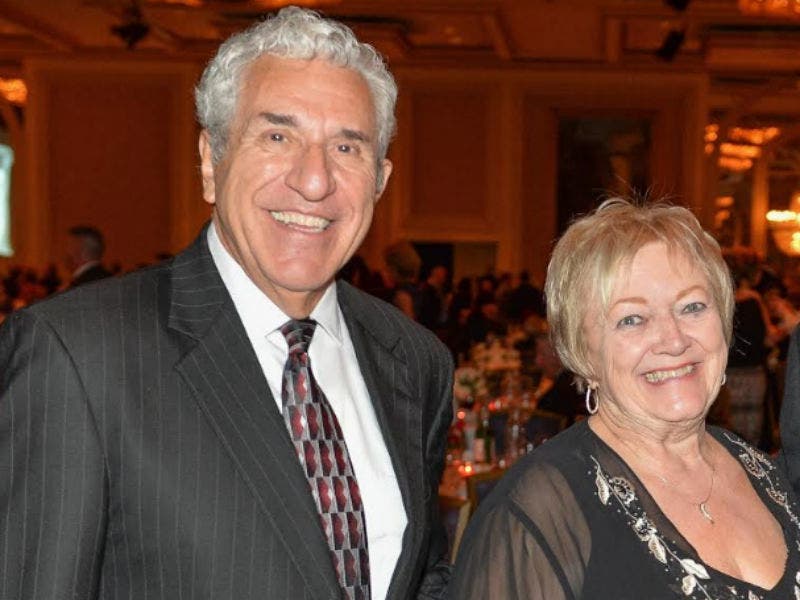
Betty has been with Frank every step of the way. The couple has known each other since they were 12 years old, before Frank was a student at Leo and Betty at Harper High School in Chicago. They lived in Evergreen Park for more than a half-century and raised eight children before venturing to downtown Chicago to experience Chicago’s cultural scene up close and personal.
Answering the Critics
Since Marist was an all-boys school for all but four of Manna’s years at the helm of the band program there, it’s hard to tell how many more stars he would have created had Marist been co-ed the whole time. But as director of the Imperial Youth Band, he has female success stories as well.
The IYB was created just in time for a girl named Therese Buckley to join. Buckley - whose father assisted Manna in the creation of the IYB - went on to be in the first class of women in the band at the University of Notre Dame.
When rumors that Manna would retire when the school went co-ed, he was quick to dispel them.
“I didn’t understand (the rumors),” he said. “I have six daughters, did the Imperial Youth Band for years and they thought I wouldn’t be able to teach girls?”
“So I put off retirement” until the first co-ed Marist class graduated, he said.
The Manna Legacy Lives on at Marist
Even in retirement, Manna continues to benefit a handful of students at Marist High School today thanks to the generosity of Harry Harczak - one of Manna’s earliest students in the band.
“I always had high regards for Frank and the things he did for me at Marist,” said Harczak, a 1974 Marist alum.
“He took me under my wing and became involved in playing even outside of school with the Imperial Youth Band, at churches and a few shows outside of school.”
So a few years back when Harczak decided he was going to give back to the school in the form of a scholarship, he chose Manna to honor.
The Frank J. Manna Scholarship Fund has been awarded to two incoming Marist students every year since 2012.
“My wife and I are blessed, so we enjoy giving back,” Harczak said.
Prospective scholarship recipients (all of which must be members of the band) write an essay and submit other criteria as selected by the school, Harczak said. Once they are selected, the partial scholarship continues for all four years as long as the student keeps a ‘B’ average in school and has no disciplinary issues.
They must also remain in the band for all four years, something Harczak nearly did not.
“Harry wanted to quit the band his first year,” Manna remembers. “But I had a conference with him and his father. I pleaded with him not to quit. His dad said right there 'Harry, you are not quitting this band, you will stay in the band with Mr. Manna.'"
Harczak, who went on to become the band’s first-chair trumpet player, refers to Manna as a “larger than life personality.”
“His commitment to the band was unmatched. He taught me about having a strong work ethic through everything he did at Marist and at the grade schools.”
Harczak remembers the band era when its size was closer to the number of students you would find in an average class.
“We only formed an ‘M’ when marching because we didn’t have enough people for a script Marist,” he said. “And if someone was missing, the ‘M’ had a hole in it.”
Students went to band after school. It wasn’t a class yet. But that didn’t mean Manna was any less passionate back then.
“In practice, a drum stick would fly out at someone now and then,” Harczak said. “Most of us know it was because Frank actually threw it. He would conduct and teach with emotion. It brought out the best of us.”
When Manna first heard of the scholarship Harczak was planning in his name it was “one of the few times he was left speechless.”
But after a few moments of silence, he responded - in true Manna fashion.
“I’m not dead yet,” he said, according to Harczak.
The Marist Band Today
Harczak, who went on the play in the band at Bradley University after his time at Marist, is one of thousands of band alums proud of what the activity has become over the years and proud of how strong it remains. It remains strong because of the work of Creagh and Assistant Band Director Matt Jackson, another former student of Manna’s.
“We’ve kept the same routines, drum cadences and in the (football) pregame show routines as well as running on the field the same way we did when we were in the band,” said Creagh, a 2004 Marist alum.
The difference?
“Well, there are girls now,” Creagh said. “I think the musical skill has increased and the social impact - with more band members meeting each other outside of school - has increased.”
The band doesn’t go to bowl games anymore, but Creagh says that he will apply to return to the Tournament of Roses Parade in a few years when the band is eligible to be considered again. Trips to Washington, D.C., Disney World and New York City still occur.
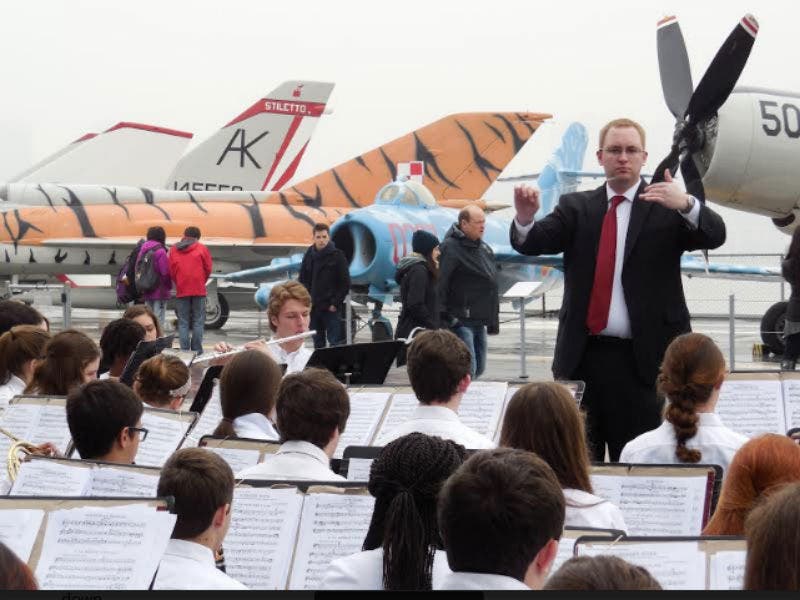
Creagh knows how hard it will be to get Marist to the Rose Bowl again. They only accept a very small percentage of bands that apply.
“The reason we went back then is because Frank was here forever, the novelty of us being an all boys school and the factor that they like big bands and we were still a show-style band,” he said. “But we will try. We’d love to go back.”
Like Manna, Creagh prefers the “music side” of band, but values having been in the Rose Bowl parade and playing in venues throughout the country.
He knew he wanted a career in music while a student at Marist, but “never dreamed” he would one day hold Manna’s position.
“Someone like that … you just think they are never going to retire.”
Watch below as Mr. Manna returns to Marist to direct the Fight Song, a song he composed in 1965, at a recent spring concert.
But Manna did eventually retire, and Creagh describes his current role as a bit of a “dream job.”
“The kids are good to work with,” he added. “It has been a challenge to establish new ideas and concepts since Frank made this program what it is. As a director, walking into a facility like this, you couldn’t ask for anything better to walk into.”
Manna was invited to guest conduct a piece at a spring concert at the school five years ago and “is always welcome here,” Creagh said.
“We are the pulse and heartbeat of the school, and we are trying to keep that tradition alive,” he said.
The tradition continues, indeed. Marist can still be spotted at most of Chicago’s largest parades and is still the featured band playing for the Knights of Columbus at Our Lady of Pompeii church before the annual Columbus Day parade.
Watch them perform here during the South Side Irish Parade in the late 2000s:
Even though Manna has been removed from the day-to-day band operations for more than a decade now, the band remains as one of the school’s best assets.
Manna remembers hearing about a conversation between his son and someone his son met while studying at Purdue University.
“When he told him that he went to Marist in Chicago, the person said to him… ‘Marist, that’s that school with that band,’” Manna said.
“I guess Marist is a band school.”
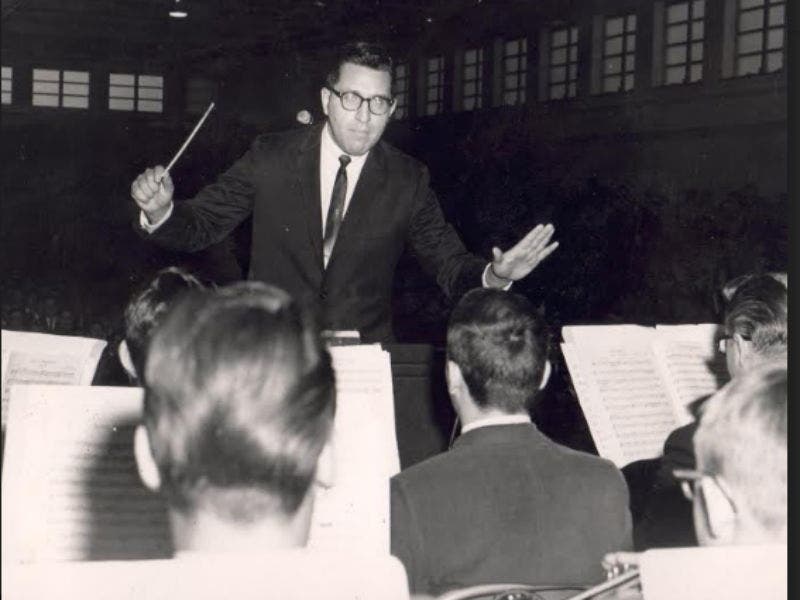
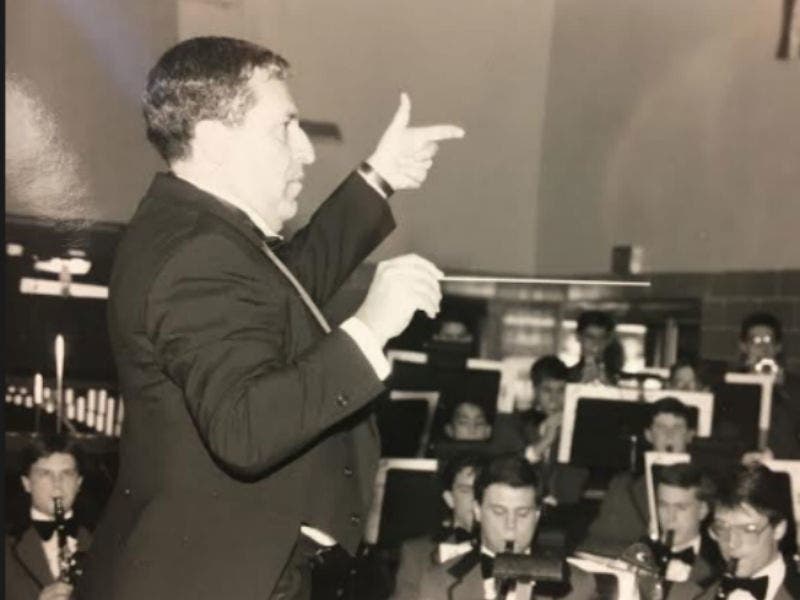
Top photo: Frank Manna conducts a Marist band concert in 1968, during the early days of the band.
Get more local news delivered straight to your inbox. Sign up for free Patch newsletters and alerts.