Community Corner
People of the Ridge: Remembering Forgotten Heroes
Mt. Greenwood Cemetery and Sons of Union Veterans of the Civil War continue Operation Remembrance.



History is made every day by people involved in interesting situations. "The People of the Ridge" series features local people, past and present, from the Blue Island Ridge. This article explores Civil War veterans buried on the Ridge and the efforts to remember them.
By Carol Flynn, Ridge Historical Society
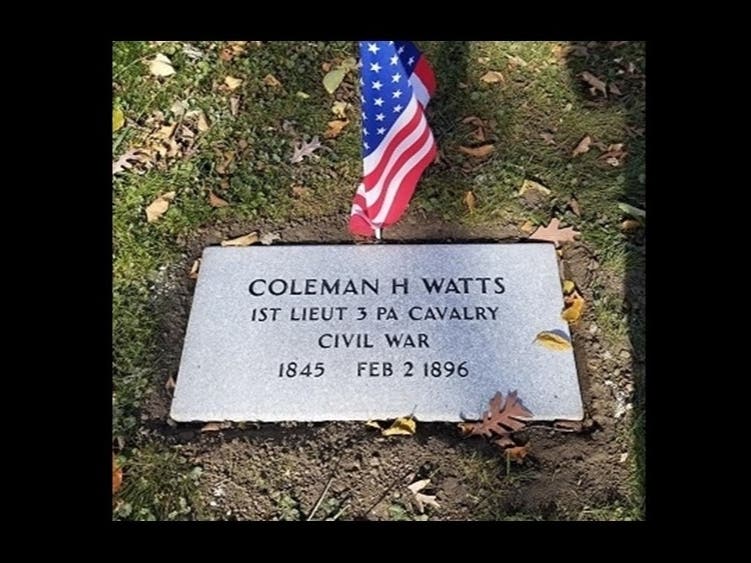
Coleman H. Watts died in Chicago on February 2, 1896, at the age of 51. He was buried in Mount Greenwood Cemetery at 2900 West 111th Street. His grave went unmarked for nearly 125 years.
Find out what's happening in Beverly-MtGreenwoodfor free with the latest updates from Patch.
The same was true for George W. Cone, Andrew Pinney, and Nelson Richart. Like Watts, they died over 100 years ago and were buried in unmarked graves in Mount Greenwood Cemetery.
In October, markers ordered by the cemetery were placed at the graves of all four men, compliments of the U.S. government. They received this commemoration because they were veterans of the U.S. military. They served in the Union forces during the American Civil War.
Find out what's happening in Beverly-MtGreenwoodfor free with the latest updates from Patch.
Paula Everett, President of the Mount Greenwood Cemetery Association, the owners of the cemetery, and Kim Demas, secretary at the cemetery, started “Operation Remembrance” in 2007 to identify and mark the graves of U.S. veterans buried there.
“The purpose of Operation Remembrance is to honor and acknowledge the veterans who have served our country by making sure these forgotten heroes have their graves marked so future generations can recognize them,” said Everett.
Public attention was called to the cemetery’s efforts via a Chicago Sun-Times article. This was noticed by then Illinois Lt. Gov. Pat Quinn, who awarded “Homefront Hero Awards” to Everett and Demas in 2007.
This award honored Illinois citizens who “demonstrated their heartfelt support for our troops through their spontaneous, unwavering generosity toward our veterans and military families, helping them to get through difficult times and letting them know that the people of Illinois honor and respect them for their patriotism and willingness to sacrifice for our shared freedom.”
The U. S. Department of Veteran Affairs (VA) furnishes, upon request and at no charge to the applicant, a headstone or marker for the unmarked grave of any deceased eligible veteran in any cemetery around the world, regardless of the veteran’s date of death. The major criteria for eligibility is that a veteran cannot have received a dishonorable discharge. There are additional criteria depending on when the veteran actively served.
The VA criteria specify that service prior to World War I requires detailed documentation, such as muster rolls; extracts from state files, or military or state organizations in which the veteran served; and pension or land warrant applications.
Finding this documentation is not always easy since many of these records go back as far as 160 years and are often incomplete or missing.
Many of the early burial records at the cemetery did not include military service information, so as a starting point in 2007, Everett and Demas used the 1929 Illinois Roll of Honor to identify veterans buried at the cemetery. This is a database that contains the locations of the burial places of many, but not all, military personnel in Illinois up to that point in time.
Then the cemetery records were checked to determine which graves were unmarked. Many of the unmarked graves belonged to veterans of the Civil War and the Spanish-American War. Everett and Demas then petitioned the VA for headstones for the unmarked graves.
The cemetery also reached out to the Sons of Union Veterans of the Civil War (SUVCW) to help identify veterans and authenticate their service records. This led to a collaboration that has gone on now for almost ten years.
The SUVCW is the legal successor to the Grand Army of the Republic (GAR) and has a charter from the U.S. Congress. The GAR was the organization for veterans of the U. S. Army, U. S. Navy, Marines, and U. S. Revenue Cutter Service who served in the American Civil War. Its members helped put together the 1929 Illinois Roll of Honor. The GAR dissolved in 1956 when its last member died. The SUVCW is the fraternal organization for male descendants of those Union veterans.
As one way to preserve the legacy of their ancestors, members of the SUVCW work with local cemeteries to recognize Civil War veterans.
David Bailey, Past Department Commander of the Illinois SUVCW, and Past Camp Commander of Philip H. Sheridan Camp 2 of the Illinois SUVWC, has been researching Civil War veterans for decades.
This past summer, Bailey sent to Everett a long list of veterans whose service records he had verified and who were identified as being buried in Mount Greenwood. Everett found these four to be in unmarked graves. The cemetery applied for the markers, using the information supplied by Bailey and their own burial records.
Bailey, who hails originally from Pennsylvania, is descended from two Civil War veterans. As a boy, he became interested in marking the graves of soldiers thanks to a visit to Gettysburg National Cemetery with his aunt, a schoolteacher.
“Aunt Helen pointed out the statues erected to honor the generals and other officers, then motioned to the thousands of soldiers’ graves, and said, ‘The generals were important, but all these individuals who fought in the war were important, also.’ In junior high, I took a class in Pennsylvania history and worked with local cemeteries on an honors project. I have been doing this for over fifty years now,” said Bailey.
According to Bailey, there are thousands of Civil War burials on the southwest side of the Chicago area, and SUVCW has helped place 374 markers so far.
But not all cemeteries are as supportive as Mount Greenwood in finding and marking veterans’ graves. SUVCW members visit a cemetery in person before contacting the administration to see if there is mutual interest in identifying and marking graves. SUVCW members have even supplied their own free labor to install new markers. Still, there are some cemeteries that just do not want to deal with a project like this.
More than 350 Civil War veterans have been identified at Mount Greenwood Cemetery to date. These include one woman who was a nurse and seven African American men who were enlisted as members of the U.S. Colored Troops. The body of a soldier killed in the war in 1865 was transferred to the cemetery from New York in 1913. More than 100 grave markers have been installed for eligible veterans.
There is one veteran listed as a deserter, so he is not qualified for a marker. Since occasionally the records are not accurate, he is being further researched.
There is even a Confederate soldier buried in Mount Greenwood Cemetery. This is not unusual given the number of people who migrated north after the war. His private marker does not indicate his affiliation.
Seeing the new markers for these four men spurred this historian to research their stories.
Coleman Hall Watts rose to the rank of first lieutenant in the Pennsylvania Calvary before his discharge in 1865. Upon his death in 1896, the Sentinel newspaper of Carlisle, Pennsylvania, reported he was from that city, the son of Judge Frederick Watts.
Coleman’s job as a civil engineer conducting surveys for projects brought him to Chicago, where he had spent most of his time for the last seven years. He was found dead in his hotel room, kneeling at his bedside as if in prayer. He left a wife, Mary Graham, also of Carlisle and the daughter of a judge, and two adult children. His family decided not to have his remains returned to his home state and had him buried in Mount Greenwood.
George W. Cone died on October 12, 1900 at the age of 63. He was from Utica, New York. Cone enlisted with the New York Infantry in April 1861 as a sergeant and by the time he was discharged in November of 1862 he had advanced to captain. In Chicago, Cone was a tailor and clothing salesman, for many years with Willoughby, Hill, and Co., which provided police and other uniforms. He then moved to F. M. Atwood, a haberdashery store at the corner of Madison and Clark Street.
Cone was a well-known member of the Forty Club, founded in the early 1880s, a men’s club limited to forty members. According to the Inter Ocean newspaper, this was “an organization of brainy people” with a “platform of recreation, good will and humor.” The group met over dinner to entertain each other, and Cone was considered a “brilliant” speechmaker. The Inter Ocean described one of Cone’s speeches in 1897 as “clever, bright, fanciful, original and happy.”
Married with several children, Cone and his family lived at 39th Street and Vincennes Avenue. He was originally buried in Oak Woods Cemetery, but his widow Adelaide had his remains removed to Mount Greenwood Cemetery in 1904.
Andrew Pinney died on April 12, 1909 at the age of 61. He was born in England. When he was very young, his family immigrated to New York, where they engaged in farming. Pinney was a private in the New York Infantry from 1863 to 1865. After moving to Chicago, he worked as a laborer. At the age of 52, he married Josephine Hansen. They lived at 73rd and South May Streets.
Nelson A. Richart died on December 12, 1904, at the age of 63. He served with the Illinois Infantry from 1862 to 1865. He was commissioned as a first lieutenant in 1865, but he mustered out of the army three days later, so he never served in that capacity.
There is conflicting information in the records for Rickart so he is still being researched. One document reported he was born in Canada, and at the time of his death he had lived in Chicago for 35-40 years, worked as a laborer, and was a widower. His address was given as 357 West 47th Street. The burial card at Mount Greenwood Cemetery recorded that his death from mitral insufficiency occurred at 4759 Princeton Avenue. Princeton Avenue is 300 West so this is likely referring to the same building. A relative, George L. Richart, who lived in Morgan Park, appears to have arranged the burial at Mt. Greenwood Cemetery, so this veteran may have a connection to the local community.
Thanks to the new grave markers, these veterans are no longer lost to history. Everett said more graves will likely be identified and marked in the future. There will be more stories to share.