Schools
Positive Teaching; Angie Legner, Grundy Special Educator
Legner's philosophy is to creating an environment where good is rewarded and to find what the students need.
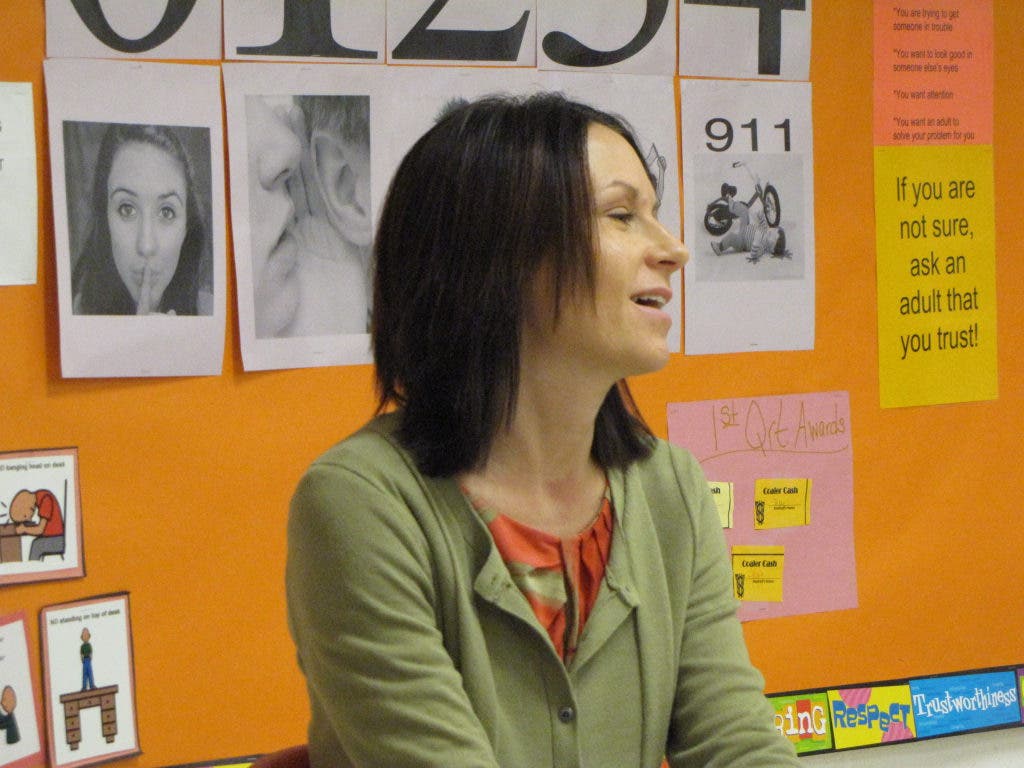


There is mostly calm inside Angie Legner’s classroom at Coal City Elementary School. Besides the group she is talking to, one student sits, sometimes crying, at one side of the room under the watchful eyes of a teacher assistant. The other eight students are attentive to Legner; they listen and speak one at a time, ignoring the other student’s outbursts. The attentive behavior is rewarded. Legner compliments the students on “good sitting,” something these students might not have been able to accomplish in a regular classroom.
The eight primary-grade students that she has in her emotional disorder program are place here by the Grundy County Special Education Cooperative. Legner shares duties in her classroom with another teacher.
Students from throughout the county are placed with Legner because their behavior was inappropriate or not otherwise suited to be part of a regular classroom setting. But, today, little misbehavior is evident. Legner’s teaching philosophy extends to all parts of this program.
Find out what's happening in Channahon-Minookafor free with the latest updates from Patch.
“This program is entirely focused on the positive," she said. "No matter what they are doing wrong, we see and we compliment them on what they are doing right, no matter what they do.”
Children who don’t comply are told that is their choice, but consequences - like making up the work as others are having free time, or sitting and waiting without being able to participate - go a long way to encourage the children to do what is asked.
Find out what's happening in Channahon-Minookafor free with the latest updates from Patch.
Legner said when she started thirteen years ago in a Braceville classroom, her methods were not as well honed. She said they had to restrain children more often for inappropriate behavior or hitting.
“My room was a very negative place," she said. "I had to ask myself: ‘How I could make my classroom a better place.’”
She attended conferences and talked to other teachers to get a handle on how to make her classroom work. What she discovered was just that: if you want students to behave and to quell their inappropriate outbursts, you have to ignore or remain impassive to the outbursts and praise them when they do behave. It sounds simple, but it takes “a lot of practice.”
She shares her teaching philosophy with student teachers who frequent her class.
“I tell my student teachers that they have to mask their emotions- to take their own personal feelings out of it," she said. "I like to show them (the student teachers) how to handle student challenges in an appropriate, positive and responsible way. The tone that is used is part of it.”
The students in her class, she said, did not ask to have a learning disability or a behavior issue. But “I try to understand them and meet their needs,” she said.
Legner also gets involved in a personal way with her students. She is in phone contact with their families at least once a week, if not more often.
“Parents need to hear positive things about their kids, too,” she said.
She uses examples from her own life in stories to the children so they can hear examples about appropriate behavior in other settings besides school.
She was driven to be a specialist with students with behavior issues because she saw that sometimes this population of students was sent to a room, where “All the answers were given to them.” It has made her adamant that all her students learn the materials at the grade level where they are age-wise. She separates the lessons so each child has his/her own instruction, based on materials at the child’s own level. She said her two teacher assistants make the different lessons possible.
She rewards the children for good sitting, for following directions, for keeping their hands to themselves, and a myriad of other classroom and social behaviors. She talks about sharing personal space and about being safe.
And it's not just the students who learn in this environment.
“I have grown in so many ways in Angie's class learning to teach these wonderful students, who are so misunderstood," Teacher assistant Paula Born said. "Angie has adapted and put together an amazing behavior program that constantly builds the students up, encourages good choices and is a constant positive force in their day, as well as (being positive to) all of her assistants. Students respect her and thrive in her class.”