Schools
Walnut Trails' Jenny Wicevic Has Passion for Teaching, Finding What Works
The special education teacher helps children learn skills they can use in their daily lives.
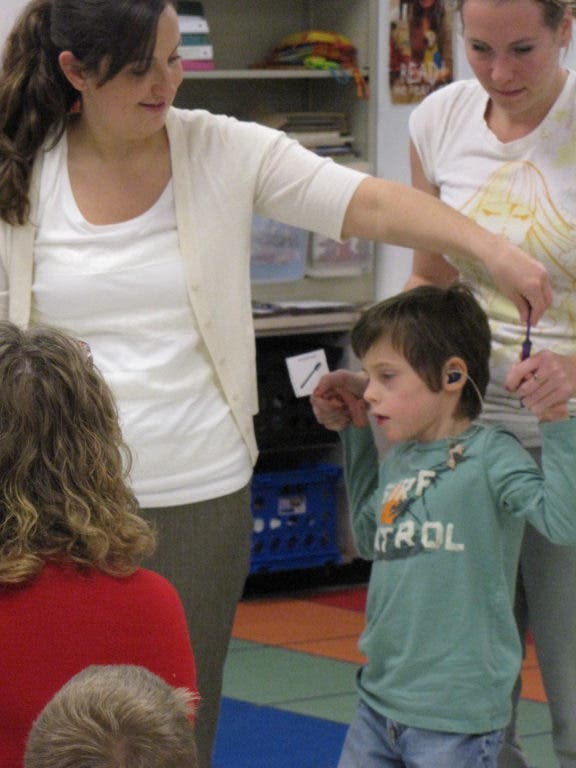

Some of the students in Jenny Wicevic’s class can’t talk, some need help manipulating small objects, others move with difficulty, or are in chairs with wheels. But nothing stops Wicevic from recognizing the potential in the 6- to 8-year-olds in her classroom at Walnut Trails School in Shorewood.
“I have to figure out where are they at,” she said. “What do they need next? And what’s important to improve their quality of life.”
Special education students from all over the Grundy County area come to the bright classroom, which seems to have a seriousness of purpose that underscores the need these children have to develop. One child works with an iPad, identifying signs for caution, poison, and stop and go lights. Another child in a sturdy wood chair works with a teacher aide who helps him pour and measure candy corn. A third child works at a machine that pronounces simple words which he matches to pictures. Wicevic announces to the group that he had said a word.
Find out what's happening in Channahon-Minookafor free with the latest updates from Patch.
Wicevic’s philosophy is that her students, whose conditions include Down syndrome, Fragile X and cerebral palsy, need skills that will serve them in their lives—skills some people would take for granted or assume children learn easily.
“We really train them for life," she said. "We teach them life skills, vocabulary, (and) what they need to know to get a job, for example, the words, ‘stop’ or ‘poison,’ or words that appear outside a restroom, ‘boy,’ or ‘girl,’ ‘men,’ and ‘women.’”
Find out what's happening in Channahon-Minookafor free with the latest updates from Patch.
That ability to work with children on life skills is what Minooka resident Elsa Villarreal says was most valuable in Wicevic’s teaching of her daughter, Amerika, two years ago. She said Wicevic emphasized to her daughter and other students the importance of daily hygiene and learning to be responsible.
“Before my daughter started with Ms. Wicevic and she wanted something, she would say 'Mommy, milk,'" Villarreal said, adding that the class made Amerika more self-sufficient, able to get things for herself and more talkative.
The joy that Wicevic gets from teaching the children in her classroom is also evident as she teaches a lesson on toiletries. She delights in showing children the shampoo and toothpaste, letting them feel the rough texture of the terry cloth towel and smell the soap so they can have a sensory experience, and discussing the items.
The exuberant Wicevic said she sees children progress on an hourly basis as she works with them. Most of the children will be in her class for three years. Wicevic also directs five teacher assistants, two of them part-time, who work right beside her and assist children whose needs dictate one-on-one supervision (for mobility or safety reasons). She has high praise for her teacher assistants.
The materials used in the class all have to be made or adapted for children at this pre-reading level, and most of the poster and card activities have been made by Wicevic. There are not many commercial materials for children who aren’t able to talk and the few things available often have to be modified, Wicevic said. Adapting the materials is all part of the effort that Wicevic puts in for her students.
As she puts it, “My job is to figure it out.”