Neighbor News
"Crossing Division Street" Explores Chicago, Family History and the Complexities of Identity
Rebecca Chamian Ribaudo's debut novel explores four generations of one family against a century of Chicago and American history
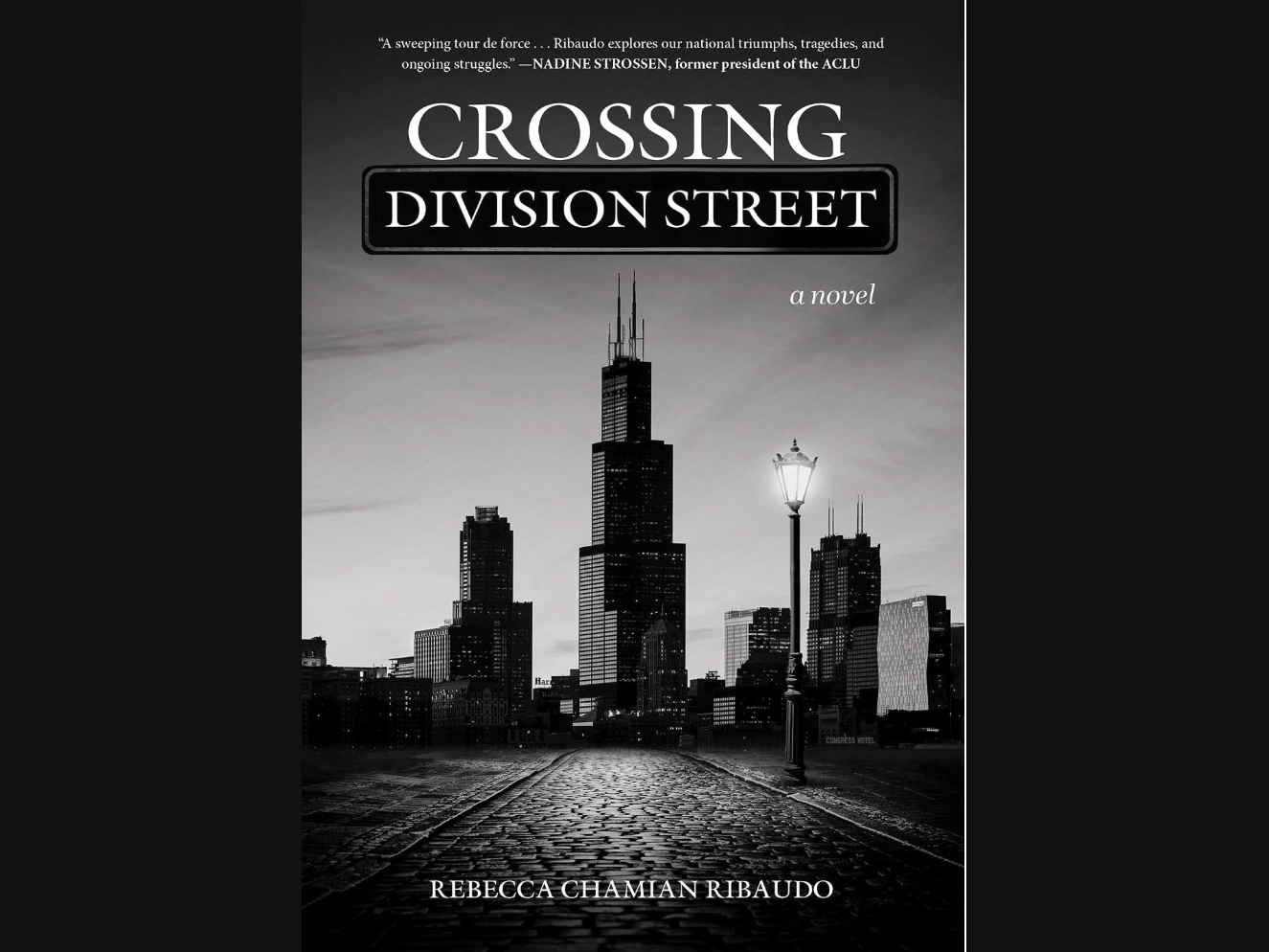
Rebecca Chamian Ribaudo's debut novel, Crossing Division Street, takes readers into a Chicago shaped by immigration, changing neighborhoods, family secrets and the complicated question of who gets to decide who they are.
The novel opens in July 1999 with Sidone Russo, a single, high-powered Chicago attorney, stopped at a red light in Cabrini-Green. Her life changes when a little girl suddenly jumps into her car, crying for help. Sidone takes off with the girl crouched in the back seat, but the encounter quickly becomes about much more than getting a frightened child to safety. It forces Sidone to confront the hidden roots she has spent years leaving behind.
Those roots lead directly into the history of Cabrini-Green and the neighborhood once known as Little Sicily or Little Hell. From there, Ribaudo expands the story into a 100-year family saga spanning four generations, connecting the personal histories of one family to the larger forces that shaped Chicago and the United States throughout the twentieth century.
Find out what's happening in Chicagofor free with the latest updates from Patch.
That scope gives Crossing Division Street its central ambition. This is not simply a story about one woman discovering something about her past. It is a novel about the ways individual lives become intertwined with the histories of neighborhoods, families and communities.
Ribaudo's portrayal of identity is particularly central to the story. The characters inhabit a world in which racial, ethnic, national and religious identities are not always abstract questions of self-definition. At different points in history, those identities can become essential to survival. Immigration, racial violence, riots, wars and assassinations form part of the historical backdrop against which generations of the family struggle to understand where they belong.
Find out what's happening in Chicagofor free with the latest updates from Patch.
That creates an interesting tension with Sidone's own worldview. She has built her adult life around independence and individualism, yet her past continually reminds her that identity can be inherited as much as it is chosen.
The conflict becomes even more consequential when Sidone becomes involved in a high-profile adoption trial. She must decide whether to leverage her hidden identity or remain true to the individualist principles that have guided her life. The choice carries consequences not only for her career, but for her family, an orphaned child and the people closest to her.
It is through that dilemma that Ribaudo connects the novel's historical themes to a deeply personal question: How much of our identity belongs to us, and how much comes from the people and communities that came before us?
The Chicago setting gives that question particular weight. Little Sicily and Cabrini-Green represent different moments in the city's history, but the novel is interested in the people who lived through those changes rather than simply the changes themselves. Neighborhoods evolve, names change and physical landscapes are transformed, but family memories and inherited experiences can survive those transformations.
That makes the book's examination of Chicago especially interesting. Places that are often remembered through a limited historical lens can contain generations of stories that complicate the familiar narrative. By tracing one family's experience across a century, Ribaudo places those individual stories alongside the broader history of the city.
The dual-timeline structure reinforces that idea. The contemporary story and the family's history are connected rather than existing as separate narratives. Sidone's present-day choices gain meaning through what came before her, while the family's past provides context for the identity she has tried to construct for herself.
At the heart of Crossing Division Street is the conflict between loyalty and independence. Sidone has spent years establishing a life according to her own principles, but confronting her family history forces her to reconsider whether independence requires rejecting the past or understanding it.
The novel also raises questions about inheritance beyond money or property. Families inherit traditions, beliefs and cultural identities, but they can also inherit secrets, expectations and unresolved conflicts. What one generation tries to hide can become something another generation must eventually confront.
Ribaudo's decision to explore these themes through a Chicago family makes the story particularly accessible. The larger historical questions are grounded in people making personal decisions about family, love, loyalty, career and belonging.
The result is an ambitious debut that asks readers to consider history not as something that happened only in the past, but as something that continues to shape the identities and choices of people living in the present.
Crossing Division Street ultimately argues that understanding identity requires looking in both directions: toward the person we have chosen to become and toward the people, places and histories that helped shape us.
For readers interested in Chicago history, multigenerational family stories and questions of identity and belonging, Ribaudo's novel offers plenty to consider. Its story of Sidone Russo becomes a larger examination of what families carry forward, what individuals attempt to leave behind and whether it is ever possible to completely separate ourselves from where we came from.
Crossing Division Street will be published September 29, 2026, by Skyhorse.