Community Corner
'Unprecedented Danger:' Doomsday Clock Moved To 90 Seconds To Midnight
The Bulletin of Atomic Scientists in Hyde Park resets the Doomsday Clock to 90 seconds to midnight, the closest it has been set since 1947.


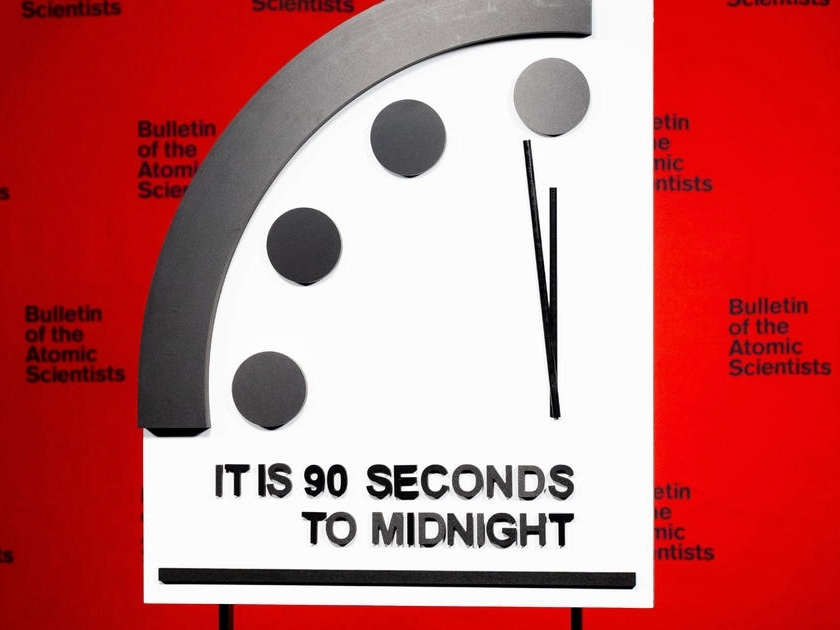
CHICAGO — The big hand of the Doomsday Clock — that visual indicator of global apocalypse — has been moved forward to 90 seconds to midnight, due in part to the war in Ukraine putting the world in unprecedented danger. This is the closest the hand has been moved since the clock’s inception in 1947.
The Bulletin of Atomic Scientists is headquartered at 1307 E. 60th St., in the lobby of the Keller Center, home to the University of Chicago Harris School of Public Policy. The Bulletin was founded in 1945 by Albert Einstein and University of Chicago scientists who helped develop the first atomic weapons in the Manhattan Project. Two years later, the scientists created the Doomsday Clock as a metaphor based on the threat posed by nuclear weapons, which Bulletin scientists consider to be the gravest danger to humanity.
Today, the figurative clock in Hyde Park has become a universally recognized indicator representing the world’s vulnerability to nuclear weapons, climate change and other disruptive technologies.
Find out what's happening in Chicagofor free with the latest updates from Patch.
.png)
The hands of the Doomsday Clock were moved forward to 90 seconds to midnight. | Jamie Christiani/Bulletin of the Atomic Scientists
The Science and Security Board of the Bulletin of the Atomic Scientists meets at least twice a year to deliberate the Doomsday Clock. In January 2020, the minute hand was moved 30 seconds forward from two minutes to 100 seconds before midnight.
Find out what's happening in Chicagofor free with the latest updates from Patch.
The clock now stands at 90 seconds to midnight—the closest to global catastrophe it has ever been. The Science and Security Board said in a written statement:
The war in Ukraine may enter a second horrifying year, with both sides convinced they can win. Ukraine’s sovereignty and broader European security arrangements that have largely held since the end of World War II are at stake. Also, Russia’s war in Ukraine has raised profound questions about how states interact, eroding norms of international conduct that underpin successful responses to a variety of global risks.
And worst of all, Russia’s thinly veiled threats to use nuclear weapons remind the world that escalation of the conflict—by accident, intention, or miscalculation—is a terrible risk. The possibility that the conflict could spin out of anyone’s control remains high.
The Science and Security Board further noted Russian President Vladimir Putin’s violating decades of commitments going back to 1994, with his nuclear saber-rattling since invading Ukraine last year.
“Russia has also brought its war to the Chernobyl and Zaporizhzhia nuclear reactor sites, violating international protocols and risking widespread release of radioactive materials. Efforts by the International Atomic Energy Agency to secure these plants so far have been rebuffed,” the scientists said.
Up until Tuesday, the clock has been moved 24 times in its -year history. The Doomsday Clock was reset at 17 minutes before midnight — the furthest back it has ever been set — due largely to the signing of the Strategic Arms Reduction Treaty between the United States and Soviet Union, ending the Cold War.
The closest the hands came was two minutes to midnight in 1953, when Russia and the United States were testing hydrogen bombs. Even during the Cuban Missile in 1962, when the world was seemingly on the brink of nuclear war, the clock remained set at seven minutes to midnight.
The Bulletin of Atomic Scientists blame Russia’s invasion of Ukraine, which it claims has “increased the risk of nuclear weapons use, raised the specter of biological and chemical weapons use.” The almost year-long war in Ukraine has also hamstrung the international community’s response to other global concerns, such as climate change.
“One element of risk reduction could involve sustained, high-level U.S. military-to-military contacts with Russia to reduce the likelihood of miscalculation …” the scientists said. “Finding a path to serious peace negotiations could go a long way toward reducing the risk of escalation. In this time of unprecedented global danger, concerted action is required, and every second counts.”
Get more local news delivered straight to your inbox. Sign up for free Patch newsletters and alerts.